





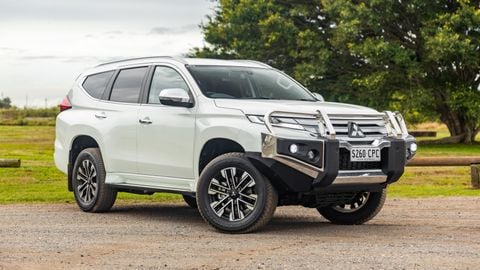
2022 Mitsubishi Pajero Sport GLS review
The Mitsubishi Pajero Sport makes little sense when you take away its four-wheel drive system, even if it does save you some dollars.

- Model tested
- 2022 Mitsubishi Pajero Sport
- Variant
- GLS 2.4L, 8-speed auto, SUV, Diesel, RWD
- Drive-away from
- $53,054†Better deals with CarExpert
- Finance
- Or$259‡per week
CarExpert's verdict on the Pajero Sport
Good
What we love
- Long warranty
- Acceptable third-row room
- Fairly thrifty turbo-diesel
Worth a thought
- Drives like a ute
- Dated technology
- Without four-wheel drive, what's the point?
Are there other rating labels?
- Excellent
- An outstanding car in almost every way. A joy to drive, packed with great features, and highly recommended.
- Very Good
- A well-rounded car that's enjoyable to drive, offers great value or features, and is easy to recommend.
- Good
- A solid choice that does most things well. Comfortable, capable, and worth considering in this segment.
- Average
- Meets the standard for this segment. May not stand out, but still a dependable and reasonable option.
- Below Average
- Falls a bit behind others in the segment, but still passes safety checks and may suit specific needs or budgets.
Introduction
We’ve said before the Mitsubishi Pajero Sport represents good value for money, offering solid off-road credentials for a reasonable price.
But what happens when you take away its four-wheel drive system, arguably its greatest attribute?
You end up with this: the 2022 Mitsubishi Pajero Sport GLS 4×2. See, Mitsubishi – like so many other brands – has increased prices across its range, and this includes the Triton ute-based Pajero Sport.
The introduction of more affordable 4×2 GLX and GLS variants for 2022 therefore represent olive branches of sorts to customers.
At launch, the GLX 4×2 allowed customers to get the cheapest possible Pajero Sport for a whole $3550 less than the year before. Comparing our GLS 4×2 tester with its 4×4 counterpart, you’re looking at a $5000 saving.
That’s a considerable difference in price, but is it enough to make up for the loss of four-wheel drive?
How much does the Mitsubishi Pajero Sport GLS 4×2 cost?
The Pajero Sport range opens at $44,440 before on-road costs for the GLX 4×2, with the GLS 4×2 next up at $49,190before on-roads – as mentioned, a cool $5000 less than a GLS 4×4, if only $250 less than a GLX 4×4.
Currently, Mitsubishi is advertising the GLS 4×2 at $52,240 drive-away.
White is the standard colour, with all other shades costing $740 with the exception of White Diamond, a $940 option. Our tester also included a Mitsubishi genuine accessory bull bar, priced at $3879.
The GLS 4×2’s price tag puts it up against some tough competition. The base Hyundai Santa Fe Diesel and Kia Sorento S Diesel are priced at $49,050 and $50,650 before on-roads, respectively, and include all-wheel drive as standard. The latter has nationwide drive-away pricing of $53,790.
Mitsubishi isn’t the only brand to offer a 4×2 version of its ute-based SUV, and it does undercut other establishment rivals.
The base GLX 4×2 undercuts the Isuzu MU-X LS-M 4×2 ($48,900) and the Toyota Fortuner GX ($49,715), which puts the mid-range GLS 4×2 at the same price point as these models. The MU-X offers a longer list of safety equipment, however, while the Fortuner comes with four-wheel drive.
The new Ford Everest in base Ambiente guise can be optioned with a third row of seating for $950, bringing the price up to $53,940 before on-roads.
While the H9 from Chinese challenger brand Haval has been discontinued, there’s still the LDV D90. It’s priced from $37,990 drive-away in base rear-wheel drive petrol guise, while even the range-topping four-wheel drive Executive diesel is $50,990 drive-away.
The Korean SsangYong Rexton range opens at $47,990 drive-away, with a standard diesel and four-wheel drive. The comprehensively equipped Ultimate is $54,990 drive-away.
What is the Mitsubishi Pajero Sport GLS 4×2 like on the inside?
While the Pajero Sport’s interior has a different design to the Triton it’s based on, material quality is no better.
Everything is finished in hard if hard-wearing plastic, other than (welcome) leatherette padding for the sides of the centre console, as seen on the Triton, as well as cloth inserts on the doors.
There’s some metal-look trim to break up the black, including climate control knobs that look rather unfortunately like pie trays.
The dashboard layout is neat and inoffensive, with both the touchscreen and climate controls mounted nice and high. The map view of which seats are occupied, however, looks like it came out of a 1980s Magna.
The extensive orange backlighting is only slightly less dated – it’s all a bit early-2000s, don’t you think?
The Triton’s similarly dated gated shifter is gone, replaced with a more modern selector and accompanied by an electronic park brake with auto hold.
In terms of storage, there’s a handy shelf below the centre console that’s easy for you (and hopefully thieves) to miss, while there’s also a decently sized centre console bin and bottle holders in the doors that can fit a 1L bottle.
While the analogue gauges are clear and legible, the instrument cluster features the same small digital screen Mitsubishi has been foisting on its vehicles for years now. There’s no digital speedometer, and the screen’s functions are awkward to navigate.
There’s no consistent fuel economy display, as it resets upon start-up by default. You can toggle between automatic and manual reset modes but instead of ticking a box in a menu, it’s a chore requiring several button pushes.
Mitsubishi offers a slicker digital instrument cluster, but it’s exclusive to the Exceed and GSR.
The seats feel plush, decently bolstered and use soft cloth upholstery, though they don’t look especially upmarket.
The steering wheel is ostensibly leather-wrapped, but like the leather-wrapping you’ll find in some Toyotas like the HiLux and Fortuner, it’s not terribly convincing and feels more like urethane.
The infotainment system is extremely dated. Everything from the weirdly formatted disclaimer message on start-up to the menu interface itself looks more than 10 years old.
There’s satellite navigation, unlike the Triton, but it’s not very good. It defaults to a really zoomed-out view, requiring you to press the centre button. Then, it zooms in too much, and everything is entirely too orange. Fortunately, there’s (wired) Android Auto and Apple CarPlay on hand.
The screen also features a row of shortcut buttons underneath.
The second row is comfortable, though seating three abreast isn’t as comfortable as similarly priced crossovers as the Pajero Sport’s ute underpinnings result in a narrower body.
Air vents are found on the roof for both second- and third-row occupants. There are none at the base of the centre console, though you’ll find a USB-A outlet plus a 220V AC outlet.
There are also three top-tether and two ISOFIX anchor points in the second row for child seats, but none for the third row.
Getting to the third row is fairly easy. Pull the toggle on either end of the second-row bench and the section you’re at – it splits 60/40 – will quickly tumble forward, allowing you to clamber back there. It’s not the widest opening, but kids should be able to manage just fine.
Just make sure you’ve already popped up the third row first, or you’ll be awkwardly pulling straps on all fours. The third-row seats fold in two parts, which makes operating them somewhat cumbersome, but at least they fold flat unlike in a Fortuner.
You’ll also need to make sure you give the second-row seats a firm shove to get them back in place.
In the farthest row, there’s decent room for kids though it’s a bit tight for adults. I’m 180cm tall, and my head was touching the ceiling. However, knee room was acceptable, which is fortunate as the second row bench doesn’t slide. There’s a single 12V outlet, plus two cupholders.
With all three rows of seating up, there’s a paltry 131L of cargo space. You’d be lucky to fit a suitcase behind the third row, and it’s well down on rivals like the MU-X (311L).
Cargo space expands to 502L with the third row dropped, and 1575L with the second row dropped.
What’s under the bonnet?
The Pajero Sport is powered by a 2.4-litre four-cylinder turbo-diesel producing 133kW of power and 430Nm of torque, mated with an eight-speed automatic transmission.
On a loop consisting of inner-city, suburban and highway driving, we averaged 8.7L/100km. The official claim is 8.0L/100km. In urban driving, this would typically climb to around 13L/100km, quite a bit more than the official urban claim of 9.8L/100km.
Braked towing capacity and maximum towball load are 3000kg and 300kg in the GLS 4×2 respectively, down 100kg and 10kg on both four-wheel drive Pajero Sport models and the diesel-powered LDV D90.
It’s also not as capable on paper as the body-on-frame MU-X and Rexton (3500kg), though it’s rated to tow more than a unibody Sorento or Santa Fe (2000kg).
How does the Mitsubishi Pajero Sport GLS 4×2 drive?
We can forgive the Pajero Sport some dynamic faux pas in four-wheel drive guise because of the level of off-road capability it offers. Those issues are a lot harder to overlook in 4×2 guise.
The Pajero Sport drives like a Triton with a thin layer of extra polish. Remember when Holden launched the Trailblazer here as the Colorado 7? That was a very honest name, and perhaps the Pajero Sport ought to be called a Triton Sport.
It sure sounds like a Triton when you take off, if with perhaps a smidge more sound deadening. There’s a gruff, workmanlike engine note, and the diesel can be heard clattering away even at highway speeds.
It’s not the last word in refinement, though it avoids being uncouth. Nevertheless, it’s considerably more gruff than a Santa Fe or Sorento. And while the cabin is decently quiet at highway speeds, you’ll hear a bit of wind noise around the roof racks as well as the faint clatter of the oiler.
The steering will feel all too familiar if you’ve driven a Triton. It’s heavy, and never seems to lighten up enough at low speeds which can make parking an arm-twirling affair.
The tiller feels vague in corners and hefty all the time, and not a nice, sporty kind of heft. There are plenty of rugged body-on-frame SUVs that are easier to drive in this respect, from the rival MU-X all the way up to the larger Nissan Patrol which boasts particularly light steering.
Damping has been improved slightly compared to the Triton, with impacts smoothed off – particularly at the rear, where leaf springs have made way for coil springs. But that doesn’t mean the ride is composed, as it feels fidgety even on fairly smooth roads.
There’s also still that typical body-on-frame shake over uneven surfaces and larger bumps, while the car feels like it heaves over larger undulations.
You’ll also feel a shake through the steering when you hit deeper ruts in the road. Pass over a manhole cover and you’ll feel a shudder through the cabin.
On anything other than flat, smooth roads, the Pajero Sport’s ute origins are all too evident.
The Pajero Sport’s eight-speed automatic makes the most of the engine’s average outputs, and is a generally smooth-shifting unit.
The turbo-diesel engine doesn’t feel peppy off the line but it’s acceptably responsive, though it has a tendency to labour up hills with even one person aboard. With seven people and their stuff, it’ll struggle.
Peak torque doesn’t come in until 2500rpm, higher than the likes of the Isuzu MU-X (1600-2600rpm).
Mitsubishi’s enormous, tactile paddle shifters can’t be found on 4×2 models, though you can use the shifter to manually select gears.
What do you get?
Pajero Sport GLS highlights:
- Seven seats
- 18-inch alloy wheels
- Automatic headlights
- Rain-sensing wipers
- Privacy glass
- Power tailgate
- Dual-zone climate control
- Six-speaker sound system
- Satellite navigation
- Electrochromatic rear-view mirror
That’s in addition to features found in the base GLX:
- 8.0-inch touchscreen infotainment system
- Wired Apple CarPlay and Android Auto
- DAB digital radio
- Electronic parking brake
- Keyless entry and start
- Leather-wrapped steering wheel and shifter
- LED headlights, fog lights and daytime running lights
- Power-folding exterior mirrors
While Mitsubishi is known for being a more value-focused brand than the likes of Toyota, the Pajero Sport can’t match challenger brand rivals like the SsangYong Rexton for sheer bang-for-your-buck.
The base Rexton ELX, for example, offers features like a digital instrument cluster, heated and ventilated front seats, and leatherette upholstery.
Is the Mitsubishi Pajero Sport GLS 4×2 safe?
The Mitsubishi Pajero Sport has a five-star ANCAP safety rating with 2015 datestamp, with the rating based on that of the mechanically-related Triton ute.
This rating was based on a frontal offset score of 15.22 out of 16 and a side impact score of 16 out of 16. Whiplash and pedestrian protection were rated Good and Acceptable, respectively.
Standard safety features include:
- Autonomous emergency braking (AEB)
- Adaptive cruise control
- Reversing camera
- Rear parking sensors
- 7 airbags incl. driver’s knee
There are no lane support systems, even though the related Triton offers lane-departure warning. Conversely, adaptive cruise control is standard on all Pajero Sports but can’t be found on any Triton.
To get blind-spot monitoring, rear cross-traffic alert and surround-view cameras, you’ll need to step up to the Exceed.
How much does the Mitsubishi Pajero Sport GLS 4×2 cost to run?
Mitsubishi’s standard warranty covers five years or 100,000km, but so long as you return to one of its dealerships at each service this extends to 10 years or 200,000km.
The Pajero Sport requires servicing every 12 months or 15,000km, whichever comes first. Servicing at dealerships also lets you take advantage of Mitsubishi’s 10 years of capped-price servicing.
- Service 1: $399
- Service 2: $399
- Service 3: $499
- Service 4: $699
- Service 5: $499
- Service 6: $699
- Service 7: $499
- Service 8: $999
- Service 9: $599
- Service 10: $699
Over the first five years, therefore, the Pajero Sport will cost $2495 to service. That’s more than a MU-X ($2315) or Santa Fe ($2295), if not dramatically so.
CarExpert’s Take on the Mitsubishi Pajero Sport GLS 4×2
When it comes to evaluating the Pajero Sport, it’s all about expectations.
We can tolerate the slightly rough ride and truck-like dynamics in a Triton because it’s a ute, and a particularly good value one at that. Likewise, these foibles are tolerable in a Pajero Sport 4×4 as it has more off-road ability than the likes of a Santa Fe or Sorento.
The Pajero Sport 4×2 has neither a tub or a four-wheel drive system to compensate for these drawbacks, while it offers no more technology or practicality than a similarly-priced unibody crossover.
Given this is a vehicle aimed at buyers doing the school run, it’s hard to swallow the lack of active safety technology, the heavy steering, and the busy ride.
The third row is relatively hospitable for smaller occupants, but if you only need an occasional-use third row Mitsubishi will sell you a more refined and more manoeuvrable three-row Outlander that can match the Pajero Sport’s affordable servicing and long warranty.
While it can tow more than the likes of the Santa Fe and Sorento, it still comes up short against entry-level versions of ute-based rivals.
It leaves the Pajero Sport 4×2 with virtually no purpose, and therefore little reason to recommend it.
Click an image to view the full gallery.





 Automotive Vehicle Spec Data & 4K images Powered by JATO Dynamics Ltd