





2022 Mitsubishi Triton GSR review
The Triton is getting long in the tooth, but still has plenty to offer value-oriented buyers unwilling to take the plunge on a Chinese rival.

- Model tested
- 2022 Mitsubishi Triton
- Variant
- GSR 2.4L, 6-speed auto, Crew Pickup, Diesel, 4x4
- Drive-away from
- $60,924†Better deals with CarExpert
- Finance
- Or$295‡per week
CarExpert's verdict on the Triton
Good
What we love
- Value relative to other big-name utes
- Quite wieldy in the city
- Super Select II four-wheel drive system
Worth a thought
- Feels dated behind the wheel
- Competition from Chinese utes in the value space
- GLS represents better value
Are there other rating labels?
- Excellent
- An outstanding car in almost every way. A joy to drive, packed with great features, and highly recommended.
- Very Good
- A well-rounded car that's enjoyable to drive, offers great value or features, and is easy to recommend.
- Good
- A solid choice that does most things well. Comfortable, capable, and worth considering in this segment.
- Average
- Meets the standard for this segment. May not stand out, but still a dependable and reasonable option.
- Below Average
- Falls a bit behind others in the segment, but still passes safety checks and may suit specific needs or budgets.
Introduction
The Mitsubishi Triton is one of the best-known names in the ute world, but it’s facing tougher-than-ever competition from every angle.
Now into its eighth year on sale, the Triton is under pressure from the Ford Ranger and Toyota HiLux sitting above it on price, and faces a challenge from the GWM Ute and LDV T60 Max with their sharper stickers.
A new model is coming in 2023 or 2024, but the current car will need to keep on keeping on for a while longer yet in the face of that stiff competition.
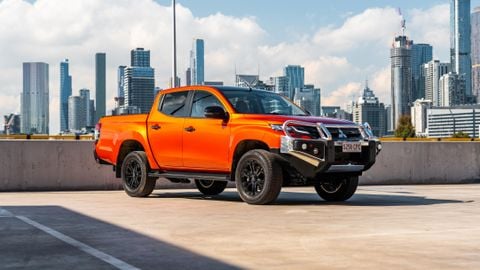
The 2022 Mitsubishi Triton GSR on test here is the most expensive variant on sale in Australia, with an aggressive exterior and a cabin packing every luxury Mitsubishi offers.
Is it still worth a look, or should the Triton be frightened by its latest range of competitors?
How much does the Mitsubishi Triton GSR cost?
The dual-cab GSR 4×4 on test here is the most expensive Triton in the range, with a sticker price of $55,690 before on-road costs.
That equates to a drive-away price of $63,490 with a NSW postcode for a GSR with the Tan and Orange interior package (fitted to our tester) and a roll-top tonneau cover, according to the Mitsubishi Australia website.
Although it’s more than you’d have paid in 2021 (and 2020, and 2019 for that matter), that’s still significantly less than you’re up for if you go searching for a top-end Ranger, HiLux, BT-50 or D-Max.
The equivalent Ranger on price is the workman-spec XLS 4×4 dual-cab ($54,330 before on-roads), while the equivalent HiLux is an SR 4×4 auto ($52,795) or SR5 4×4 manual ($58,680).
It’s not the bargain it once was, but the Triton still stack up strongly on the value front alongside big names from other brands.
2022 Mitsubishi Triton dual-cab pricing:
- Mitsubishi Triton GLX 4×2 ute auto: $38,940 (+$1000)
- Mitsubishi Triton GLX 4×4 cab chassis manual: $39,940 (+$1000)
- Mitsubishi Triton GLX 4×4 cab chassis auto: $42,190 (+$1000)
- Mitsubishi Triton GLX-R 4×2 ute auto: $42,940 (+$1000)
- Mitsubishi Triton GLX 4×4 ute auto: $43,190 (+$1050)
- Mitsubishi Triton GLX+ 4×4 ute manual: $43,940 (+$1250)
- Mitsubishi Triton GLX+ 4×4 ute auto: $46,190 (+$1700)
- Mitsubishi Triton GLX-R 4×4 ute auto: $47,190 (+$1250)
- Mitsubishi Triton GLS 4×4 ute manual: $48,940 (+$1650)
- Mitsubishi Triton GLS 4×4 ute auto: $51,190 (+$1650)
- Mitsubishi Triton GSR 4×4 ute auto: $55,690 (+$2450)
Prices exclude on-road costs
What is the Mitsubishi Triton GSR like on the inside?
There’s no getting around it, this particular Triton is very orange.
Our tester was fitted with the $1000 Tan and Orange interior package, which gets you lashings of… tan and orange leather. It’s distinctive, but we’d be steering clear.
The Triton really shows its age inside. The driver is faced with simple analogue gauges and a basic trip computer that lacks a digital speedo, and the infotainment system looks and feels old-hat alongside what’s on offer in the new Outlander. More on that to come.
The fundamentals are still good, however. The driving position is accomodating for tall drivers, and the steering wheel telescopes out to meet you – something missing on some rivals.
A bit more under-thigh support would be nice on long drives, where the flat seat base can leave you with a numb behind.
It’s hard and shiny, but the plastic trim used for most touch points feels hard-wearing, while the metal shift paddles could have been lifted from a Lancer Evolution.
Storage spots include cupholders, an open cubby below the USB ports ahead of the gear shifter, a narrow but deep centre console, big doors bins with room for a one litre bottle or two, and a glovebox.
As for the infotainment tech? The central touchscreen has Apple CarPlay, Android Auto, and DAB+ digital radio, so it’s well-featured, but it’s basic considering even a base Ford Ranger now gets a massive, vertically-oriented screen.
The picture is washed out and hard to read in direct sunlight, and its responses to inputs are pretty sluggish. The picture itself isn’t flush with the touchscreen glass itself, either, so you can lose information from the outer edges of the display from some angles.
The reversing camera is average at best, and makes knowing where the outer reaches of that long rear overhang lie harder than it should be. Mitsubishi offers a surround-view camera like some of its rivals (both cheaper and more expensive), but it’s not available on all Tritons due to the semiconductor crunch.
Infotainment used to be an afterthought in utes, now it’s a core requirement. The next Triton will need to take a great leap forward if it’s to be competitive on the technology front, because the current iteration really feels its age.
Given it’s a bit narrower than its rivals, the Triton feels quite compact in the rear if you plan to make use of all three seats. Access through the small-ish rear doors is par for the class, but the upswept window line means shorter kids may feel a little bit claustrophobic.
Legroom and headroom are acceptable for kids and average-sized adults, and the inclusion of a fold-down central arm rest, USB charge ports, and roof-mounted air vents will help keep little ones comfortable on longer trips.
There are dual ISOFIX points back there, along with three top-tether anchors.
The tray in the Triton measures 1520mm long with the tailgate up, 1470mm wide, 475mm deep, and 1085mm between the arches.
What’s under the bonnet?
Power in the Triton GSR comes from a 2.4-litre turbo-diesel making 133kW and 430Nm. It’s sent to the road through a six-speed automatic transmission, and a switchable four-wheel drive system.
Along with the usual 2H, 4H, and 4L modes, the all-wheel drive system in the Triton has a four-wheel drive mode that keeps the centre differential unlocked. That allows you to drive the car in four-wheel drive on sealed, dry roads like an SUV.
Most dual-cab utes need to be driven in 2H mode on tarmac to avoid differential binding.
Claimed fuel economy is 8.6 litres per 100km, and the fuel tank holds 75L. Braked towing capacity is 3100kg, down on the 3500kg offered elsewhere in the class.
How does the Mitsubishi Triton GSR drive?
The Triton is relatively compact alongside a new Ranger, or something like a GWM Ute, which means it’s relatively easy to pilot in tight city spaces.
It doesn’t fill a lane as fully as most of its rivals, and its short-ish wheelbase makes for an impressive 11.8m turning circle.
The trade off is that long rear overhang, which doesn’t help the Triton’s off-road credentials. It also makes it more difficult to balance the car with a heavy load in the tray.
MORE: Mitsubishi Triton off-road review
Previous experience with the Triton is that it’s not quite as stable as its newer, larger rivals with a comparable load in the tray.
Mitsubishi’s turbo-diesel engine settles quickly into a reasonably quiet idle, and isn’t too gruff in day-to-day driving.
With less than two tonnes to lug around (light by dual-cab standards) it offers decent punch away from the traffic lights, and has enough punch in reserve for highway overtaking. When you really dip into the throttle’s travel it can get a bit shouty, but for the most part the engine is an unobtrusive partner.
Likewise the six-speed transmission for the most part shuffles smartly through the gears. You can take control with the metal paddles, but shifts are slow and slightly jerky.
Road noise is reasonably well suppressed at 100km/h on the sort of coarse-chip roads common in Australia, so it’s not hard to make phone calls on the run. Newer utes are quieter and more SUV-like again, but the Triton isn’t disgraced by its rivals.
Ride quality is okay, but nothing more. Unladen, the ride at the rear is typically terse for a ute with leaf springs, but sharper hits can shudder through the ladder frame and into the cabin which isn’t pleasant.
It makes the Triton feel more more workmanlike than some of its competitors, which better isolate occupants from the outside world.
Also missing from the Triton are the active driver assists becoming common in the ute world. It doesn’t have adaptive cruise control, let alone active lane-keeping, which means you need to be more switched on during long highway drives.
Some buyers will prefer their ute remains a more old-school beast that doesn’t beep or bong at them every time they come close to a white line, but there’s no getting away from the fact the Triton is lacking technology plenty of buyers expect in 2022.
What it does offer, however, is the option of running in four-wheel drive on sealed surfaces. The Super Select II four-wheel drive system features 2H, 4H, and 4L modes like most of its rivals, but it also has a 4H mode suitable for driving on regular roads.
That means when it rains and the road is slippery, you’re able to enjoy the security of four-wheel drive.
Where utes in 2H (rear-wheel drive) mode can be a bit sketchy on slick tarmac thanks to the combination of a light rear end and AT tyres, the Triton just gets on with the job.
What do you get?
Triton GSR highlights:
- Black grille
- Black roof
- Black 18-inch alloy wheels
- Power driver’s seat
- Heated front seats
- Leather upholstery
- Surround-view camera
The Tan Orange interior package ($1000, as tested) adds:
- Tan Orange leather upholstery
- Tan Orange interior trim
Standard equipment for the wider range is as follows:
Triton GLX cab-chassis highlights:
- 6.1-inch touchscreen infotainment system
- Cruise control
- Remote central locking
- Air-conditioning
- 16-inch steel wheels
- Vinyl floor covering
- Two-speaker sound system
- Reversing camera (dependent on tray fitted)
Other Triton GLX models add:
- 7.0-inch touchscreen infotainment system
- Wired Android Auto and Apple CarPlay
- DAB+ digital radio
- Four-speaker sound system
- 16-inch steel wheels (17-inch in 4WD Single Cab cab-chassis)
Triton GLX dual-cab and GLX club cab add:
- Rain-sensing wipers
- Autonomous emergency braking
- Lane departure warning
- Automatic headlights
- Front fog lights
Triton GLX+ adds:
- 16-inch alloy wheels
- Reversing camera
- Rear parking sensors
- Side steps
- Climate control air-conditioning
- Rear differential lock
- Roof-mounted rear air circulator
Triton GLX-R adds:
- Leather-wrapped steering wheel and shifter
- Chrome door handles and mirrors
- 18-inch black-finish alloy wheels
- Privacy glass
Triton GLS adds:
- Super-Select II four-wheel drive system
- LED headlights
- LED daytime running lights
- Keyless entry and start
- Six-speaker sound system
- Front parking sensors
- Automatic high-beam
- Power-folding exterior mirrors
- Dual-zone climate control
- Blind-spot monitoring
- Rear cross-traffic alert
- Paddle shifters (auto only)
Is the Mitsubishi Triton GSR safe?
When the Mitsubishi Triton was tested by ANCAP in 2015, it received a five-star safety rating.
It received a frontal offset score of 15.22 out of 16 and a side impact score of 16 out of 16. Whiplash and pedestrian protection were rated Good and Acceptable, respectively.
All 2022 Mitsubishi Triton models come standard with front, side and curtain airbags, as well as a driver’s knee airbag and anti-lock brakes.
All models bar the base GLX in Single Cab and manual Club Cab guise also include autonomous emergency braking (AEB) with forward-collision warning, as well as lane departure warning.
Triton GLS and GSR models add blind-spot monitoring and rear cross-traffic alert.
How much does the Mitsubishi Triton GSR cost to run?
Mitsubishi’s standard warranty covers five years or 100,000km, but so long as you return to one of its dealerships at each service this extends to 10 years or 200,000km.
Servicing at dealerships also lets you take advantage of Mitsubishi’s 10 years of capped-price servicing. Maintenance in the Triton is required every 12 months or 15,000km – whichever comes first.
Mitsubishi Triton service pricing:
- Service 1: $399
- Service 2: $499
- Service 3: $499
- Service 4: $699
- Service 5: $499
- Service 6: $699
- Service 7: $499
- Service 8: $999
- Service 9: $599
- Service 10: $699
CarExpert’s Take on the Mitsubishi Triton GSR
The Triton is starting to feel its age, but it still has a place in 2022.
Not everyone is willing to take a punt on an upstart Chinese brand for their work ute, no matter how much cheaper they are than the established players, and you can get a lot of Triton for your money relative to a new Ranger or HiLux.
With that in mind, we’d be look at the GLS instead of the GSR. It’s $4000 cheaper, and only misses out on non-essential equipment such as black exterior highlights, a powered front seat, and leather upholstery.
Although a surround-view camera is something we’d usually recommend on a ute, the washed-out unit on the Triton isn’t as useful as it really should be.
Specced as such, the Triton represents sharp value and is still a capable dual-cab ute.
Click the images for the full gallery





 Automotive Vehicle Spec Data & 4K images Powered by JATO Dynamics Ltd