





William Stopford
Ford Transit Custom recalled for fire risk
Almost 800 current-generation Ford Transit Custom double cab vans are being recalled for a potential fire risk.
14 Hours Ago
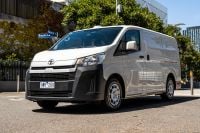
Toyota has treated its HiAce van to a few small upgrades, but rivals like Ford and Volkswagen are piling on the pressure.


If this is the car for you, we’ll compare offers from trusted dealers, handle the back and forth and manage your purchase from enquiry to delivery.
In the commercial van world, it seems like there’s nothing that can quite match the might of the Toyota HiAce.
Even with the arrival of new competitors and the consistent turnover of updates for high-profile competitors in the past year, the HiAce continues to be Australia’s favourite van. Toyota has delivered more than 10,000 examples this year, dwarfing the 3500-odd sales posted by the more modern, runner-up Ford Transit Custom in the same time.
Toyota has also updated the HiAce to better align it with the times. Headline changes include a new digital instrument cluster and adaptive cruise control, while wireless Apple CarPlay and Android Auto are now standard, alongside a window on the passenger-side sliding door.
Other than that, the changes to the sixth-generation HiAce have been minimal since its release in mid-2019. It’s still rear-wheel drive and fitted with Toyota’s widely deployed 2.8-litre turbo-diesel four-cylinder, and the Toyota HiAce LWB Van with barn doors on test here is still among the most popular variants.
Do these minor updates make the HiAce a better pick than its newer rivals?

Our tester is the cheapest barn-door HiAce currently on sale, priced at $54,630 before on-road costs, which is nevertheless about $3000 more than before.

| Model | Price before on-road costs |
|---|---|
| 2026 Toyota HiAce LWB Van manual | $51,880 |
| 2026 Toyota HiAce LWB Van | $53,880 |
| 2026 Toyota HiAce LWB Van with barn doors | $54,630 |
| 2026 Toyota HiAce LWB Van GL Pack | $54,880 |
| 2026 Toyota HiAce LWB Van GL Pack with barn doors | $55,630 |
| 2026 Toyota HiAce LWB Crew Van | $56,880 |
| 2026 Toyota HiAce SLWB Van | $62,440 |
| 2026 Toyota HiAce SLWB Van with barn doors | $63,190 |
You’d be forgiven if you didn’t notice the table above is a little shorter than the last time we reviewed the HiAce. Missing are the two 12-seat Commuter bus variants, which are currently unavailable.
Contrary to what its big sales figures may suggest, the HiAce Van does have a few rivals. Standouts in the segment include the Ford Transit Custom LWB priced from $57,590 before on-roads, and the Hyundai Staria Load priced from $46,990 plus on-roads.
Additionally, there’s the Volkswagen Transporter from $58,590 plus ORCs, and for $48,411 drive-away you can also get the keys to an LDV Deliver 7 LWB.
To see how the Toyota HiAce stacks up against its rivals, use our comparison tool
The front of the HiAce’s cabin is still a relatively comfortable space, and it’s been elevated by the tech upgrades.

The infotainment system still looks and feels outdated, but the addition of wireless smartphone mirroring is more than welcome. Using Apple CarPlay during our week with the van revealed no issues, making it easy to hop in and go without too much thought.
It’s worth noting that a little more setup is required than with a wired connection, which may not be ideal for fleets or businesses with multiple drivers. Of course, you can still plug in using the USB-A port below the gear selector.
To the right is the new instrument display, a 7.0-inch unit that marks a vast upgrade over the old, primarily analogue setup. As practical as real gauges are, the new display brings the HiAce closer to rivals like the Transit Custom, even if it’s still a little rudimentary in form and function.
There isn’t really any customisation available, but you can flick through a handful of different menus using buttons on the steering wheel. It’s clear the screen exists purely to show you as broad a range of information as possible without any fluff, and it’s quite good at that.


Otherwise, the HiAce is unchanged. There are practical storage options, such as five cupholders (three on the dashboard, two on the back of the centre console), a large passenger-side glovebox, and a centre console bin, which sits under a large plastic tray rather than a central armrest.
It’s disappointing that Toyota still hasn’t fitted any armrests other than the hard-plastic ones attached to the front doors, as many rivals have them inboard of the seats. This makes the HiAce a touch less comfortable than it could be, but at least the seats are nicely cushioned.
Driving position ergonomics are also good and it’s easy to get into a comfortable position. This is supported by the fact that everything is laid out neatly and logically, which means it all makes sense in the context of a work van.
Topping all that off is a large T-bar-like gear selector that’s easy to use, and old-school tri-dial climate controls. Toyota has prioritised function over form, and there’s still a sense of unwavering familiarity from behind the steering wheel.


Moving backwards to the meat and potatoes of the HiAce, the cargo hold is colossal – 6.2 cubic metres to be exact – and left almost entirely empty from the factory, giving you room to customise it to your needs.
The lack of any upholstery or trim (save for a few wood panels on the doors) means you don’t have to worry about damaging the interior when loading and unloading the HiAce, aside from scratches on the painted floor. A durable cargo liner is available as an accessory.
And the breadth of accessories makes the HiAce a very versatile pack mule.
On the floor of the cargo area are six heavy-duty tie-down points mounted at the front, middle and rear to prevent cargo from moving around and damaging the side panels on the move, or sliding into the back of the seats, which are unprotected as standard.

The inclusion of barn doors on our tester certainly makes loading cargo easier, as access is excellent when they’re open to their full 180-degree wingspan. They’re also convenient if you’re loading via forklift.
They’ll easily hold themselves open at 180 degrees, though that will dramatically expand the van’s width. If you only need them open halfway there are manual struts for each door, which seem sturdy and clip neatly into the back of each door when not in use.
Full-height sliding doors are fitted to both sides of the van as standard, enabling easy access to the hold.
Floor cut-outs are incorporated behind each door to make it easier to climb in, though they take up a little floor space at the front of the load bay.
| Dimensions | Toyota HiAce LWB |
|---|---|
| Length | 5265mm |
| Width | 1950mm |
| Height | 1990mm |
| Wheelbase | 3210mm |
| Cargo bay length | 2530mm |
| Cargo bay width | 1760mm (1268mm between wheel-arches) |
| Cargo bay height | 1340mm |
| Cargo bay volume | 6.2m³ |
To see how the Toyota HiAce stacks up against its rivals, use our comparison tool
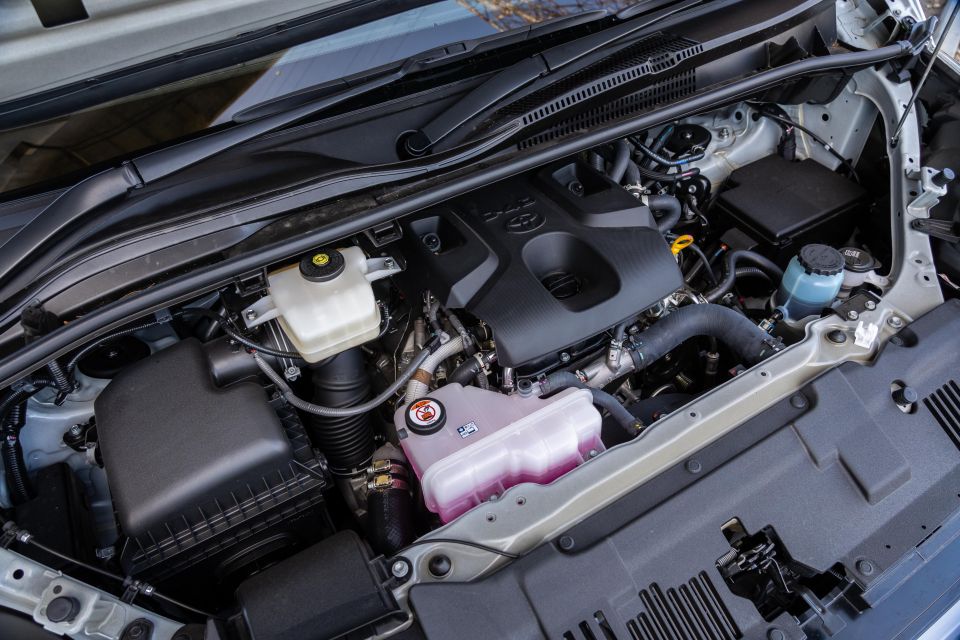
The HiAce is powered by Toyota’s widespread 2.8-litre turbo-diesel, also found in the HiLux, Prado, and outgoing Fortuner. Like all but one other HiAce variant, our tester was fitted with a six-speed automatic transmission, which means the engine produces 450Nm of torque instead of 420Nm with the manual.
| Specifications | Toyota HiAce LWB Barn Door |
|---|---|
| Engine | 2.8L 4cyl turbo-diesel |
| Power | 130kW |
| Torque | 450Nm |
| Transmission | 6-speed auto |
| Driven wheels | Rear-wheel drive |
| Kerb weight | 2260kg |
| Fuel economy (claimed) | 7.8L/100km |
| Fuel economy (as tested) | 8.5L/100km |
| Fuel tank size | 70L |
| Fuel requirement | Diesel |
| Payload | 1075kg |
| Gross Vehicle Mass (GVM) | 3300kg |
| Gross Combination Mass (GCM) | 4800kg |
| Unbraked towing capacity | 400kg |
| Braked towing capacity | 1500kg |
Our week with the van primarily involved freeway commuting, with a fair amount of suburban driving thrown in as well. The fuel economy reading we recorded was still higher than Toyota’s claim, and even with idle-stop/start tech, we’d expect commercial use with frequent stops would further increase consumption.
To see how the Toyota HiAce stacks up against its rivals, use our comparison tool
Generally speaking, none of the HiAce’s on-road manners have really changed.

The cavernous cargo area with its metal floor, metal walls, and wood panelling means it’s still echoey on the move, and you’ll definitely notice a lot of driveline whine. Not that this is a deal-breaker, but rivals like the Transit Custom have rear bulkheads behind the seats as standard and are better insulated as a result – a bulkhead is optional in Toyota land.
Sideways visibility has actually been improved, however, partly due to the lack of a standard bulkhead. The HiAce includes a window on its passenger-side sliding door, and while vision still isn’t perfect, it’s acceptable for a van. It’s at least supported by reliable blind-spot monitoring.
Speaking of visibility, the short bonnet is as good as invisible from the driver’s seat, even if you sit quite high. This can make the van a bit more challenging to park nose-in, especially now you’re further away from the front of the vehicle since the latest HiAce ditched its long-running vertical front-end.
Fortunately, there are front parking sensors on hand. If you prefer to reverse-park (a viable option in tight-ish spaces on account of those lower-opening barn doors), there are also handy reverse sensors and a camera, and the van’s perfectly flat sides make it easy to square the vehicle up between the lines.

The turbo-diesel powerplant, meanwhile, produces plenty of torque low in the rev range and has no issue getting things going. But there’s no denying this engine is now ancient, and its loud, barely muffled racket makes the HiAce feel pretty tired.
Still, it’s responsive to throttle inputs and smooth enough as it climbs through the rev range. It’s surprisingly spritely unladen, and the 1075kg payload leaves a lot of overhead for cargo. The powertrain is nothing if not sensible, a sentiment that extends to the competent and predictable automatic transmission.
It still features a convenient engine idle-stop/start function that helps save fuel if you spend a lot of time at a standstill, unlike some other Toyotas that use this diesel engine. If you’re not a fan, there’s a button beneath the climate controls to switch it off.
At higher speeds, wind noise is very noticeable. Again, the lack of any accessories to insulate the interior of our tester exacerbated this. When paired with a loud driveline, the HiAce feels much less refined than most of its van rivals.
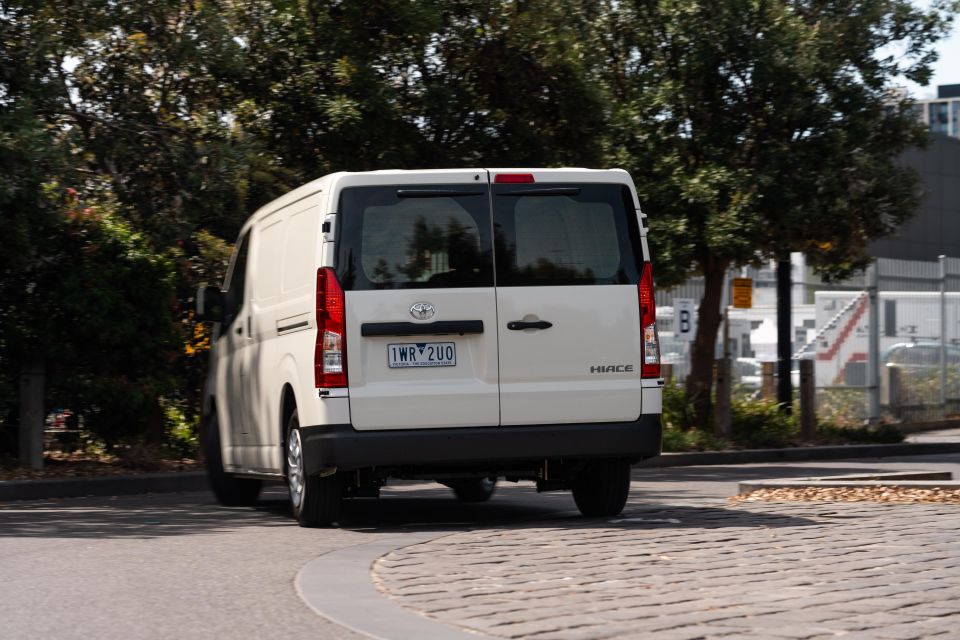
As planted as it feels on the road thanks to its relatively long wheelbase, the HiAce can also be a little bouncy – noticeably more so than the new Transporter, for example. This is forgivable on account of its decent payload, and it never feels like it’s going to bobble off the road – it may not ride like a car, but it’s by no means a truck.
We like this van’s direct steering feel, which makes it easy to place on the road and reasonably maneuverable at low speeds. The HiAce recently gained electric power steering, which is a decent improvement over the old hydraulic system and makes it feel a little more modern.
Also new is adaptive cruise control, which behaves reliably, while the new steering system has enabled a well-configured lane-centring system. This is a key upgrade over the pre-update model, and makes it much more tolerable on long freeway stints.
All in all, the HiAce is still the HiAce. It’ll happily help with any cargo-transport needs, but it lacks the refinement of many of its newer rivals.
To see how the Toyota HiAce stacks up against its rivals, use our comparison tool
All HiAce Vans, including our tester, seat only two occupants, with no option to add a second row. HiAce Crew Vans, however, come with five seats, and the Commuter bus has 12.
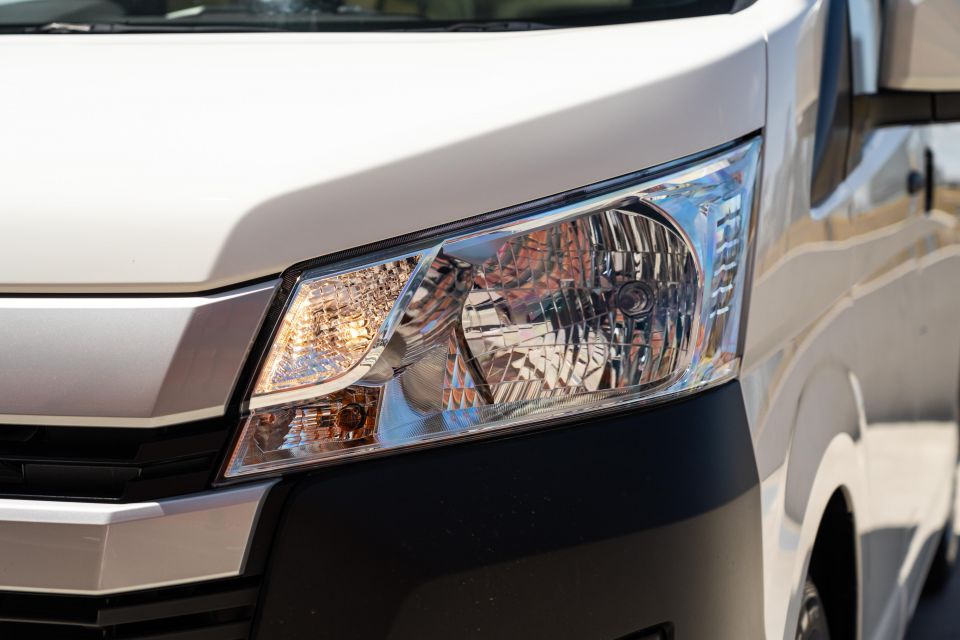

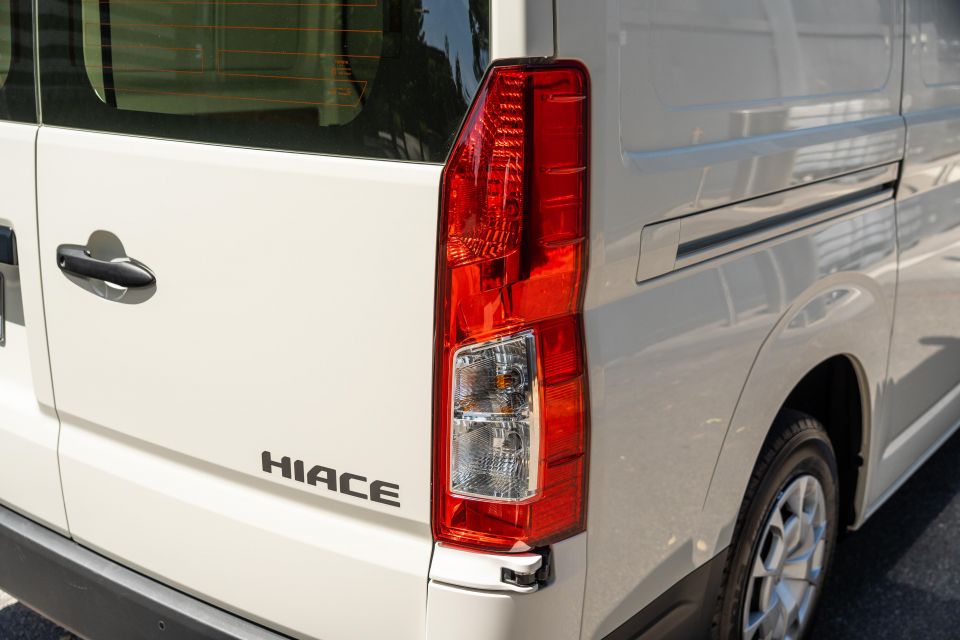
2026 Toyota HiAce equipment highlights:
HiAce Crew Van adds:

If this is the car for you, we’ll compare offers from trusted dealers, handle the back and forth and manage your purchase from enquiry to delivery.
There are several option packs available for the HiAce.
The GL Pack ($NCO) adds:
The Panel Pack ($NCO)adds:
The Four-Door Pack ($NCO) adds:
Additionally, there are countless accessories available for the HiAce, but pricing is only available via a dealer. These include:
To see how the Toyota HiAce stacks up against its rivals, use our comparison tool
The Toyota HiAce has a five-star ANCAP safety rating, based on testing conducted in 2025.

| Category | Toyota HiAce |
|---|---|
| Adult occupant protection | 80 per cent |
| Child occupant protection | 86 per cent |
| Vulnerable road user protection | 87 per cent |
| Safety assist | 81 per cent |
Standard safety equipment highlights:
Additionally, the HiAce boasts a ‘Platinum’ ANCAP collision avoidance rating, with a total score of 90 per cent. For context, the larger Ford Transit scored 93 per cent.
To see how the Toyota HiAce stacks up against its rivals, use our comparison tool
The HiAce is backed by Toyota Australia’s five-year, unlimited-kilometre warranty, or five years/160,000km for commercial users. Servicing is required every six months or 10,000km, whichever comes first.

| Servicing and Warranty | Toyota HiAce |
|---|---|
| Warranty | 5 years, unlimited kilometres 5 years, 160,000km (commercial users) |
| Roadside assistance | $99 or $139 per year, depending on plan, excl. rental or hire use |
| Service intervals | 6 months or 10,000km |
| Capped-price servicing | 5 years (10 services, $365 each) |
| Annual service cost | $730 |
| Total capped-price service cost | $3650 |
Rivals like the Volkswagen Transporter have longer 12-month/30,000km service intervals, which means less downtime for maintenance. However, the VW is also slightly more expensive to service, averaging $776 annually.
Ford’s Transit Custom, meanwhile, is covered by capped-price servicing for four services (with the same intervals as the Transporter), costing only $499 per year.
To see how the Toyota HiAce stacks up against its rivals, use our comparison tool
The Toyota HiAce certainly remains a safe choice, but it’s really starting to feel dated.

Of course, it’s impossible to ignore its worth as a work vehicle, complemented by its proven (if not ancient) diesel engine, huge capacity, and easy driving. At the same time, the minor tech upgrades are a much-needed inclusion, and the HiAce is still as configurable as ever.
That makes it an easy option if you need a van, and the number of them you see on the road is a clear indication that a significant number of business owners and couriers have come to the same conclusion. In the context of its rivals though, the HiAce is lagging behind.
The Ford Transit Custom is a prime example. It’s visually sharper outside, while being more modern and comfortable inside, and it comes with a bulkhead and three-abreast seating as standard. Much the same can be said of the new Volkswagen Transporter, too.
Those competitors may be more expensive, but their better-rounded packages challenge the value-for-money equation of the ever-popular HiAce.
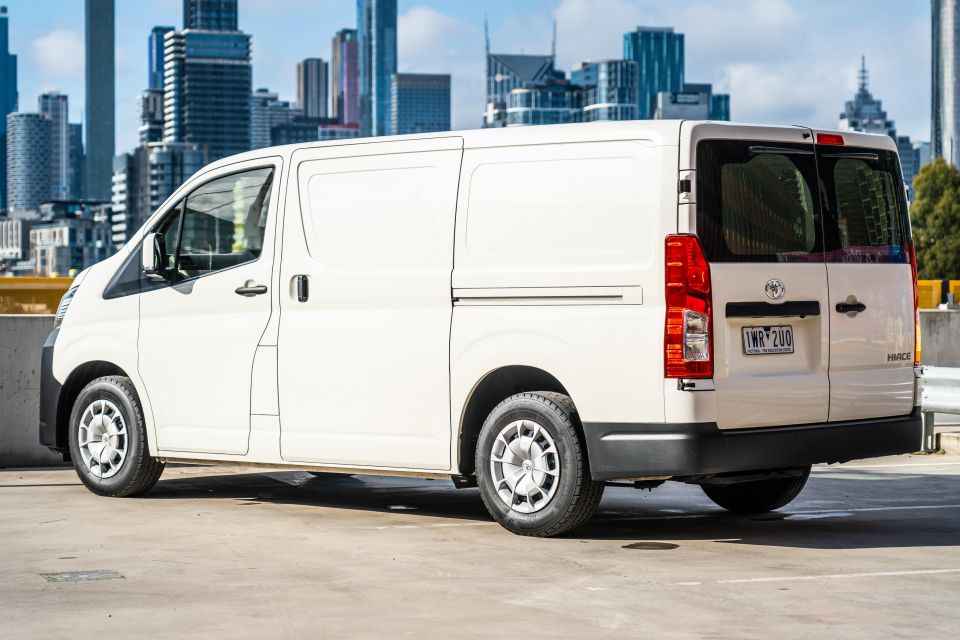
CarExpert can save you thousands on a new Toyota HiAce. Click here to get a great deal.
Click the images for the full gallery
If this is the car for you, we’ll compare offers from trusted dealers, handle the back and forth and manage your purchase from enquiry to delivery.
Quickly see how this car stacks up against its competition. Select any benchmark to see more details.
Toyota HiAce
Toyota HiAce Sales rolling 12-months#
*Based on VFACTS and EVC data
Looking for complete Toyota HiAce price history?
Our Toyota HiAce Pricing Page shows exactly how prices have changed over time.
2025
$57,393
2024
$84,086
2024
$87,176
Max Davies is a CarExpert journalist with a background in regional media, with a passion for Japanese brands and motorsport.
Add CarExpert as a Preferred Source on Google so your search results prioritise writing by actual experts, not AI.
William Stopford
14 Hours Ago

Damion Smy
3 Days Ago
Damion Smy
4 Days Ago
William Stopford
7 Days Ago
Damion Smy
16 Days Ago

Matt Campbell
2 Months Ago
Add CarExpert as a Preferred Source on Google so your search results prioritise writing by actual experts, not AI.
# Based on VFACTS and EVC data
† Displayed prices are based on the drive-away price of the vehicle, which includes delivery charges, registration fees, number plates, and applicable road taxes, based on a Sydney location. However, prices may vary between states and territories, and additional costs such as compulsory third party (CTP) insurance, dealer delivery fees, and optional extras are not included. These prices are subject to change without notice and may not reflect current market pricing or dealer offers.
 Automotive Vehicle Spec Data & 4K images Powered by JATO Dynamics Ltd