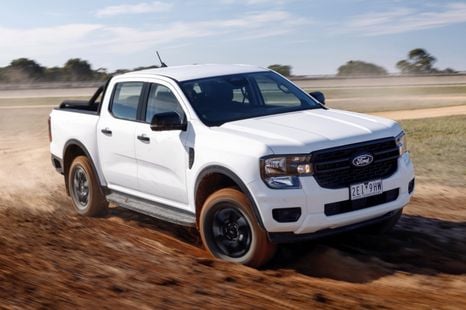
The Ford Ranger V6 has more muscle on paper, but how much difference does that make against the four-cylinder? We line up an XLT V6 and a four-cylinder Wildtrak for sound checks, timed acceleration runs, and wet-weather drag races. Both cost around $70,000 plus on-road costs when we filmed in 2022.
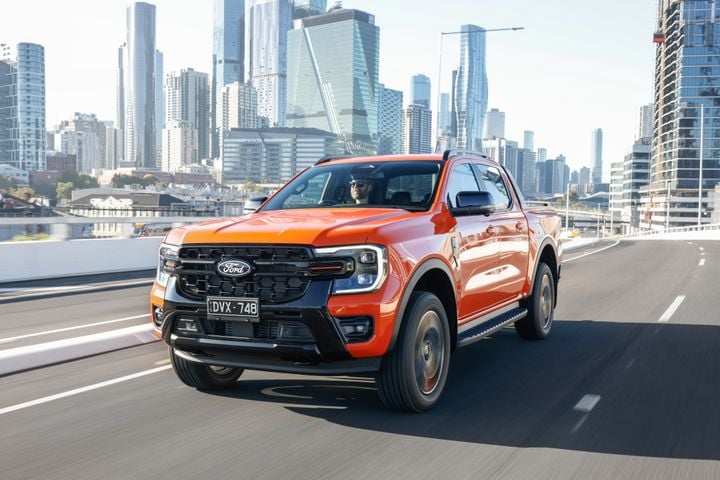
The Wildtrak’s 2.0-litre turbo-diesel four-cylinder produces 154kW of power and 500Nm of torque. The XLT counters with a 3.0-litre turbo-diesel V6 delivering 184kW and 600Nm. Both use 10-speed automatic transmissions, but the V6 also offers an automatic four-wheel drive mode. Despite its heavier engine, the less lavishly equipped XLT is only around 10kg apart from the Wildtrak in overall weight.
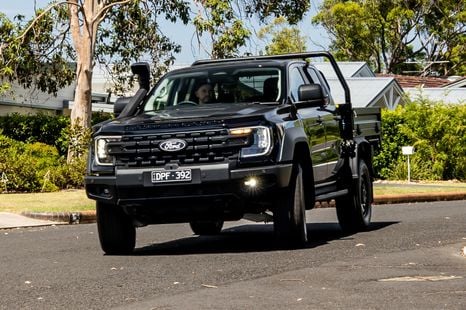
These aren’t perfectly matched test vehicles. Both wear all-terrain tyres, but from different brands, and the wet surface adds another variable. The V6 sounds more refined during our stationary comparison, while the four-cylinder has a more familiar diesel-ute note.
In two-wheel drive with traction control active, the Wildtrak reaches 100km/h in 10.0 seconds. Switching stability control off cuts that to 9.8 seconds, while four-wheel drive high range brings a 9.7-second result. That last setting was used for straight-line testing; it isn’t a recommendation to use locked four-wheel drive on sealed roads.
The V6 records 8.6 seconds in two-wheel drive with traction control on, improving to 8.5 seconds with stability control disabled. Automatic four-wheel drive reduces that to 8.4 seconds, then 8.2 seconds with stability control off. It’s a worthwhile improvement, even if the extra shove feels less dramatic than we anticipated.
Rain and available space limit the head-to-head races to an eighth of a mile, or approximately 201 metres. The V6 pulls ahead, recording runs around 10.3-10.4 seconds. Repeating the exercise with its tailgate lowered produces no material advantage, rather than proving an aerodynamic benefit.
We’d lean towards the V6 for its extra reserve when overtaking or towing, although this comparison doesn’t include a towing test. The four-cylinder still makes a respectable showing. The question is whether the V6’s stronger performance and broader drivetrain options justify the extra spend for your needs.