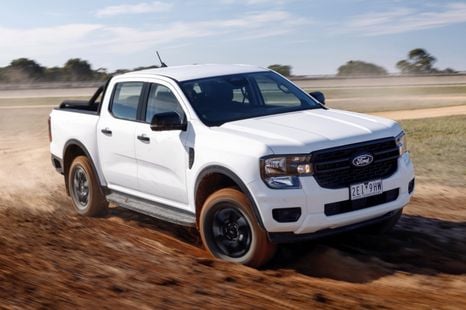
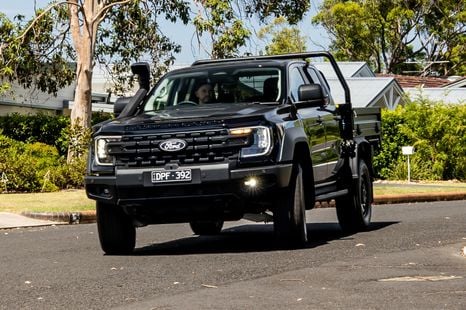
The Ford Ranger has plenty of off-road buttons, but how useful are they when the tyres start slipping? We take a 2023 Ranger Sport through our off-road course to explore its traction control, rear differential lock, low-range gearing, and hill descent control.
This example wears highway-terrain tyres rather than all-terrains, an important limitation in mud and on sharp rocks. Quoted clearance is 234mm, with a 30-degree approach angle, 25.6-degree departure angle, and 800mm wading depth. Those figures help explain its capability, but they don’t remove the need to assess each obstacle.
Inside, the drive selector offers two-wheel drive high range, automatic four-wheel drive, four-wheel drive high range, and low range. The rear differential lock can operate in two-wheel drive as well as high- and low-range four-wheel drive. We would prefer a physical diff-lock button rather than having to access it through the touchscreen.
The off-road display brings together driveline information, cameras, and pitch and roll readings. The front camera proves particularly handy when placing the vehicle on an obstacle or approaching a crest that is difficult to see over.
On the moguls in two-wheel drive, traction control impresses by keeping the Ranger edging forward with a rear wheel airborne. Engaging the rear differential lock then helps it escape a slippery section. Four-wheel drive high range also needs the locker to complete the muddy mogul test, so simply selecting four-wheel drive isn’t a cure for every traction problem.
For the muddy climb, we select Mud/Ruts mode and then low range, with the rear differential locked. The Ranger climbs convincingly despite its mud-covered highway tyres. Hill descent control is another highlight, allowing us to adjust descent speed using the steering-wheel controls.
Low range gives useful control over rocks, while a crossing just under 700mm deep is completed with a small slip on the climb out. We know the depth at this test site; unfamiliar water still calls for checking both depth and the surface underneath before entering.
Our verdict is encouraging for owners tackling basic off-road terrain in a standard vehicle. The electronics make the job approachable, but more serious use warrants suitable tyres and consideration of additional protection, rather than expecting the standard setup to handle everything.