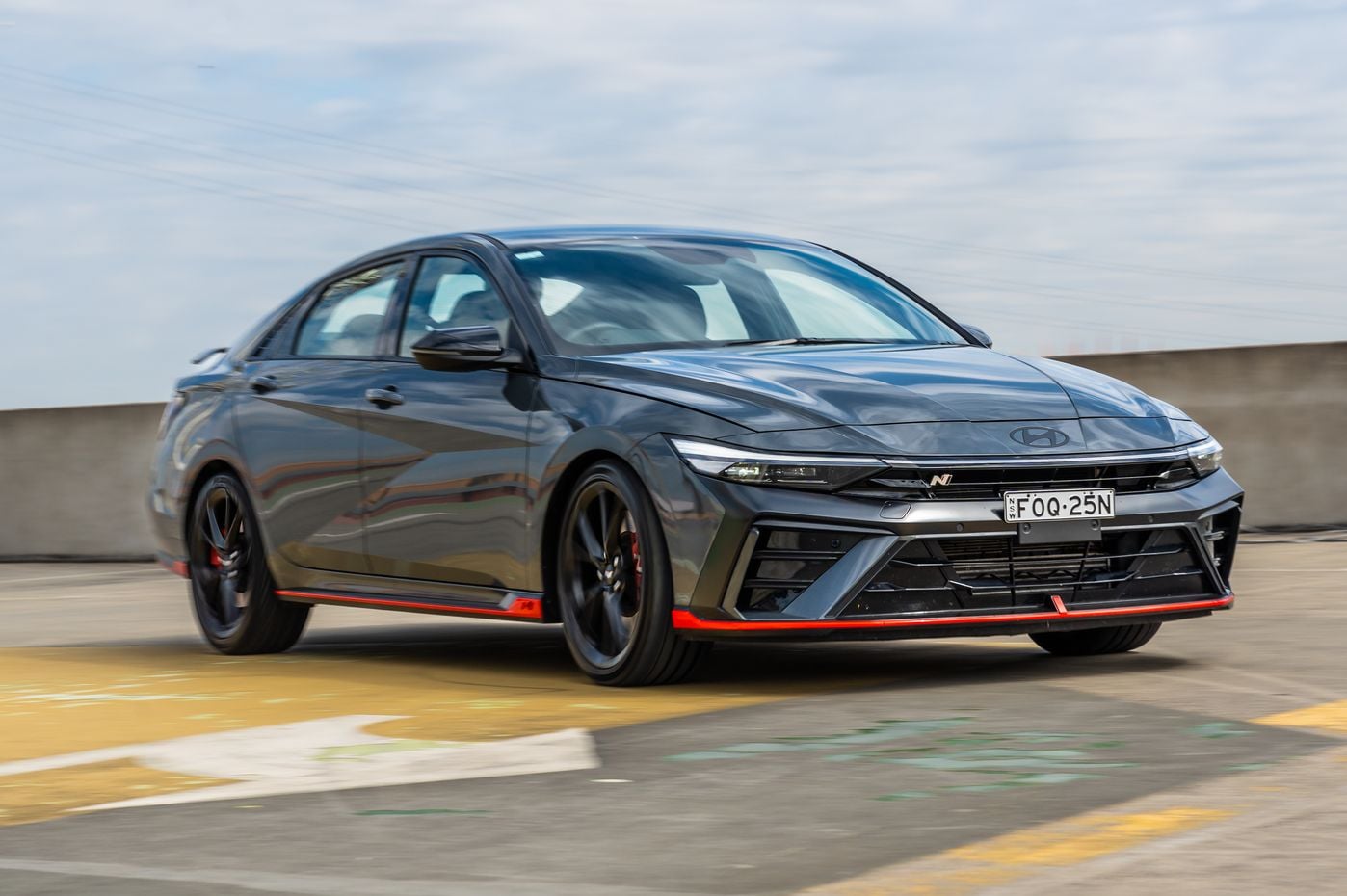
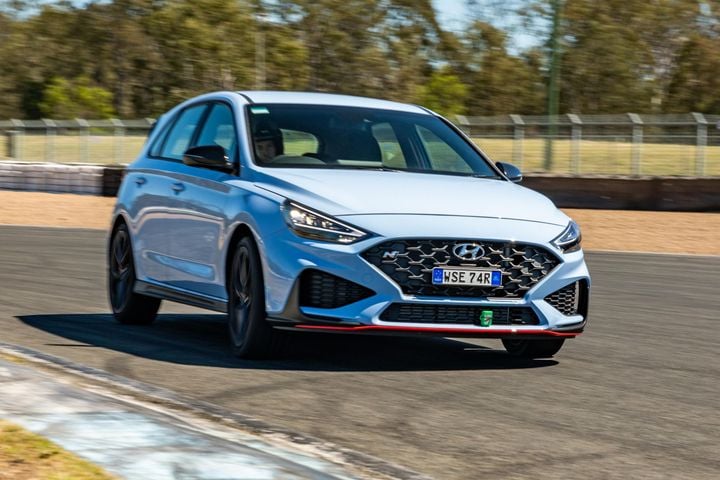
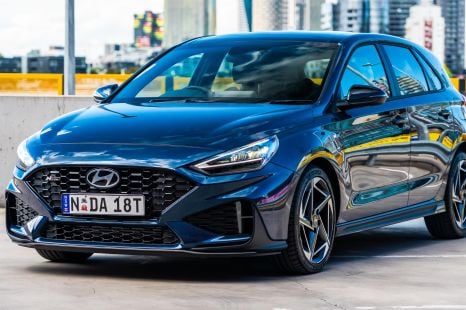
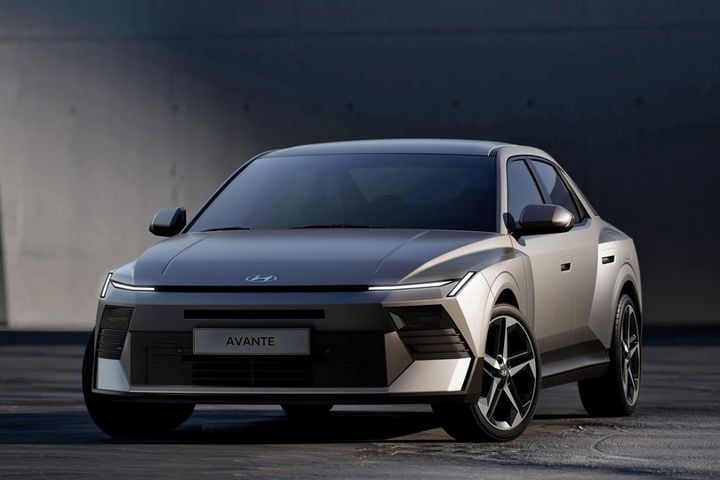
The Hyundai i30 Sedan N makes a convincing case for the performance sedan. In our 2024 test, its sharp handling, enthusiastic exhaust, and usable everyday manners outweigh some ordinary cabin plastics. The price quoted during filming was $52,000, following a facelift that brought extra equipment and mechanical refinements.
Our test car pairs a 2.0-litre turbocharged four-cylinder petrol engine producing 206kW of power with an eight-speed dual-clutch automatic. A six-speed manual was also available. The automatic is responsive without constantly hunting through gears, while an electronically controlled limited-slip differential helps the front tyres put the power down.
Forged 19-inch wheels wear Michelin Pilot Sport 4S tyres, and the brakes inspire confidence on track. The steering offers useful feedback, and once the tyres warm up the car feels particularly eager through corners. It can still push wide if we’re greedy with the throttle, but adjusting our inputs brings the front end back into play.
Adaptive damping helps it balance that enthusiasm with daily comfort. The ride is firm without becoming punishing over our rough-road section, and body control through the faster undulations is excellent. Tyre noise remains a compromise. Industry Scientific supplied our sound meter and calibrated our cabin-material tester.
Inside, the heated and ventilated front seats are comfortable, and the twin 10.25-inch displays bring navigation and Bluelink connectivity. Apple CarPlay and Android Auto require a cable. Hard surfaces detract from the presentation, while rear head room and toe room are limited. The 464-litre boot is useful, though its rear brace obstructs access through the folded seats.
Annoying speed-limit and attention alerts take the shine off the experience. Adaptive cruise control is absent, although the steering assistance performs well in our lane-support assessment. The reversing camera could also be clearer.
We try several acceleration setups. The quickest 0-100km/h run is 5.84 seconds using launch control at 3000rpm with stability control off and without N Grin Shift. Adding that temporary power boost doesn’t improve the standing-start result in our runs. Braking from 100km/h takes 37.86 metres.
It’s not the plushest sedan for the money, but the combination of grip, character, and accessible performance is hard to ignore. For us, the fun comfortably justifies the compromises.