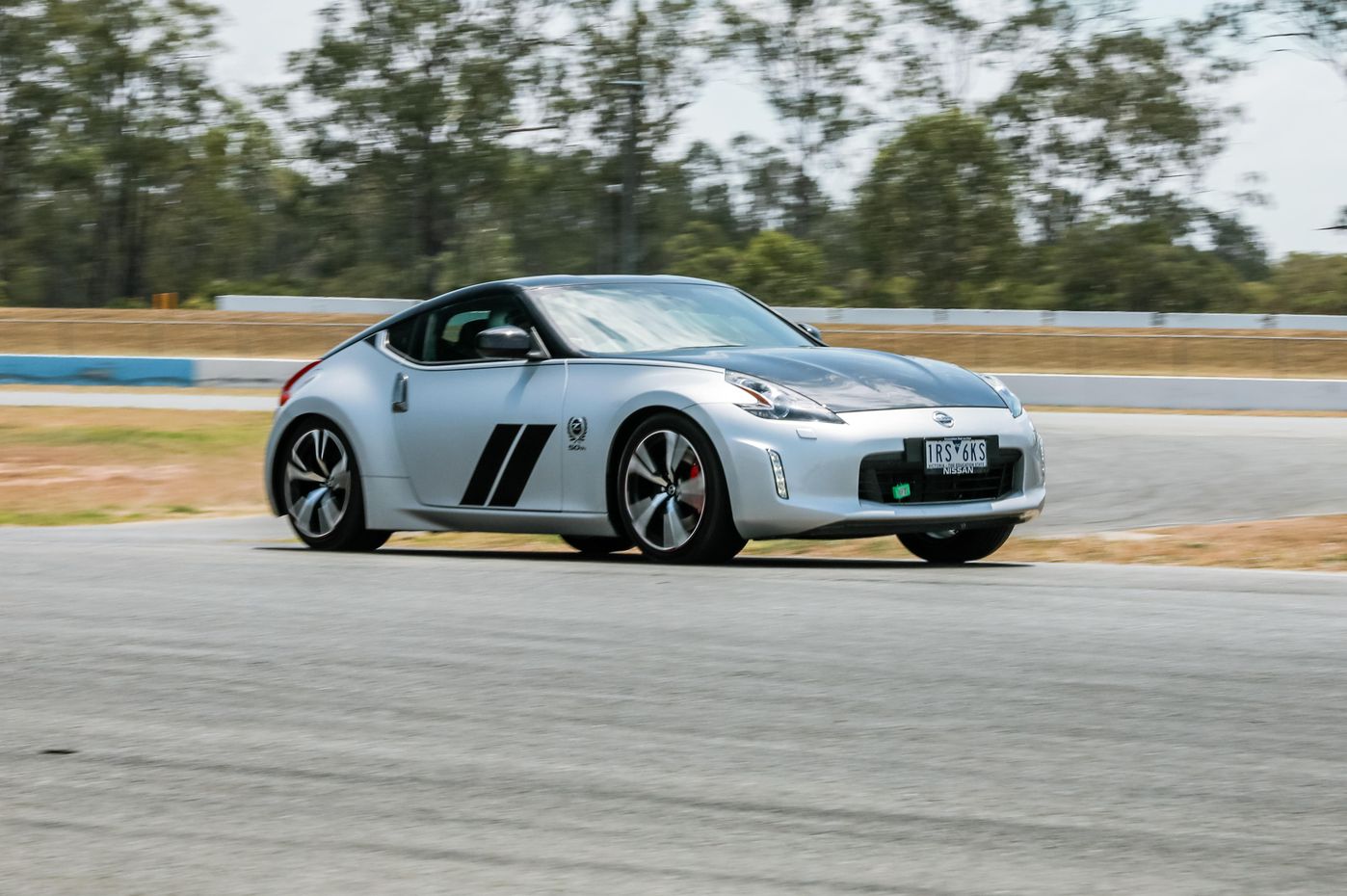
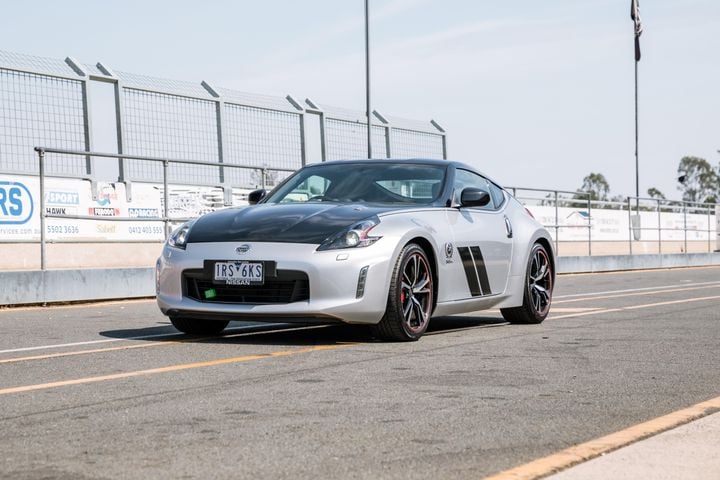
The Nissan 370Z has the ingredients for an entertaining track car: a naturally aspirated V6, rear-wheel drive, and a chassis that rewards commitment. Our 2021-model test at Queensland Raceway puts Chris Atkinson behind the wheel to find out how well those ingredients work together, and where the older sports coupe still falls short.
This example pairs its 3.7-litre V6 with a seven-speed automatic transmission, producing 245kW of power and 363Nm of torque. The engine feels strongest towards the top of the rev range. There is useful performance available, but we would welcome more response lower down to help drive out of corners.
The seating position makes a good first impression, with enough adjustment to get comfortably settled. The steering wheel proves harder to position exactly as desired, and the fixed shift paddles initially feel a little out of reach. Once lapping, however, reaching them is less troublesome than expected. A padded knee support is another welcome detail when bracing through corners.
Suspension and braking are the highlights. The chassis allows some movement before building support, staying composed as the load increases. The brake pedal has a progressive, consistent feel that makes it easier to modulate braking effort. Together, they give us confidence to lean on the car rather than tiptoe around its limits.
The automatic is less convincing. Upshifts take time to complete, costing some momentum, although downshifts are generally satisfactory. More frustratingly, switching off traction control does not remove all intervention in our test. The car sometimes applies a brake as we turn in, yet allows more movement on other laps. That inconsistency makes it difficult to trust its responses at the limit.
Our best lap is 1:01.0, set earlier in the morning. The filmed run later in hotter conditions is 1:01.5, an important distinction rather than two interchangeable results. The quicker time is respectable for this car, even with the frustrations.
Ultimately, the 370Z is fun and capable, with particularly strong suspension and brakes. Its high-revving power delivery, slower upshifts, and unpredictable electronic intervention keep it from delivering all the potential we can feel underneath.