





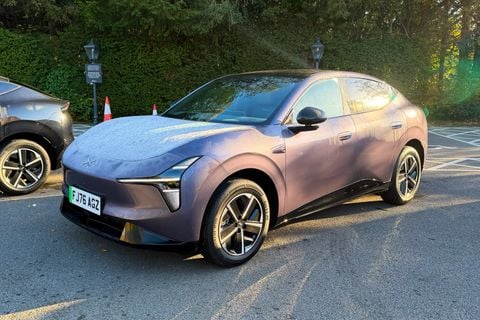
2027 Xpeng L03 review: Quick drive
The L03 brings sharp Australian pricing, generous space, and some personality to the affordable electric SUV market – but its ride still needs work.

CarExpert's take on the L03
Good
What we love
- Distinctive styling, spacious second row
- Comfortable seats, generous equipment
- Competitive pricing, DC charging capability
Worth a thought
- Unsettled ride on poorly surfaced roads
- Fiddly climate controls, steering wheel shape
- Parking assistance disappointed on this drive
Are there other rating labels?
- Excellent
- An outstanding car in almost every way. A joy to drive, packed with great features, and highly recommended.
- Very Good
- A well-rounded car that's enjoyable to drive, offers great value or features, and is easy to recommend.
- Good
- A solid choice that does most things well. Comfortable, capable, and worth considering in this segment.
- Average
- Meets the standard for this segment. May not stand out, but still a dependable and reasonable option.
- Below Average
- Falls a bit behind others in the segment, but still passes safety checks and may suit specific needs or budgets.
Introduction
There's no shortage of reasonably priced electric SUVs coming to Australia. The harder question is what makes you choose one over another.
The Xpeng L03 starts well. It looks good, there is plenty of space inside, and the Australian range opens at $41,900 before on-road costs. It also has a bit of personality, which is welcome in a class where some cars seem determined to be as anonymous as possible.
Xpeng also wants you to see it as a technology company, with advanced driver assistance a big part of its pitch. That could become a meaningful advantage. For now, though, there are some more basic things to get right.
We drove a right-hand drive, rear-wheel drive electric L03 around London, where narrow streets and some pretty ordinary road surfaces gave its suspension plenty to deal with. This was a short first drive in an overseas-specification car, rather than a test of the final Australian version. It left us liking quite a lot about the L03, but wanting a more settled ride.
How much does the Xpeng L03 cost?
Australian buyers will have three battery-electric versions of the L03 to choose from, plus a PowerX extended-range electric vehicle (EREV) variant. The latter matches the entry-level EV on price, and uses a petrol engine to generate electricity for the battery; its wheels are driven only by an electric motor.
| Model | Price before on-road costs |
|---|---|
| 2027 Xpeng L03 PowerX Long Range RWD | $41,900 |
| 2027 Xpeng L03 RWD Standard Range | $41,900 |
| 2027 Xpeng L03 RWD Long Range | $46,900 |
| 2027 Xpeng L03 AWD Performance Ultra | $53,900 |
That puts the L03 almost level with the Geely EX5 Complete and BYD Atto 3 Evo Dynamic, both priced from $41,990 before on-road costs. It is a competitive starting point, but there is no shortage of alternatives.
Xpeng says all four L03 variants will be available from the Australian launch in December. The more conventionally shaped L05 mid-size SUV will follow in the first half of 2027.
What is the Xpeng L03 like on the inside?
If you've been in a recent Chinese electric car, the layout will look familiar. There is a large 15.6-inch infotainment touchscreen in the middle, a smaller 8.9-inch digital instrument cluster ahead of the driver, and relatively few physical controls.
It is a nice place to sit. The seats in our test car were particularly comfortable, with heating and massage, while the large panoramic glass roof helps the cabin feel open. It is a fixed roof, so it doesn't open.
Australian specifications differ: full front-seat massage is reserved for the Performance Ultra, while the other grades get a driver's seat lumbar relaxation function.
The rear seats are a real strength. There is plenty of legroom, and four adults could comfortably use this car without anyone feeling short-changed. The coupe-like roof hasn't turned the second row into somewhere you would only put the kids.
The boot looked reasonably useful, too. Xpeng’s European VDA figures put it at 367 litres, expanding to 1131L with the rear seatbacks folded, plus 89L in the rear-wheel drive EV’s front boot. The Australian brochure uses a different measuring method.
Wireless Apple CarPlay worked well throughout our drive. It connected properly, stayed connected, and did what we wanted without becoming another thing to fiddle with.
The phone charger was less convincing. Although the wireless pad is rated at 50W, our iPhone showed standard charging, and using a USB-C cable was noticeably more effective.
The USB-C socket we used was inside the centre console, meaning a cable had to run out of the compartment. An easily accessible socket next to the phone would be more convenient. The Australian specifications list two USB-C ports and one USB-A port overall.
The stereo in our car was also fairly ordinary. It lacked the bass and punch we'd have liked.
Our bigger frustration was the air-conditioning. You use the screen to adjust not only the climate settings, but the direction of the air vents. Even on the lowest fan setting we tried, there was more air coming at us than we wanted, which meant going back into the menu and moving the airflow away on the screen.
What's wrong with reaching over and moving a vent? This feels like adding work to do something that was already very easy.
We raised that exact issue with Xpeng creative director Rafik Ferrag, who told CarExpert: “No, but this is definitely a problem that we are tackling right now.”
That's encouraging, but it's not a commitment to change the L03 before it arrives here. Some proper climate buttons and manually adjustable vents would make this cabin easier to live with.
What’s under the bonnet?
The Australian-spec Standard Range EV has a rear-mounted motor producing 163kW of power and 280Nm of torque. The Long Range lifts peak power output to 183kW, with the same torque output. The Performance Ultra adds a front motor for all-wheel drive.
| Australian EV specifications | Standard Range RWD | Long Range RWD | Performance Ultra AWD |
|---|---|---|---|
| Battery capacity, gross | 58.3kWh | 71.2kWh | 71.2kWh |
| Battery chemistry | LFP | LFP | LFP |
| Claimed range, WLTP | 445km | 520km | 440km |
| 0-100km/h, claimed | 7.5 seconds | 6.6 seconds | 4.5 seconds |
| Kerb weight | 1870kg | 1940kg | 2040kg |
These are manufacturer-supplied figures for Australian versions. The battery size and exact grade of our overseas RWD test car were not confirmed.
The PowerX is a separate option we've not driven here. It combines a 37.2kWh battery with a 178kW/280Nm rear motor and a 1.5-litre petrol engine that acts as a generator, rather than driving the wheels. Xpeng claims 215km of electric range and 1017km of combined range on the WLTP cycle.
How does the Xpeng L03 drive?
The ride is the main thing Xpeng needs to look at here. On London’s poorly surfaced roads, our L03 felt jittery and busier than it needed to be. There was too much body movement, and it didn't settle as quickly as we'd have liked after bumps.
It wasn't terrible, and on a smooth road you might wonder what we're complaining about. But we spent enough time on broken surfaces for it to become a consistent irritation. This is a family car, and they're exactly the kind of roads it needs to handle comfortably.
Underneath, there are MacPherson struts at the front and a five-link independent rear suspension. It feels like there's room to improve the calibration, although this short drive didn't establish exactly what needs changing.
Xpeng has already confirmed local vehicle dynamics and driver-assistance testing. We'd like that work to deliver a more composed L03 for Australia, but there's no confirmed suspension change to report.
Beyond the ride, it was quite pleasant to drive. The rear-wheel drive car had enough performance for getting around town and carrying a small family, without feeling particularly dramatic. You don't need the quickest version of every electric SUV, and this vehicle felt entirely adequate for the job.
The steering was light enough to make navigating tight streets easy, without being completely devoid of feedback. Outward visibility was good, and the camera system helped when reversing and manoeuvring in confined spaces.
We were less keen on the steering wheel’s shape. The sporty, flattened rim might look interesting, but when you need a lot of steering lock, you find yourself holding it at awkward angles. We'd prefer a conventional round wheel.
The parking assistance also let us down. Activating it was simple enough, but on several attempts the car stopped too far from the kerb and left itself sticking out more than we wanted.
We've experienced much better parking assistance in Xpeng’s X9 people mover, so this isn't a reason to write off the company’s system altogether. The particular parking spaces we tried may have contributed. Still, the results in this car, on this drive, were disappointing.
What do you get?
The L03's confirmed Australian equipment list is generous, even at the entry level.
2027 Xpeng L03 standard equipment highlights:
- Head-up display
- Heated and ventilated power-adjustable front seats
- Heated steering wheel
- Heat pump
- Powered tailgate
- Wireless smartphone mirroring
The rear-wheel drive grades have 18-inch alloy wheels, while the Performance Ultra moves to 20s.
Along with its extra motor, the Ultra adds:
- Full front-seat massage
- Upgraded audio
- Active road noise cancellation
- Turing computing hardware required for Xpeng’s upcoming NGP driver-assistance system
The L03 also has some visual appeal to go with the equipment. The coupe-like shape, frameless doors, and distinctive lighting give it more personality than the Geely EX5. We think it's a good-looking car, which counts for something when so many alternatives look fairly generic.
Is the Xpeng L03 safe?
The L03 doesn't yet have an ANCAP safety rating. Australian specifications list seven airbags, autonomous emergency braking, adaptive cruise control, lane-keeping assistance, blind-spot monitoring, rear cross-traffic alert, and a surround-view camera.
The more interesting future development is NGP, or Navigation Guided Pilot. For Australia, only the Performance Ultra flagship will come with the necessary Turing hardware, with Xpeng targeting a local rollout during 2027, subject to the required approvals and deployment work.
This is supervised Level 2 driver assistance. The driver remains responsible and must be ready to take over. It should not be confused with an autonomous car that lets you stop paying attention, and we did not assess NGP on this drive.
If it works well here, it could give the Ultra a useful point of difference. Australian activation terms and any ongoing charges still need confirmation, and its performance against Tesla’s autonomous driving system remains to be tested locally.
There is also fresh price pressure from the Tesla Model 3, which now starts at $45,900 before on-road costs. Its optional Full Self-Driving (Supervised) system costs an additional $149 per month. It's a sedan rather than an SUV, but it's relevant if advanced driver-assistance is what's drawing you to the Xpeng.
How much does the Xpeng L03 cost to run?
We can't give you a meaningful real-world efficiency or range verdict from this short drive. Xpeng’s Australian-spec energy consumption claims are 15.3kWh/100km for the Standard Range EV and 16.0kWh/100km for the Long Range.
| Model | Maximum AC | Maximum DC |
|---|---|---|
| Xpeng L03 Standard Range | 11kW | 193kW |
| Xpeng L03 Long Range / Performance Ultra | 11kW | 236kW |
| BYD Atto 3 Evo Dynamic | 7kW | 110kW |
| BYD Atto 3 Evo Premium | 11kW | 220kW |
| Geely EX5 Complete / Inspire | 11kW | 100kW |
As you can see above, the L03's charging capability is competitive, particularly against the Geely. However, it's also important to compare the L03 with the newer Atto 3 Evo, which has moved the BYD’s charging capability forward. Not these are Australian charging speed limits and that peak DC power is not the average rate over a charging session and requires a suitable charger and battery conditions.
Xpeng quotes 20 minutes for a 10-80 per cent DC fast-charge across its Australian L03 EV range. Geely’s quoted 20-minute time for the EX5 covers 30-80 per cent, so those two headline times don't represent the same amount of charging.
The 11kW AC limit is useful, and it matches that of the Geely and Atto 3 Evo Premium. Offering 22kW would have given Xpeng another point of difference for buyers with access to a suitable three-phase power supply. The PowerX instead accepts up to 6.6kW AC and 123kW DC.
For private buyers, Xpeng’s Australian vehicle warranty runs for seven years with unlimited kilometres. The high-voltage battery and key electric drive components have separate eight-year, 160,000km coverage, subject to the warranty terms.
Scheduled service intervals are 12 months or 20,000km, whichever comes first. Australian L03 servicing prices have not yet been confirmed.
CarExpert’s Take on the Xpeng L03
Based on this first acquaintance, the L03 is a good car that has enough going for it to deserve a place on an affordable electric SUV shopping list.
It looks good, the rear seats are spacious, the front seats are comfortable, and Australian pricing is competitive.
But the ride needs to settle down. That matters more to us in a daily family car than another screen feature or a promise about what the software might do next year. The climate controls could also be much simpler.
Sort out the suspension for our roads and we could see the L03 moving from good to very good. For now, we'd want to drive the Australian-spec car on local roads before making that call.
NGP may eventually strengthen the case for the Ultra. For now, the space, equipment, and styling are its strongest attractions, and a more composed ride would make it considerably easier to recommend.
Click the images for the full gallery






 Automotive Vehicle Spec Data & 4K images Powered by JATO Dynamics Ltd