


2027 GWM Haval H7 review
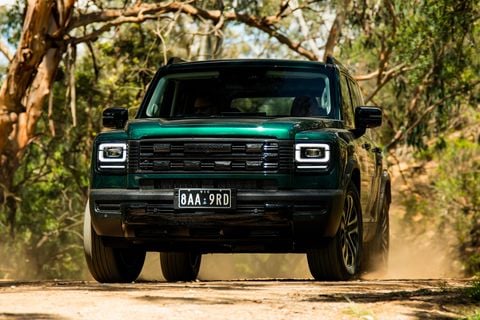
Land Rover Defender looks for under half the price? The new Haval H7 offers insane value, a classic 4WD design and car-based SUV manners on the road.

CarExpert's take on the Haval H7
Good
While it doesn't deliver proper 4WD levels of capability, the H7's Rob Trubiani-fettled chassis offers competent ride and handling, while the boxy body is surprisingly well finished inside for the money. Skip the HEV with its occasionally quirky powertrain and go straight for the more powerful PHEV.
What we love
- Excellent value for money
- Tough, 4WD-inspired looks
- PHEV's powerful performance
Worth a thought
- HEV's fuel use, throttle quirks
- Light-duty towing capacity
- Occasionally busy ride
Are there other rating labels?
- Excellent
- An outstanding car in almost every way. A joy to drive, packed with great features, and highly recommended.
- Very Good
- A well-rounded car that's enjoyable to drive, offers great value or features, and is easy to recommend.
- Good
- A solid choice that does most things well. Comfortable, capable, and worth considering in this segment.
- Average
- Meets the standard for this segment. May not stand out, but still a dependable and reasonable option.
- Below Average
- Falls a bit behind others in the segment, but still passes safety checks and may suit specific needs or budgets.
Introduction
Is it a Jeep, or a Land Rover? No, it's a... GWM!
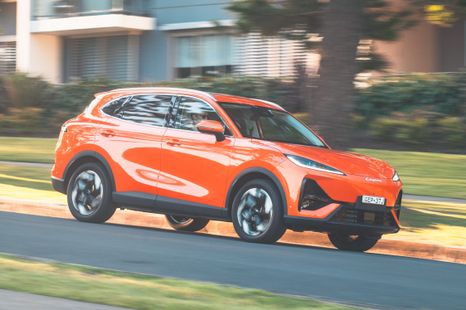
The new 2027 GWM Haval H7 has arrived in Australia and it's a proper departure from its unloved predecessor. Gone are the bulgy 'Big Dog' looks in favour of a square, boxy mid-size SUV that has a very classic off-roader vibe about it, and it comes exclusively with electrified powertrains – both hybrid (HEV) and plug-in hybrid (PHEV).
Not to accuse anyone of copying, but there are pretty distinct hints of Land Rover Defender and Jeep Wrangler about the design, which certainly should appeal to Australia's more adventurous SUV buyer demographic.
Similarities with existing off-road icons or not, the new H7 has certainly resonated with buyers, at least according to GWM, which has reported record pre-launch interest – more than any other GWM model before it, in fact. Part of the reason for that is likely the price – you can get into one of these for as little as $45,990 drive-away, while the PHEV kicks off from $49,990 drive-away.
But those thinking this is a cheap, hybridised rival for the Toyota Prado will need to think again, because the new H7 is more or less a Chinese-market Haval H6L – a monocoque (car-based) medium SUV that's more or less the likely successor to the existing Haval H6 in Australia.
A unibody platform under its rugged-looking body means the H7 isn't as capable as larger off-road SUVs like the Ford Everest or even GWM's own Tank 300, but the Chinese brand is confident its chunky looks and mildly improved off-road performance over the H6 will be enough to sway many Australian buyers – to the tune of a projected 1000 sales per month.
Does it drive as good as it looks? We joined the Australian media drive in Melbourne to find out.
How much does the GWM Haval H7 cost?
The 2027 GWM Haval H7 range kicks off from $45,990 drive-away for the base Lux Hybrid (HEV), while the Lux PHEV starts from $49,990 drive-away – both introductory offers for "a limited time".
| Model | Drive-away pricing | Introductory drive-away pricing |
|---|---|---|
| 2027 GWM Haval H7 Lux HEV AWD | $46,990 | $45,990 |
| 2027 GWM Haval H7 Vanta HEV AWD | $49,990 | - |
| 2027 GWM Haval H7 Lux PHEV AWD | $50,990 | $49,990 |
| 2027 GWM Haval H7 Vanta PHEV AWD | $53,990 | - |
Even after the introductory offer lapses (at an undisclosed date at this point in time), the H7 HEV and PHEV both represent compelling value for money alongside the mid-size SUV segment stalwarts, particularly the electrified ones.
If you want a top-selling Toyota RAV4 Hybrid, you'll barely get a base GX FWD for the price of the H7 Lux PHEV, and the same goes for the Subaru Forester Hybrid – noting that both of these models are not plug-in vehicles with EV driving capability.
If you're looking at a PHEV alternative, the Mitsubishi Outlander Plug-in Hybrid EV starts from $58,990 before on-road costs for the base ES. The higher-spec Exceed grades kick off at over $70,000 plus on-roads, for reference.
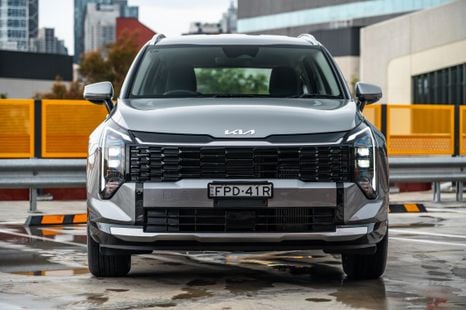
While the H7 measures 4680mm long without its rear-mounted spare wheel, it's also worth noting that its 4800mm overall length and 1950mm width puts it in the same dimensional ballpark as larger car-based SUVs like the Kia Sorento, which like the Haval offers both HEV and PHEV powertrains in addition to turbo-diesel options. It's also more expensive, though it offers three rows of seating, which the GWM lacks. The Sorento HEV range kicks off from $59,490 drive-away, while the Sorento PHEV starts at $69,990 drive-away.
To see how the GWM Haval H7 lines up against the competition, check out our comparison tool
What is the GWM Haval H7 like on the inside?
Bluff fascias, straight lines and big digital displays dominate the front of the new H7's spacious, boxy cabin.
Compared to its predecessor, the new H7 gets a much cleaner interior design which draws clear inspiration from the likes of the Defender with a crossbeam-style dash and exposed screws, while integrating the Chinese brand's latest tech and design elements.
General build and material quality feels good, and the available Apricot leatherette seat upholstery – only available with Emerald Green and Phantom Black exterior paints – brings something a little different, though it won't be for everyone.
There's a real focus on display technology, with the 12.3-inch digital instrument cluster augmented by a big 15.6-inch touchscreen infotainment system, both powered by GWM's latest Coffee OS software which feels at least two generations ahead of the system it replaces.
While the design and layout of the interface is somewhat derivative and could be confused with a number of systems from other Chinese brands, response to inputs and overall user-friendliness is a marked improvement.
Wireless Apple CarPlay worked seamlessly during our day with the H7, and embedded navigation and DAB+ digital radio functionality mean you don't haven't to rely on your smartphone to power the interface.
There are quick-access shortcuts to toggle the homescreen, where you can configure different widgets and get a live projection of your vehicle, with virtual buttons to open the sunroof and tailgate. Annoyingly, however, the former is in lieu of physical switches for the sunshade and opening glass roof.
Thankfully, GWM has listened to customer feedback and retained a bank of physical toggle switches beneath the display for functions like temperature, fan adjustment and air recirculation to bolster the permanent virtual toolbar on the touchscreen.
Another thing I noticed is that when using Apple CarPlay you cannot swipe down from the top of the display to get quick access to notifications or the touchscreen's control centre, which toggles various vehicle functions.
I'm also impressed with the new digital driver's display, which feels much more mature and sophisticated than in GWM's previous-generation products, and is infinitely more configurable and attractive than before.
You can choose from several layouts, my personal pick of which are the virtual dials, though you can also sub in a map display for better visibility of navigation as well as off-road meters. The colours, clarity and refresh rates of this new display are really good – and the contrast is great in dark mode.
Top-spec Vanta versions add a projector-type head-up display for the driver, but oddly there's no EV symbol to show you when the vehicle is solely operating on battery power.
I say this because when the H7 is in 'EV Priority' mode, the 'EV' script in the dash is signifying the selected powertrain profile, not the powertrain operation mode as it still says EV while the petrol motor is running to send charge to the battery.
Other little Easter eggs throughout the cabin include the H7 graphic on the dashboard, while there are nice touches like the strap-look bottle holders in the doors.
Storage is pretty good throughout the cabin, with a slew of cubbies and holders for your odds and ends, including a rubberised shelf for your phone with a wireless charging pad, a shelf ahead of the front passenger integrated into the dashboard fascia, big cupholders and a storage nook under the bridge-type centre console.
A powered driver's seat is standard, but to get electric adjustment for the front passenger you'll need to opt for the flagship Vanta, which you'll also need to do if you want memory presets or heating and ventilation functions.
One thing worth noting is that GWM has finally added tilt adjustment for the driver's seat base, which is a godsend if you're lanky and long-legged like me.
Despite its hefty size on paper, the Haval H7 is launching strictly as a five-seater for now. There is a longer three-row version sold in China known as the Raptor Plus, which is under consideration for a future launch in Australia, where it's likely to be called the H7L if it comes here.
The tall and boxy profile means there's a spacious and airy feel in both rows, with the rear seats offering a good amount of space for adults behind adults. The flat floor and wide centre seat mean you could fit three of them across at a pinch if you need to as well – though the centre console does protrude a tad.
You get directional air vents back there, as well as USB-A and -C charging ports to keep devices juiced. Map pockets behind the front seats also feature, as do bottle holders in the doors and a fold-down centre armrest with additional cupholders.
For child seats, there are requisite ISOFIX anchors in the outboard rear seating positions, and top-tether points on the backs of all three rear seats.
Further back, while there's no third row of seating, there is a handy 586 litres of cargo capacity with the second row in use, expanding to 1404L with the rear seatbacks folded down.
GWM doesn't quote a measurement method, but given the shape and physical size of the boot we would presume both of those figures are measured to the roof.
It's a nice and square load area, but there's no cargo cover or blind to hide your stuff out of sight, despite the tall windows. The rear seatbacks also don't fold quite flat, though the load floor is level with them so there's no awkward step if you need to load in longer items.
There's not much in the way of underfloor storage, but thankfully there's a full-size spare wheel mounted very conspicuously on the tailgate.
| Dimensions | GWM Haval H7 |
|---|---|
| Length | 4800mm |
| Width | 1950mm |
| Height | 1843mm |
| Wheelbase | 2738mm |
| Wading depth | 580mm |
| Cargo capacity | 586L – Rear seats up 1404L – Rear seats folded |
To see how the GWM Haval H7 lines up against the competition, check out our comparison tool
What's under the bonnet?
Both the H7 HEV and PHEV incorporate a turbocharged 1.5-litre petrol engine teamed with two electric motors and a battery pack.
| Specifications | H7 HEV | H7 PHEV |
|---|---|---|
| Engine | 1.5L 4cyl turbo-petrol | 1.5L 4cyl turbo-petrol |
| Engine outputs | 110kW + 240Nm | 110kW + 240Nm |
| Electric motor outputs | Front: 80kW + 170Nm Rear: 130kW + 260Nm | Front: 80kW + 170Nm Rear: 150kW + 260Nm |
| System outputs | 182kW + 670Nm | 320kW + 670Nm |
| Battery | 1.53kWh li-ion | 33.7kWh LFP |
| Transmission | 4-speed DHT | 4-speed DHT |
| Drive type | AWD | AWD |
| Weight | 1970kg – Kerb | 2150kg – Kerb |
| Payload | 500kg | 500kg |
| 0-100km/h (claimed) | 7.0 seconds | 4.9 seconds |
| Fuel economy (WLTP) | 7.0L/100km – WLTP | 0.9L/100km – Combined 7.49L/100km – Charge sustaining |
| Energy consumption (claimed) | - | 24.2kWh/100km |
| Fuel economy (as tested) | 8.3L/100km | 6.1L/100km – HEV mode |
| Electric driving range | - | 137km – WLTP |
| Fuel tank capacity | 55L | 55L |
| Fuel requirement | 91-octane regular unleaded | 91-octane regular unleaded |
| CO2 emissions | 159g/km | 19g/km |
| Emissions standard | Euro 6 | Euro 6 |
| Braked tow capacity | 1500kg | 1500kg |
To see how the GWM Haval H7 lines up against the competition, check out our comparison tool
How does the GWM Haval H7 drive?
While it's pitched as a more capable mid-size SUV than most, the H7's launch drive program included mostly mixed on-road conditions with a couple of unsealed roads thrown in.
We started in the H7 HEV, driving from Essendon Fields in Melbourne's north out to Healesville in the east, followed by a return journey in the PHEV.
The route including freeway driving on the Metropolitan Ring Road, and then a mix of suburban and B-roads out to Healesville, in addition to a couple of aforementioned gravel sections.
From behind the wheel the H7 HEV drives and feels very much like a larger H6 HEV, with the same general characteristics in terms of powertrain response.
It's obviously a physically larger vehicle, but chassis tuning (in China, not locally) by Rob Trubiani – who previously led Holden's vehicle dynamics department – has definitely ironed out the disjointed and often clumsy feel of older GWM models.
There's a sense of security and stability from the road holding, even if there's a slight firmness to the primary ride that transmits most smaller road imperfections through the seat, and it settles quite nicely on the highway.
The steering is accurate and nicely weighted, so the H7 handles with confidence and maturity in the 'burbs and on winding B-roads. Truthfully, it's a world away from the old one.
Body control is also well-sorted given this is a tall SUV with a 210mm standard ride height, never feeling topsy-turvy or wobbly when changing direction or traversing tighter turns. Body lean is predictable and nicely controlled in bends.
Powertrain performance isn't too bad for such a large vehicle, with the H7 Hybrid's quoted 182kW/670Nm outputs providing more than enough shove to get this near-2.0-tonne SUV moving without feeling lethargic or underpowered – as some ladder-frame off-road SUVs often do.
That said, a familiar quirk with GWM's hybrid system remains. On a couple of occasions on both road and dirt we noticed the handover between EV and ICE power would elicit a surging response from the powertrain at sustained low-throttle openings, going from about 20 per cent to nearly 80 per cent of peak power without really changing pedal inputs.
Further, GWM's four-speed 'Direct Hybrid Transmission' occasionally gets caught out when you suddenly put your foot down and demand all the powertrain has to give. If you're driving with measure at lower speeds though, it generally does its job quietly in the background.
It was particularly noticeable on the gravel, as the trails we covered included a number of tight turns before an uphill climb. We're hoping this is an easy fix with a software update that amends throttle calibration.
Speaking of the dirt, the standard 19-inch wheels shod in 255/60 R19 Kumho rubber on the HEV proved very capable on unsealed roads, providing impressive stability and traction despite intermittent rain and a damp road surface.
It really required intervention from the traction and stability control systems, though there were one or two occasions when the traction control cut power quite suddenly when it detected slip while exiting turns, which was a bit annoying.
Otherwise though, the high ground clearance and solid road-holding should inspire confidence if you're looking for a medium-large SUV with mild off-road capability.
Sadly, we didn't get a chance to properly test out its capability on more difficult trails.
| Off-road dimensions | GWM Haval H7 |
|---|---|
| Ground clearance | 210mm |
| Approach angle | 25 degrees |
| Departure angle | 32 degrees |
| Ramp breakover angle | 20 degrees |
| Wading depth | 580mm |
The Haval H7 offers no less than eight drive modes, from Eco, Normal and Sport through to 4WD, Snow, Mud, Sand and Towing. Each optimises the powertrain and on-board electronics for the desired profile and driving conditions.
Eco is far too lethargic for anything other than low-speed city driving, while Sport primes the ICE and electric motors for full power and holds revs for better response. Normal is best for most of the time.
There are also EV, EV Priority and HEV modes, allowing you to choose your desired mix of power sources. Once usable charge has depleted, EV Priority will mimic a series hybrid, using the electric motors to do the bulk of the driving, though you'll hear the petrol engine kick in.
Switching into the PHEV for the return leg, there's a more EV-first feel to the powertrain performance and you do notice the extra 180kg or so of weight from the larger battery.
That said, the floor-mounted power storage unit helps to lower the centre of gravity, and the added power of the PHEV's drivetrain makes it feel significantly peppier, particularly in Sport mode – GWM also claims 4.9 seconds from 0-100km/h. Even if that's half a second off, it's still quick for this segment
The aforementioned EV-first powertrain character largely alleviates that surging sensation we noted in the HEV, while also contributing to a quieter cabin under acceleration and at speed, delivering improved refinement.
We never really got close to GWM's official fuel consumption claims with either powertrain, though to be fair we weren't driving in real-world conditions given the bulk of our route was winding, high-speed B-roads.
Both models also have an odd pedestrian alert sound that plays at low speeds while the vehicle is relying on electric power. It sounds like the Pull Stars in Super Mario Galaxy – if you know, you know.
We'll need more time with the Haval H7 to test its efficiency in everyday conditions, and find out whether the PHEV's claim of 130km-plus on battery power alone is an achievable one.
On the assistance front, the H7's suite of active safety systems are refreshingly non-invasive for a Chinese product, and generally work well without any hiccups.
The Intelligent Cruise Assist combines adaptive cruise and lane-centring functions for semi-autonomous highway driving capability, and it's actually a pretty accurate and reliable system.
Activating it is a little fiddly though – you have to double-flick the gear selector stalk down twice, and to resume after braking or cancelling you have to hold it down for a moment or two, which I needed to Google to find out as there's no obvious symbol or label.
Beyond that, the only other gripe is that the driver attention monitor will audibly and visually prompt you to take a break if you yawn – which can also be triggered by opening your mouth wide when you're making a funny face or belting out a long note during the climax of your favourite Mariah Carey ballad...
The H7's assistance suite is rounded out by all the usual suspects, including blind-spot monitoring and rear cross-traffic alert, a standard surround-view camera system with 3D View and transparent chassis function, traffic sign recognition and Door Open Warning.
GWM has fitted the SUV with 18 sensors to power these systems, including four surround cameras, four front and four rear anti-collision radars, one forward-facing ADAS camera, as well as five millimeter-wave radars.
To see how the GWM Haval H7 lines up against the competition, check out our comparison tool
What do you get?
Both the HEV and PHEV powertrains are offered in Lux and Vanta trim levels.
2027 GWM Haval H7 Lux highlights:
- 19-inch alloy wheels
- Full-size spare
- Automatic LED headlights
- Automatic high-beam
- Power-folding exterior mirrors
- Proximity entry and start
- Launch control
- Hill descent control
- Electronic park brake with auto hold
- 8 drive modes – Normal, Eco, Sport, 4WD, Snow, Sand, Mud, Towing
- 12.3-inch digital instrument cluster
- 15.6-inch touchscreen infotainment system with Coffee OS
- Wireless Apple CarPlay, Android Auto
- DAB+ digital radio
- 8-speaker sound system
- Leatherette seat upholstery
- 6-way power driver's seat with 2-way power lumbar
- Steering wheel tilt and reach adjustment
- Wireless phone charger
2027 GWM Haval H7 Vanta adds:
- Rear privacy glass
- Gloss-black door handles, mirrors, bumper trim
- Matte-black badging
- Head-up display
- Heated steering wheel
- Auto-dimming rear-view mirror
- 8-way power driver's seat with memory, welcome function, 4-way power lumbar
- 4-way power passenger seat
- Heated and ventilated front seats
- Ambient lighting
- 10-speaker sound system
To see how the GWM Haval H7 lines up against the competition, check out our comparison tool
Is the GWM Haval H7 safe?
The GWM Haval H7 is currently unrated by ANCAP, though company representatives say they're actively working with the independent safety authority to get it tested and rated.
While a safety rating has not yet been announced, GWM says it has "high expectation of a five-star ANCAP result", in line with the rest of its current models.
Standard safety equipment includes:
- 7 airbags incl. front-centre
- Adaptive cruise control
- Autonomous emergency braking – AEB
- Blind-spot monitoring
- Driver fatigue monitoring
- Emergency lane-keep assist
- Lane-keep assist
- Parking sensors – front, rear
- Rear cross-traffic assist
- Safe exit warning
- Surround-view cameras
- Traffic sign recognition
- Traffic jam assist
- Tyre pressure monitoring
As noted earlier, the H7 is fitted with 18 sensors to power its assistance and active safety systems, including four surround cameras, four front and four rear anti-collision radars, one forward-facing ADAS camera, as well as five millimeter-wave radars.
To see how the GWM Haval H7 lines up against the competition, check out our comparison tool
How much does the GWM Haval H7 cost to run?
The GWM Haval H7 is covered by the Chinese brand's seven-year, unlimited-kilometre warranty, with roadside assistance and capped-price servicing for the same duration.
| Servicing and Warranty | GWM Haval H7 |
|---|---|
| Warranty | 7 years, unlimited kilometres – Vehicle 8 years, unlimited kilometres – HV battery |
| Roadside assistance | 7 years |
| Service intervals | 12 months or 10,000km – First 12 months or 15,000km – Second thereafter |
| Capped-price servicing | 7 years |
| Average annual service cost | $460 |
| Total capped-price service cost | $3220 – 7 years |
To see how the GWM Haval H7 lines up against the competition, check out our comparison tool
CarExpert's Take on the GWM Haval H7
It won't give a Prado or a Defender sleepless nights, but the H7 carves out its own path in the burgeoning mainstream mid-size SUV segment.
Tough off-roader looks, electrified powertrains and incredible value for money are highlights. It's also spacious, comfortable and pretty refined to drive – namely the PHEV.
While we can't verify whether the increased ground clearance and improved off-road angles relative to, say, the smaller H6 are worth it, the design inside and out will appeal to those in the market for an iconic 4WD design, even if it mimics the real thing.
Sure there are niggles, such as the hybrid's power delivery quirks and the occasionally busy ride, or the driver attention monitor that doesn't like you really getting into carpool karaoke. But really, there's not a lot to complain about here – especially considering the price.
While the new H7 may not surpass the segment-leaders in many respects, it's a solid all-rounder with an arguably unbeatable value equation, wrapped in a body that's truly unique at this end of the market.
If you don't need proper off-roading or towing capability – which would require you to look at a Tank 300/500 or even an entry-level Everest – the GWM Haval H7 has plenty to offer, and more cool factor than the equivalent H6 HEV or PHEV.
The PHEV is our pick, and you may as well get the Vanta with all the fruit while you're at it.
CarExpert can save you thousands on a new GWM Haval H7. Click here to get a great deal.
Click the images for the full gallery









 Automotive Vehicle Spec Data & 4K images Powered by JATO Dynamics Ltd