





2027 BMW 7 Series review: Quick drive
BMW's Neue Klasse revolution has reached its flagship limousine, bringing a fresh look and new technology as part of a comprehensive facelift.

CarExpert's take on the 7 Series
Very Good
What we love
- Cleaner exterior styling
- Special rear-seat experience
- Agility belies size
Worth a thought
- Standout features cost extra
- Not special enough up front
- Digital controls undermine tactility
Are there other rating labels?
- Excellent
- An outstanding car in almost every way. A joy to drive, packed with great features, and highly recommended.
- Very Good
- A well-rounded car that's enjoyable to drive, offers great value or features, and is easy to recommend.
- Good
- A solid choice that does most things well. Comfortable, capable, and worth considering in this segment.
- Average
- Meets the standard for this segment. May not stand out, but still a dependable and reasonable option.
- Below Average
- Falls a bit behind others in the segment, but still passes safety checks and may suit specific needs or budgets.
Introduction
It seems only fitting that the 7 Series luxury limousine – BMW's traditional flagship model – should receive the biggest mid-life overhaul in the Bavarian brand's history.
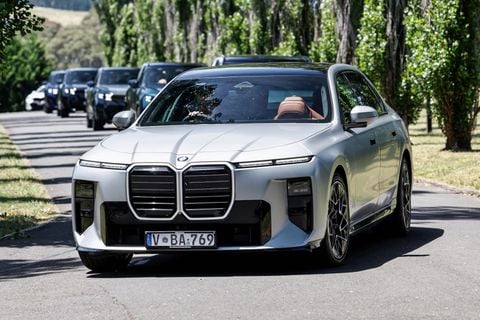
Transformed to align with – and lead – BMW's Neue Klasse revolution, the facelifted G70-generation 7 Series and i7 remain recognisable from the outside, albeit with revised front-end styling, fresh lighting treatments, and the option of new BMW Individual two-tone paint finishes. All of which improve its look, in my humble opinion.
Inside, however, the changes are far more extensive. The interior has been thoroughly redesigned, gaining new steering wheel options, Panoramic iDrive, and a 14.6-inch front passenger touchscreen – the first for BMW – as standard across the range.
It's a case of evolution rather than revolution in the second row, with the rear entertainment screen picking up BMW's latest-generation processor.
From a mechanical perspective, the i7 benefits most, scoring a new 112.5kWh battery (up from 105.7kWh) using the latest ‘Gen6’ cylindrical cell technology from the iX3 and upcoming i3. As a result, it can travel further and charge faster than before.
The petrol-powered 740 hasn't been overlooked, either, with its turbocharged inline-six engine tweaked to deliver more punch while consuming less fuel.
That all sounds like a recipe for success, but Mercedes-Benz has made similarly sweeping changes to its rival S-Class.
So, is the 7 Series up for the fight? A brief introduction to the updated 740 on the roads of rural New South Wales revealed plenty.
How much does the BMW 7 Series cost?
The petrol-powered 740 comes in $5000 dearer than the outgoing 740i M Sport, while the electric i7 60 xDrive wears the same price tag as the pre-update model.
| Model | Price before on-road costs |
|---|---|
| 2027 BMW 740 | $277,900 |
| 2027 BMW i7 60 xDrive | $306,900 |
More broadly, the 740 essentially competes in a class of three with the S-Class (from $264,200 before ORCs) and Lexus LS (from $204,695 before ORCs), both of which were also recently updated. The i7 also goes up against the electric Mercedes-Benz EQS (from $184,900 before ORCs).
Audi long had a say in this segment with the A8, though Australian sales of the fourth-generation model ceased last year.
Compare the BMW 7 Series
Want to see how the BMW 7 Series lines up against the competition?
Use our comparison tool for a side-by-side look at the specs, features and prices of the 7 Series and its rivals.

What is the BMW 7 Series like on the inside?
Automatic doors and an external 'ceremonial light carpet' set the tone, reminding all who enter the 7 Series of their VIP status, driver included.
But, after slipping into the driver's seat, I was initially left underwhelmed.
Not because the cabin disappoints in isolation – far from it – but because the layout, key controls and technology suite felt strikingly similar to those of the half-priced X5 we'd driven just hours earlier.
Indeed, there's a strong family resemblance across BMW's latest generation of vehicles.
That means the dashboard houses BMW's new Panoramic iDrive system, featuring a 17.9-inch central touchscreen, a separate passenger screen, a head-up display (HUD), and a Panoramic Vision display that shows a customisable set of key information including speed, trip data, and navigation directions across the base of the windscreen.
By contrast, the outgoing 7 Series presented with just a single, wraparound screen housing supported by a HUD, so the scope of the changes is significant.
For the tech-savvy, there's a lot to appreciate here.
The quality of the visuals across all the displays is first class, and a definite leap over the old car, while the quirky parallelogram infotainment screen is easy to reach and brimming with functionality including native satellite navigation, wireless smartphone mirroring and a connected app store.
As is often the case at media launch events, we didn't have enough time to trawl through all the menus and submenus, so question marks remain over its day-to-day usability.
The passenger screen, meanwhile, is actually useful! It bugs me how many aren't, merely mirroring the basic functions of the centre screen, but the system in the 7 Series allows the front passenger to stream video content, play games or even dial in to business meetings on the go, while supporting up to two bluetooth devices – headphones, game controllers, microphones etc. – simultaneously.
Its compatibility with headphones helps to prevent driver distraction, as does a monitor that locks the screen when the steerer glances across at it for longer than 1.5 seconds at a time, or 10s within a 30-second period.
Those who aren't so fond of screens, however, may bemoan the 7's slight shift away from traditional notions of luxury.
The interior materials – a mix of Alcantara, rich, aromatic leathers and metal accents in our test car – are top notch, satisfying several senses, and diamond-patterned ambient lighting strips in the panoramic glass roof deliver huge visual wow-factor.
However, in following the industry trend towards screen-based controls, BMW has missed an opportunity to make its flagship more tactile. Physical switchgear is scarce, and what remains doesn't always hit the spot.
The handcrafted glass toggles for the gear selector and seat adjusters look fancy enough, but don't feel as special as Volvo's old Orrefors crystal knob, and don't get me started on the steering wheel situation...
Three different versions of BMW's new squircle design are available, but all house the same cluttered haptic buttons that are fiddly and easily mistaken. The 'wheel' itself sits nicely enough in the hands, though the standard vertical spokes are both an eyesore and an impediment to some steering manoeuvres.
BMW has thankfully retained its traditional notchy indicator stalk, not that owners use it often...
You know what they do use just about every day? Climate controls, all of which are now screen-based. That's a slight annoyance in itself, made worse by the removal of physical vent adjustment. BMW has softened the blow somewhat by making airflow shortcuts easily accessible.
There's no need to constantly fiddle with the seat heating and ventilation controls, either, as the 7 Series can automatically adjust both to maintain your preferred temperature.
But, that aside, I didn't find the driver's seat to be particularly comfortable. For whatever reason, the backrest seemed to place excessive pressure on my upper back, forcing me into a slightly hunched posture, and prolonged efforts to adjust it away proved fruitless.
Comfort is subjective, of course, but I didn't expect it to be a reason for criticism in a flagship luxury limousine.
One advantage of moving controls to the screen is that it frees up centre console real estate, the 7 Series occupying this space with a roomy split-opening armrest compartment, unremarkable cupholders, and a more noteworthy magnetised wireless charger that powers up phones fast. Additional storage can be found in the door cards and glovebox.
But, all things considered, you'd much rather sit in the second row... provided the right boxes are ticked.
Well, it's one box really - the Connoisseur Lounge Package. Priced at $17,900, this expensive option set includes a reclining lounge seat with a powered leg rest and an extendable footrest on the passenger side, as well as a 31.3-inch fold-down entertainment screen. With both fitted, sitting in the back is like flying first class.
The recliner allows anyone measuring up to a height of around 190cm to stretch out and relax in cloud-like comfort, while both outboard seats offer electric adjustment, heating, ventilation, and massage functions. Soft cushions are attached to the head restraints for an even cushier experience.
Both rear passengers also get their own zone of climate control, as well as shared access to storage under the centre armrest, a set of cupholders, and a choice of wired and wireless device charging options.
Electric blinds cover the side and rear windows, while an overhead shade provides additional protection from the sun and nosey outsiders.
About the only thing missing is a fridge of some sort to keep snacks and beverages cool.
Most rear-seat functions are controlled through individual touchscreens integrated into the door cards. From here, passengers can adjust their seats, climate settings, sunshades and entertainment without much effort.
And it's the aforementioned entertainment system that steals the show. Spanning almost the entire width of the cabin, the updated ultra high-resolution screen supports video streaming, gaming, and even Zoom meetings, boasting outstanding picture quality and a responsive touchscreen interface.
With the blinds drawn and the optional 36-speaker Bowers & Wilkins Diamond sound system – now featuring Dolby Atmos surround sound – in full effect, you may as well be in a private cinema.
Of those 36 speakers, 16 are dedicated to the rear compartment, delivering an impressively immersive audio experience. That said, I wasn't particularly fond of the 4D audio function, which sends vibrations through your back, creating a sensation akin to standing beside a powerful nightclub speaker. Thankfully, the intensity can be reduced or the effect disabled altogether.
Again, up to two sets of bluetooth headphones can connect for a more private viewing experience.
However, there are a couple of drawbacks. The screen won't drop down if the front seats are set too far back, punishing taller drivers. And while impressive in its functionality, the system relies heavily on stable cellular service. Nevertheless, it's the best in-car entertainment offering I've come across, beating out the 17-inch OLED display in the Zeekr 009.
On a more practical note, BMW quotes 540 litres of boot capacity for the updated 740, up on both the S-Class (530L) and Lexus LS (430L).
The 7 Series does not come from the factory with a spare tyre, relying instead on a tyre repair kit.
| Dimensions | BMW 740 |
|---|---|
| Length | 5395mm |
| Width | 1950mm |
| Height | 1550mm |
| Wheelbase | 3215mm |
| Cargo capacity | 540L |
To see how the BMW 7 Series lines up against the competition, check out our comparison tool
What's under the bonnet?
Seven different versions of the new 7 Series, spanning petrol, diesel, mild-hybrid and electric powertrains, were revealed in Germany earlier this year, of which just two are currently offered in Australia.
| Specifications | BMW 740 |
|---|---|
| Engine | 3.0L turbo-petrol inline-six with 48V mild-hybrid assistance |
| Power | 294kW |
| Torque | 580Nm |
| Transmission | 8-speed automatic |
| Drive type | Rear-wheel drive |
| Weight | 2190kg |
| 0-100km/h (claimed) | 5.4 seconds |
| Fuel economy (claimed) | 7.7L/100km |
| Fuel economy (as tested) | 10.2L/100km |
| Fuel tank capacity | 74L |
| Fuel requirement | 95-octane premium unleaded |
| CO2 emissions | 179g/km |
| Emissions standard | EU7 |
As before, the local 7 Series range opens with the 740 – renamed from 740i – which is powered by BMW's venerable B58 turbo-petrol inline-six, now producing an extra 14kW and 40Nm. Mild-hybrid assistance comes from a similarly uprated 13kW/200Nm electric motor.
Despite the higher outputs, there's been a modest improvement in fuel economy, with claimed combined consumption dropping from 7.9L/100km to 7.7L/100km.
Alternatively, buyers can opt for the electric i7 60 xDrive running the same dual-motor all-wheel-drive setup as the outgoing model.
Total system outputs remain unchanged at 400kW and 745Nm, while a larger battery sees range improve from 625km to 727km, based on the WLTP test cycle.
The new Gen6 battery also boosts the i7's maximum DC fast-charging rate to 250kW, up from 195kW.
We weren't afforded the opportunity to drive an i7 on this occasion, but you can check out its full specifications below:
| Specifications | BMW i7 60 xDrive |
|---|---|
| Drivetrain | Dual-motor electric |
| Battery | 111.5kWh nickel manganese cobalt (NMC) |
| Power | 400kW |
| Torque | 745Nm |
| Drive type | All-wheel drive |
| Weight | 2770kg |
| 0-100km/h (claimed) | 4.8 seconds |
| Energy consumption (claimed) | 18.2-21.9kWh/100km |
| Claimed range | 727km |
| Max AC charge rate | 22kW |
| Max DC charge rate | 250kW |
To see how the BMW 7 Series lines up against the competition, check out our comparison tool
How does the BMW 7 Series drive?
In many ways, our first drive – a solo 20-minute country road loop – wasn't reflective of how the car is likely to be used day-to-day.
But by the same token, it was also somewhat fitting, as the 7 Series is a very multi-talented machine.
Of course, it's first and foremost a luxury limousine.
The B58 turbocharged inline-six, while found in some of BMW's sportiest models, has been retuned to meet a different brief in this application. It's a little lazier, smoother, and much quieter, delivering refined performance that's sure to please both driver and passenger.
In a similar vein, overall noise levels are much lower than in the vast majority of passenger cars. The cabin is exceptionally quiet, aided by acoustic glass and generous helpings of insulation.
Then there's the comfort piece. Riding on standard two-axle air suspension with electronically controlled dampers, the 7 Series floats along in a dignified, controlled manner.
The large wheels and low-profile tyres send some vibrations from Australia's coarse rural roads up through the seat bases, but the adaptive dampers do a good job of absorbing harsher impacts from ruts and potholes, far fewer of which litter popular motorways.
Yet, despite its chauffeuring credentials, the 740 is still brimming with BMW DNA. That's to say, it's an 'ultimate driving machine' at heart.
Having not driven a 7 Series previously, I was somewhat expecting a boat on wheels, but that's far from the case.
All the inputs are spot on – both pedals are firm, responsive and progressive, while the steering is relatively light yet precise, contributing to sharp turn-in.
The 740 also feels remarkably agile for a 2.2-tonne limo, even in Comfort mode, with rear-axle steering helping to disguise its considerable size. Indeed, the car seems to shrink around you.
Throw in some rear-wheel-drive dynamics, and there's more fun to be had punting the 740 down a twisty road than you might expect.
That agility has more practical benefits, too, likely easing the burden of everyday urban manoeuvres – slipping into the pickup line at the airport, navigating tight city laneways, parking at a busy shopping centre, and performing the odd U-turn.
In such situations, you'll also experience excellent outward visibility, with easily judged front corners, no significant blind spot, and a chunky rear window.
So, not only does the 7 Series isolate passengers from the outside world – as it very well should – but it also offers the driver the luxury of choice. The everyday can be unsurprisingly effortless or surprisingly engaging, and that's what sets BMW's flagship apart.
To see how the BMW 7 Series lines up against the competition, check out our comparison tool
What do you get?
A technological transformation headlines the equipment changes for the updated 7 Series.
2027 BMW 740 equipment highlights:
- 20-inch alloy wheels
- M Sport Package:
- M Sport brakes with blue calipers
- Sport leather steering wheel
- M front and rear bumpers
- Black exterior trim
- Black side sills
- Black Alcantara headliner
- Adaptive two-axle air suspension
- Rear-wheel steering
- Adaptive LED headlights
- Comfort access
- Soft-close doors
- Four-zone climate control
- Automatic powered bootlid
- 17.9-inch touchscreen infotainment system
- BMW ConnectedDrive
- Connected services
- Dashcam
- Wireless Apple CarPlay and Android Auto
- 3D head-up display
- BMW Panoramic Vision display
- 14.6-inch passenger screen
- 18-speaker Bowers and Wilkins surround sound system
- Wireless smartphone chargers – front and rear
- Multifunction front seats
- Heating
- Ventilation
- Massage
- Position memory
- 'Sky lounge' panoramic glass roof
- Heated steering wheel
- Heated armrests
- Multifunction rear seats
- Executive Lounge rear console
- Electric roller sunblinds – side windows, rear window
- BMW Touch Command rear door displays
The i7 60 xDrive adds:
- 21-inch alloy wheels
- Adaptive Chassis Control Professional
- Active roll stabilisation
- Automatic power-operated doors
- BMW Individual Merino leather or wool and cashmere upholstery
- Executive Lounge rear seating
- BMW IconicSounds Electric
To see how the BMW 7 Series lines up against the competition, check out our comparison tool
Options
BMW 7 Series options include:
- BMW Individual two-tone paintwork: $16,500
- Frozen Tanzanite Blue combination: $20,500
- BMW Individual special request paint: $8600
- 36-speaker Bowers & Wilkins Diamond surround sound system: $12,500
- M Sport Pro Package: No cost
- Black M Sport brake calipers
- M leather steering wheel
- High-gloss Shadow Line exterior trim
- M rear spoiler
- Darkened tail-lights with M logos
BMW 740 options also include:
- First Edition Package (MY27 only): $12,900
- 21-inch BMW Individual alloy wheels
- Two-tone exterior paintwork
- BMW Individual Merino leather or wool and cashmere upholstery
- Alternative 21- and 22-inch alloy wheels: $2600–$4500
- BMW Individual Merino leather with exclusive elements or wool and cashmere upholstery: $18,500
- Connoisseur Lounge Package: $17,900
- Automatic power-operated doors
- 31.3-inch fold-down BMW Theatre Screen
- Executive Lounge rear seating
BMW i7 60 xDrive options also include:
- First Edition Package (MY27 only): No cost
- 21-inch BMW Individual alloy wheels
- Two-tone exterior paintwork
- BMW Individual Merino leather or wool and cashmere upholstery
- Alternative 20-, 21- and 22-inch alloy wheels: No cost
- Alternative BMW Individual upholstery and interior trim finishes: No cost
Is the BMW 7 Series safe?
As has long been the case, the BMW 7 Series and i7 haven’t been crash-tested by ANCAP or Euro NCAP.
Standard safety equipment includes:
- 7 airbags incl. front, front-side, curtain, centre
- Autonomous emergency braking (AEB)
- Pedestrian and cyclist detection
- Junction assist
- Evasive steering assist
- Driving Assistant Plus
- Adaptive cruise control with stop/go
- Steering and Lane Control Assistant – lane-centring
- Lane departure warning
- Lane-keep assist
- Blind-spot monitoring
- Side collision warning and intervention
- Front and rear cross-traffic alert
- Safe exit warning
- Traffic sign recognition
- Driver attention monitoring
- BMW Parking Assistant Professional
- Front and rear parking sensors
- Surround-view cameras
- Automated parking assist
- Remote parking via smartphone
- Reversing Assistant
- Tyre pressure monitoring
- Active pedestrian protection
To see how the BMW 7 Series lines up against the competition, check out our comparison tool
How much does the BMW 7 Series cost to run?
BMW looks after its top-end 7 Series clientele by covering scheduled servicing costs for the first five years of ownership.
| Servicing and Warranty | BMW 7 Series |
|---|---|
| Warranty | 5 years, unlimited kilometres |
| Roadside assistance | 3 years |
| Service intervals | Condition-based (detected by vehicle) |
| Prepaid servicing | 5 years free |
Mercedes-Benz, on the other hand, charges $8090 over the same period – yikes!
Both premium German manufacturers back their vehicles with a five-year, unlimited-kilometre warranty in Australia.
To see how the BMW 7 Series lines up against the competition, check out our comparison tool
CarExpert's Take on the BMW 7 Series
BMW spruiks the 7 Series as “the best car to drive, the best car to be driven in”, and the latest 740 can't be far off on both counts.
As a driving tool, it's the quintessential all-rounder – quiet and comfortable, yet highly competent.
And from the perspective of a passenger, it's hard to beat a climate-controlled, massaging recliner and industry-leading in-car entertainment. I do find it cheeky that BMW charges a decent chunk extra for these headline features, though, given you'd expect a fully loaded flagship to be, well... fully loaded.
And from behind the wheel, the 7 Series feels a little too similar inside to lesser models in the BMW lineup, raising questions over the value in its hefty price tag.
But I guess that's not why you buy one, is it? This is much closer to a 'money no object' purchase, and judged on that basis, the 7er makes a compelling case for itself.
I wouldn't mind getting behind the wheel of an updated S-Class, though, to more thoroughly test BMW's claim. And throw in a Rolls-Royce, any Rolls-Royce, while you're at it.
CarExpert can save you thousands on a new BMW 7 Series. Click here to get a great deal.
Click the images for the full gallery






 Automotive Vehicle Spec Data & 4K images Powered by JATO Dynamics Ltd