




Max Davies
2027 Ford Ranger review
The Ford Ranger remains Australia's favourite ute – and the nation's top-selling model overall – for good reasons, and the Wildtrak V6 is one of them.
7 Hours Ago
Toyota has left plenty on the table with its first ever electric HiLux – a pricey ute with limited utility.

Deputy Road Test Editor
Deputy Road Test Editor
Deputy Road Test Editor
Deputy Road Test Editor
If this is the car for you, we’ll compare offers from trusted dealers, handle the back and forth and manage your purchase from enquiry to delivery.
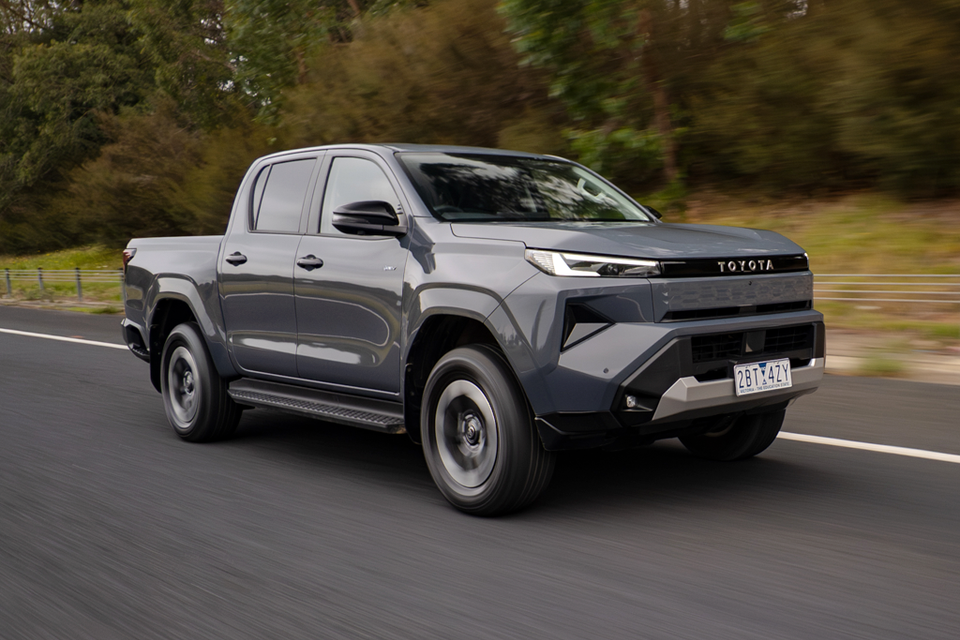
The Toyota HiLux has gone electric – but this isn’t a ute aimed at the average tradie or adventurous family.
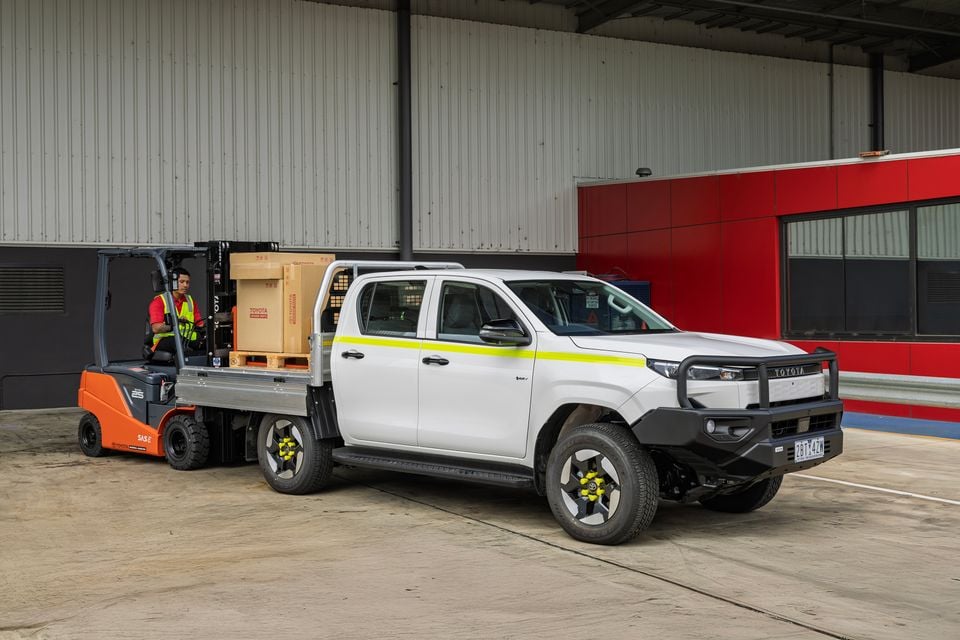
Instead, Toyota’s first battery-powered HiLux has been developed for a very specific audience: mining, business and government fleets that need a workhorse, but also want to reduce their tailpipe emissions – or at least be seen to be doing so.
Early sales tell the story. Around 300 examples have been spoken for since the HiLux BEV went on sale in May, many of them ordered by major mining, energy and infrastructure operators including BHP, Newcastle Coal, Acciona and Essential Energy.
Fewer than 10 – less than three per cent – have been bought by private individuals.
Toyota expects to sell just 500 examples this year – a tiny proportion of total HiLux sales.
That narrow positioning is particularly interesting as plug-in hybrid (PHEV) utes gain momentum in Australia. Toyota says it won’t rush a HiLux PHEV until the technology can meet its standards for payload and heavy towing, leaving buyers who want any form of plug-in HiLux with this or nothing.
With that in mind, does the HiLux BEV do the nameplate proud, or has electrification compromised too much of what makes the HiLux a global icon?
The three BEV variants are the most expensive members of the HiLux lineup, as diesel power tops out at $71,990 before on-road costs in Rogue or Rugged X trim.
| Model | Price before on-road costs |
|---|---|
| 2026 Toyota HiLux BEV SR dual-cab/chassis | $74,990 |
| 2026 Toyota HiLux BEV SR dual-cab pickup | $76,490 |
| 2026 Toyota HiLux BEV SR5 dual-cab pickup | $82,990 |
Other electric utes are thin on the ground, with KGM's Musso EV (from $60,000 drive-away) and the LDV eT60 ($92,990 plus ORCs) being the only alternative in showrooms at this stage.
However, that's set to change soon with the introduction of the MG U9 EV within 12 months, and perhaps the Isuzu D-Max EV and LDV eTerron 9.
To see how the Toyota HiLux lines up against the competition, check out our comparison tool
Almost identical to the equivalent diesel HiLux.
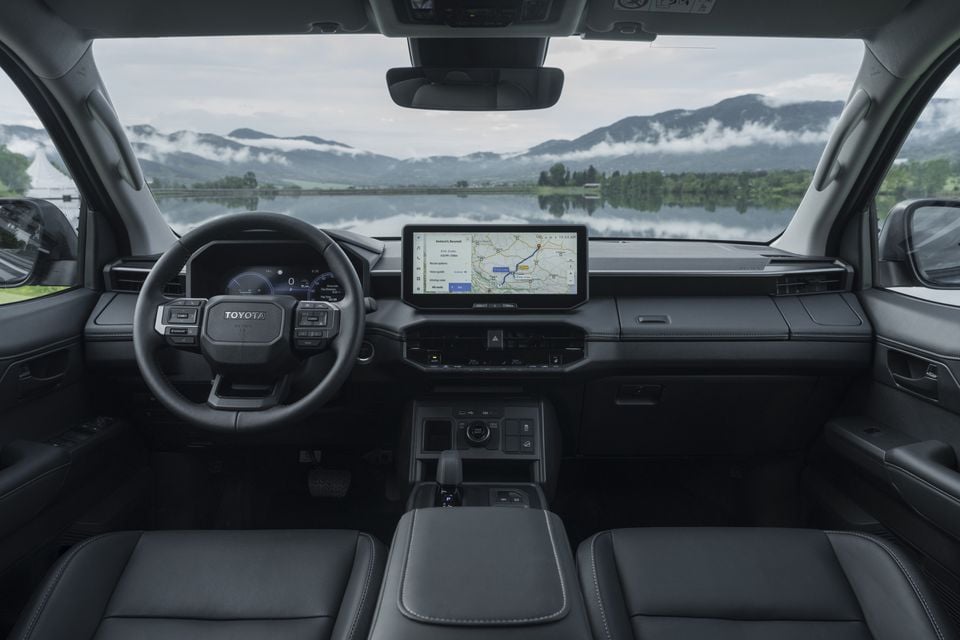
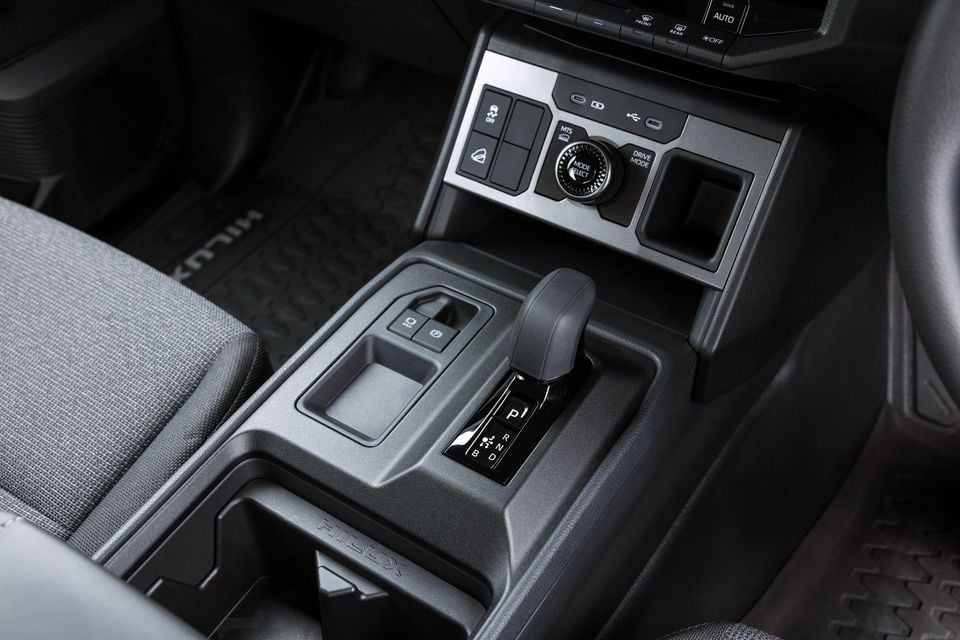
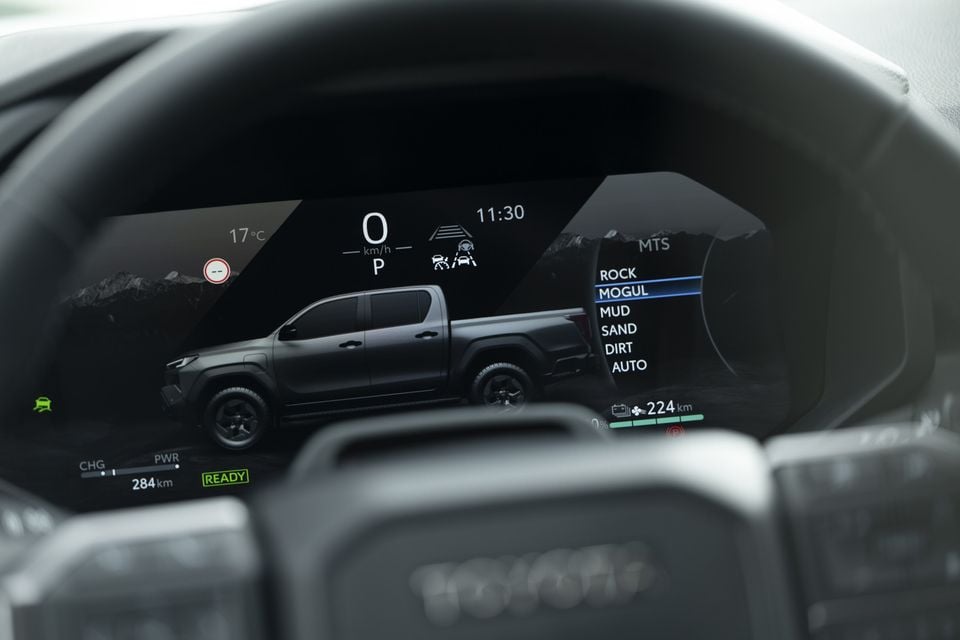
In fact, the only real distinguishing features are a dinky little EV gear selector on the centre console and EV-specific readouts for the digital instrument display.
Otherwise, it's standard HiLux fare. So regardless of specification, the interior feels solid and functional rather than luxurious.
Exhibit A: materials and build quality. The cabin is dominated by plain, hard plastics that are more likely to stand the test of time than impress showroom shoppers, although everything feels firmly screwed together.
The SR5 gets soft door and armrest trims plus carpeted floors, but it doesn't feel like a $90,000 ute inside. A top-spec Kia Tasman, for example, is more plush and around $10k cheaper.
Does cabin material feel matter to fleet operators? Not particularly. But it could dissuade potential private buyers, and plays into a broader value equation that most certainly does matter.
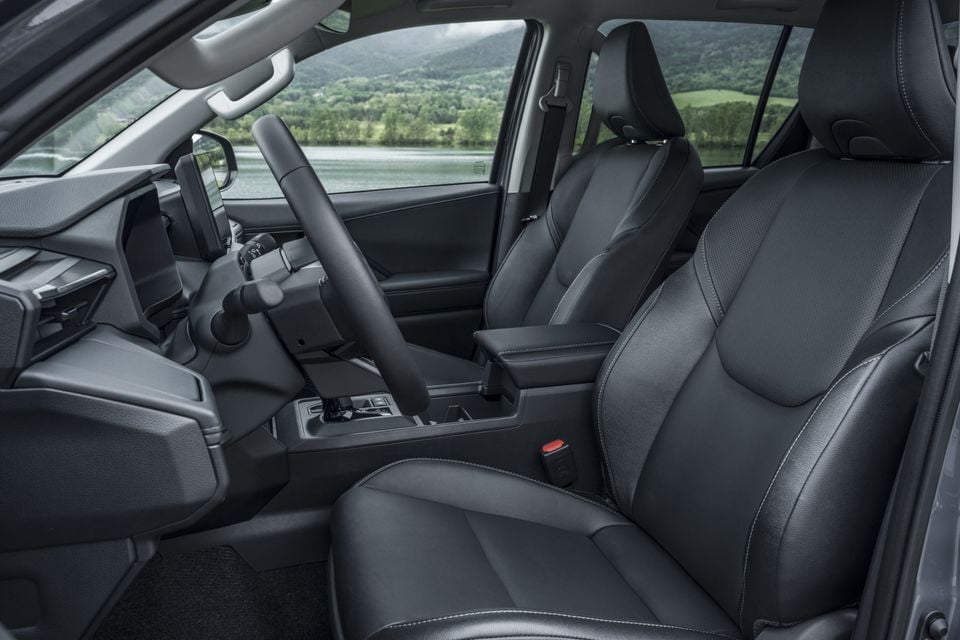
Those who end up behind the wheel of a battery-powered HiLux are at least likely to appreciate the front seats. I was grateful to be allocated an SR5 at the launch event, as it gets spill-resistant leatherette upholstery, seat heating, electric adjustment for all parameters including the angle of the base cushion, and a heated steering wheel. However, the seats in the base SR remain comfortable, given they share the same generous dimensions and cushioning.
The steering wheel offers ample tilt and reach adjust, too, so workers of differing shapes and sizes should be able to find their ideal driving position in quick time.
It doesn’t take long to get acquainted with all the cabin controls, either.
The climate control switches are front and centre – exactly where you expect them to be – while the steering wheel houses a set of separated, clearly labelled buttons linked to cruise control, audio, and phone functions. How straightforward is that!?
Stalks protruding from each side of the steering column take care of everything to do with the lights and wipers, as is tradition.
Behind them sits a big, bright instrument display that presents EV-specific information (eg: battery charge) and a set of configurable gauges.
There are few vehicle segments in which Toyota ranks among the best for tech integration, but this new-generation HiLux bucks that trend by putting mainstay utes such as the Mazda BT-50, Isuzu D-Max, and Mitsubishi Triton to shame.
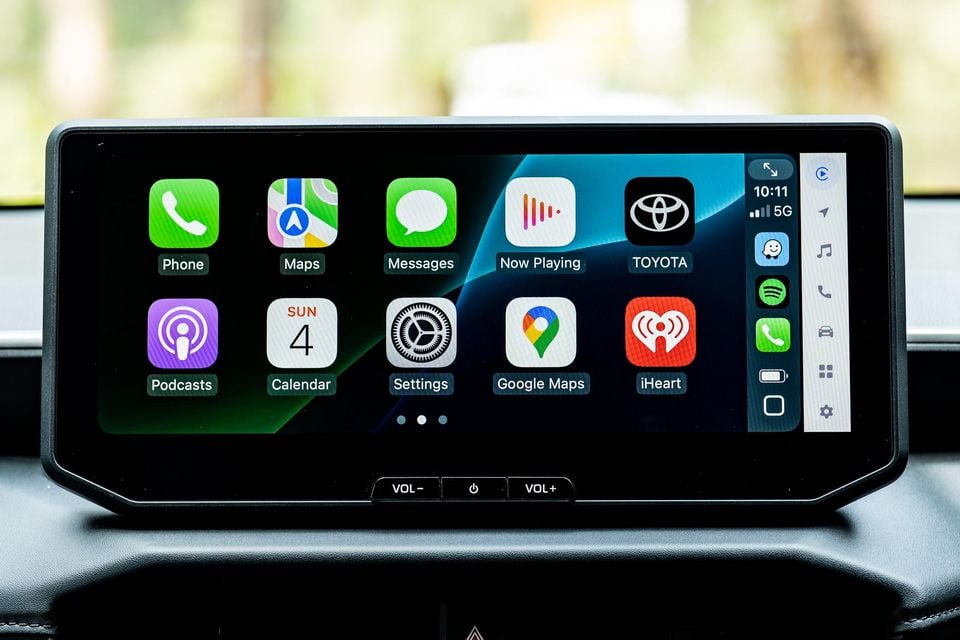
Moving across, the central touchscreen is visually sharp, responsive and mounted high on the dashboard.
Toyota’s interface is basic but easy to navigate, helped by pinned shortcuts down the right-hand side. Wireless Apple CarPlay and Android Auto are standard, which is a must given there isn’t a native app ecosystem.
USB-C ports are fitted in both rows, alongside a 12V socket and a 220V/1500W power source that could prove useful on site.
The inclusion of Toyota Connected Services allows for remote functionalities and EV-specific insights through the myToyota Connect app.
Cabin storage is another strong point.
There are cupholders in the dashboard and centre console, a hidden compartment above the glovebox, a deep bin beneath the centre armrest, a recess for a phone at the bottom of the centre stack, and a sunglasses holder overhead. The door bins are skinny but still take 600ml drink bottles.
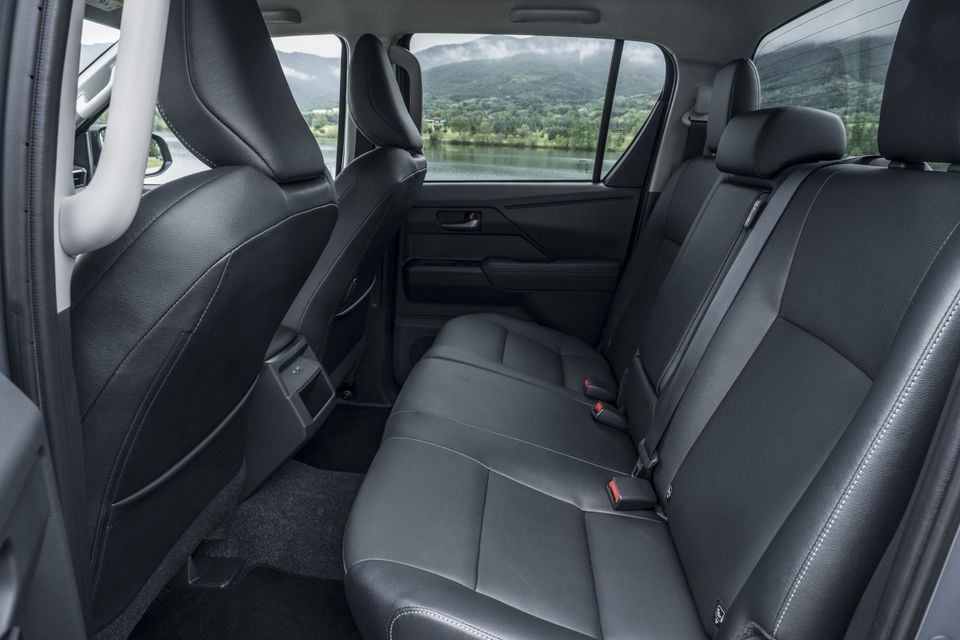
The second row isn't nearly as generous.
Longer-legged adults can fit, thanks to decent toe room and soft front seatbacks that are kinder on knees than hard plastic shells. However, headroom is the main limiting factor, becoming tight for occupants six-two or taller.
Nevertheless, larger utes such as the GWM Cannon Alpha, MG U9, and Kia Tasman are better suited to ferrying passengers.
In a similar vein, the HiLux is light on rear amenities, with only bottle holders, map pockets and a fold-down centre armrest to cover the basics.
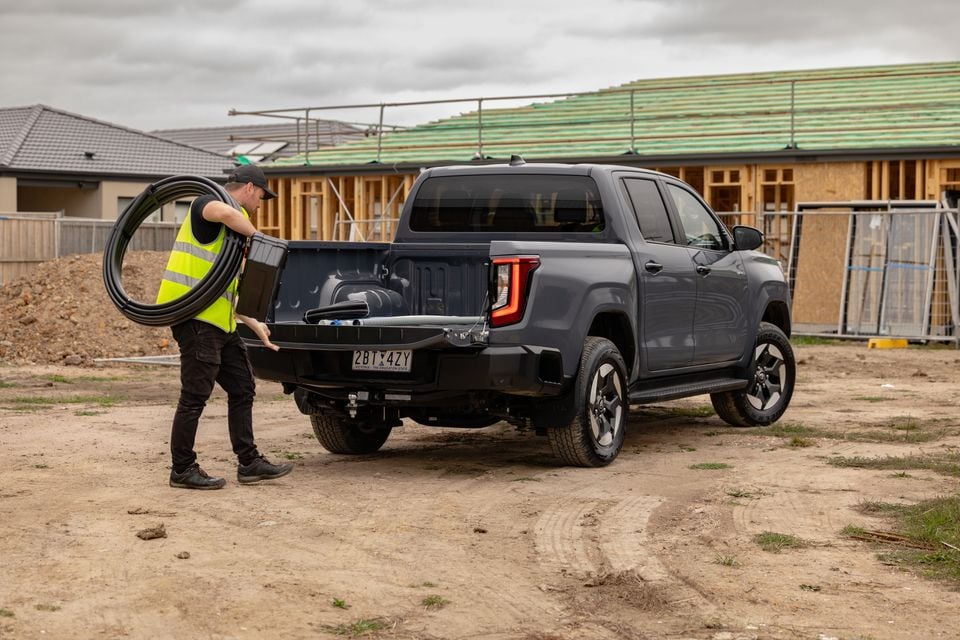
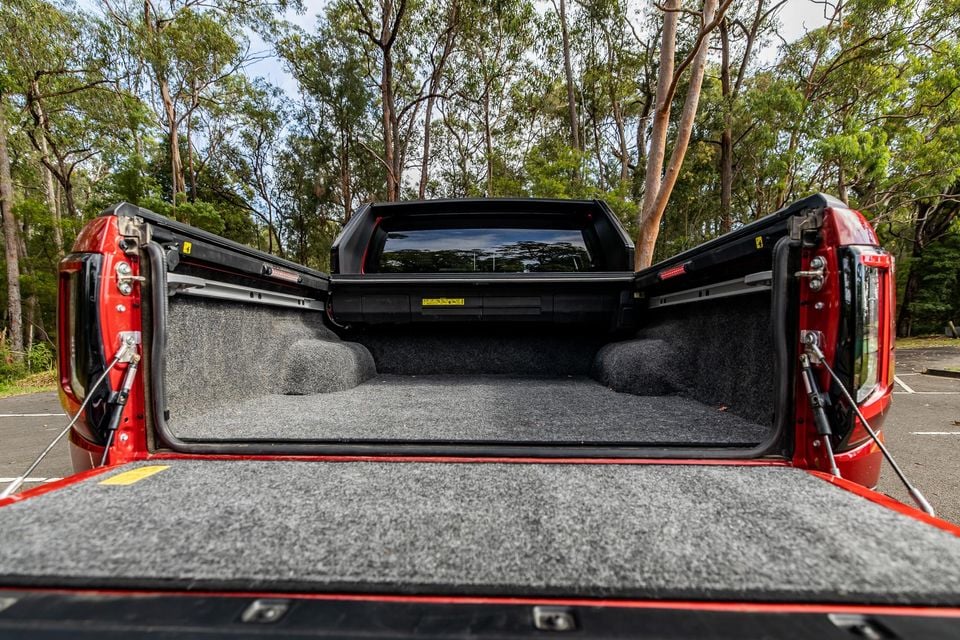
Out back, the tub is hardly brimming with features, either. You get a damped tailgate and a few tie-down hooks, but that's about all.
Payload is capped at a low 725kg for pickup variants, while the Musso EV and Ford Ranger Hybrid both top 800kg.
At least the HiLux comes with a full-size spare wheel, which can't be said of the only other fully electric ute currently on sale.
| Dimensions | Toyota HiLux BEV pickup |
|---|---|
| Length | 5320mm |
| Width | 1855mm |
| Height | 1845mm |
| Wheelbase | 3085mm |
| Tub volume | 1000L (approx.) |
To see how the Toyota HiLux lines up against the competition, check out our comparison tool
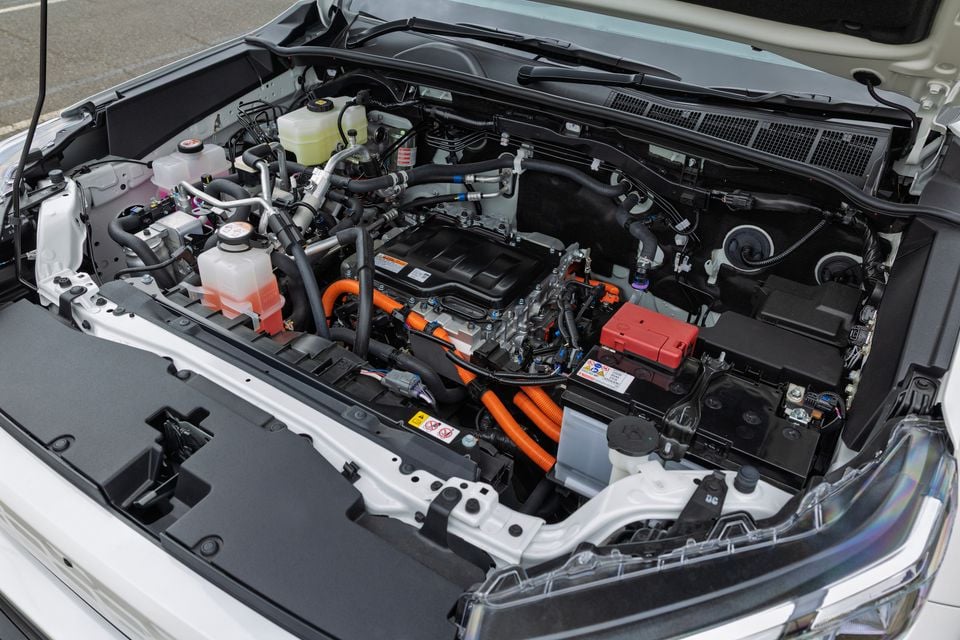
There’s only a dual-motor all-wheel drive powertrain available, incorporating 82kW/206Nm front and 129kW/269Nm rear electric motors for total system outputs of 144kW and 468Nm.
| Specifications | Toyota HiLux BEV pickup |
|---|---|
| Drivetrain | Dual-motor electric |
| Battery | 59.2kWh lithium-ion |
| Power | 144kW |
| Torque | 468Nm |
| Drive type | Electronically controlled all-wheel drive |
| Energy consumption (claimed) | 20.2kWh/100km |
| Energy consumption (as tested) | 23.2kWh/100km |
| Claimed range | 245km – WLTP |
| Max AC charge rate | 10kW |
| Max DC charge rate | 150kW |
| Weight | 2420-2455kg |
| Payload | 715-725kg |
| Braked towing capacity | 2000kg |
| Gross vehicle mass (GVM) | 3145-3170kg |
| Gross combination mass (GCM) | 4670kg |
A diesel HiLux, by contrast, delivers 150kW of power and between 420Nm and 500Nm of torque depending on the transmission.
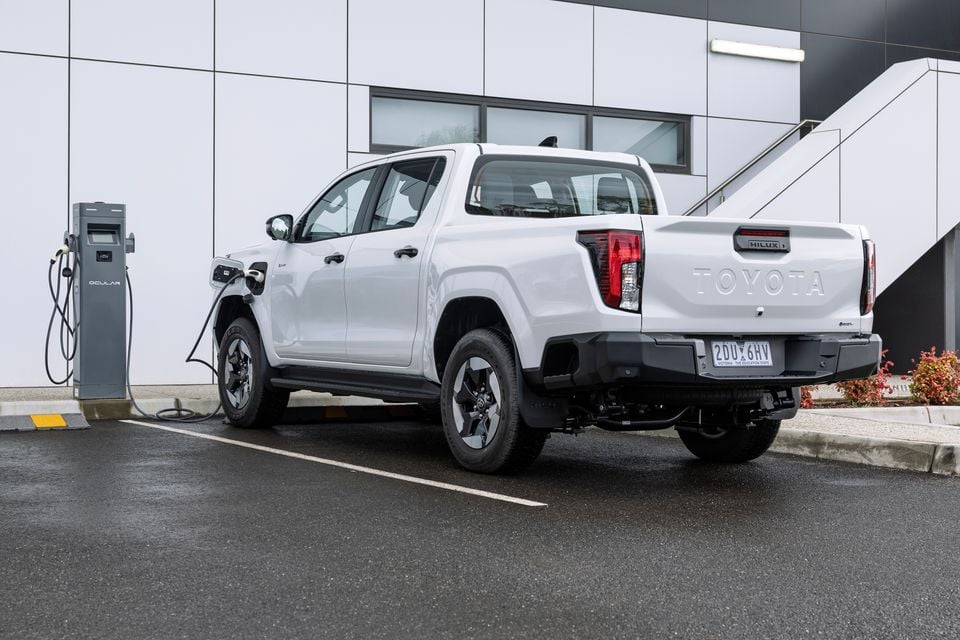
The HiLux BEV has a 59.2kWh lithium-ion battery that can be fast-charged at up to 150kW on DC power, via which a 10 to 80 per cent charge is claimed to take as little as 30 minutes. It also supports 10kW three-phase AC charging, on which a 10 to 100 per cent charge is claimed to take approximately 6.5 hours.
Driving range is capped at 245km for pickup variants, dropping to below 200km for the cab-chassis.
Braked towing capacity is well down on the 3500kg offered by the diesel HiLux and both the MG U9 EV and LDV eTerron 9 expected for Australia.
To see how the Toyota HiLux lines up against the competition, check out our comparison tool
There's still a start/stop button, but don't expect any fanfare, as the HiLux BEV awakens silently.
It's a disconcerting experience given how accustomed we are to the clatter of a turbo-diesel engine, although that uneasy feeling quickly passes once the strengths of electric power begin to shine through.
The first of those strengths is the aforementioned quietness of the powertrain, which makes the HiLux far more pleasant to drive in traffic. While this launch drive was mostly limited to high-speed cruising on country roads plus some off-roading, it's easy to deduce that council, infrastructure and depot-based fleet operators will appreciate this ute's newfound refinement.
There's also huge appeal in how the BEV performs compared to its diesel counterparts. With 468Nm of immediately accessible torque, the battery-powered HiLux responds instantly to throttle inputs with smooth, linear acceleration – unlike that of traditional internal combustion engine (ICE) pickups.
It does, like most EVs, taper off as you approach freeway speeds. However, the BEV remains marginally quicker than diesel variants from 0-100km/h... at least when unladen.
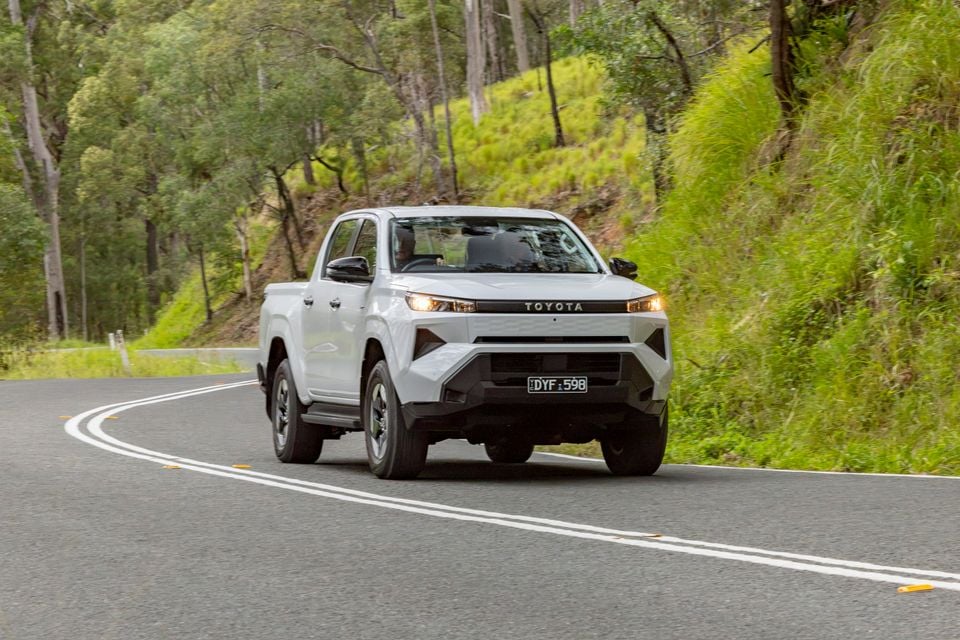
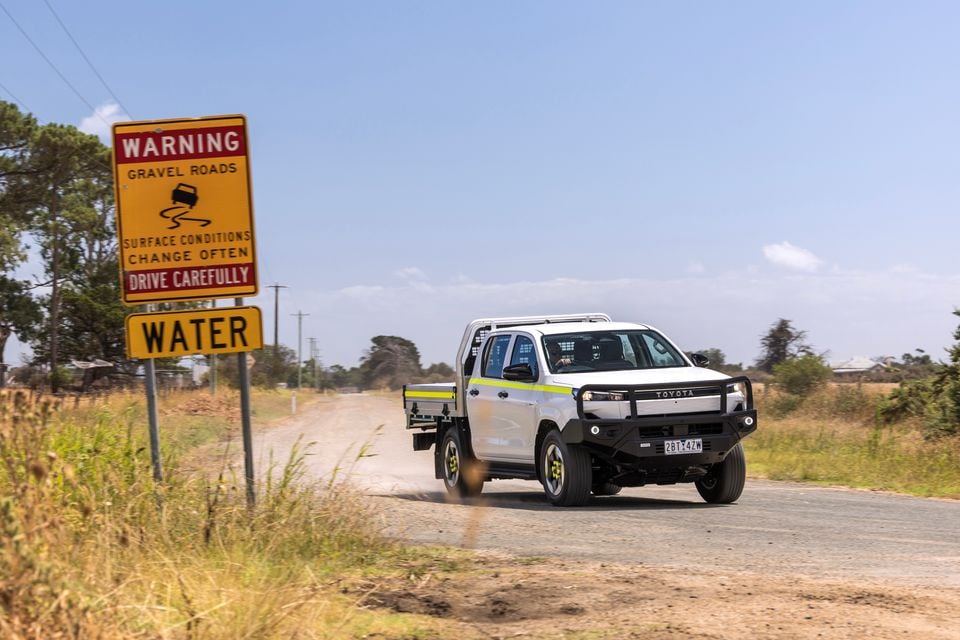
That's a big caveat, because utes are often expected to tow and carry heavy loads. This one, not so much, given its braked towing capacity (2000kg) and payload (715-725kg) are both well down on oil-burning HiLuxs, not to mention other rivals.
It also lacks the ability to cover long distances, with a claimed driving range of just 245km. Add a trailer or some cargo and that figure is likely to plummet. As such, owners and fleet operators will require fast, reliable charging options.
However, reiterating my earlier point, the BEV is better suited to a limited set of lighter duties, due to its reduced noise, vibration, and harshness (NVH).
Another calling card of EVs is regenerative braking, and that's present here, albeit in a mild form. In 'D' for drive, there's a palpable delay between letting off the throttle and gentle deceleration, while shifting into 'B' mode unlocks a slightly higher level of intensity that's still a long way off single-pedal driving.
If this is the car for you, we’ll compare offers from trusted dealers, handle the back and forth and manage your purchase from enquiry to delivery.
As such, the brake pedal still gets a workout, so thankfully it's firm, progressive, and easy to judge.
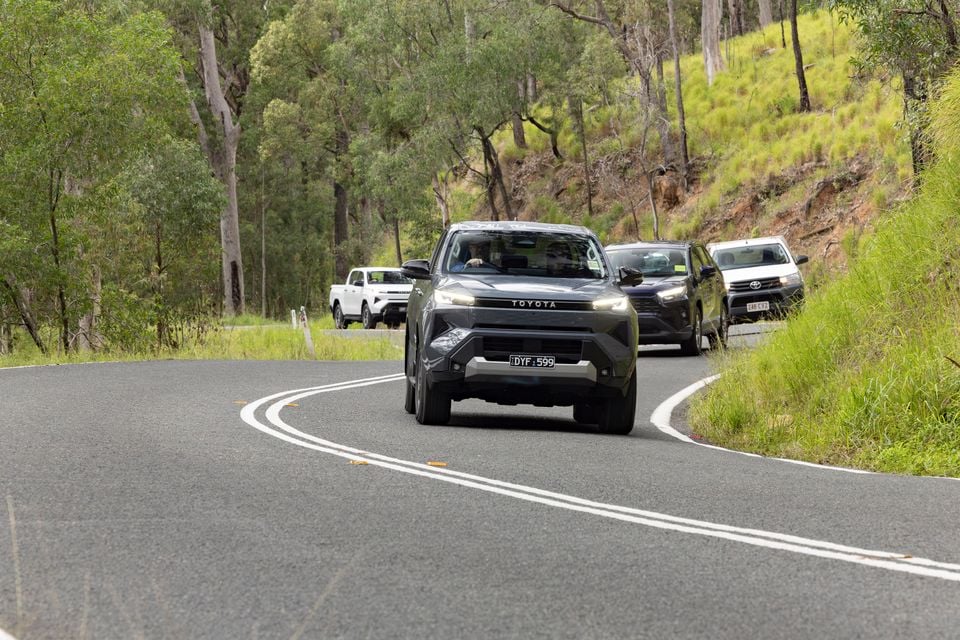
While not BEV-specific, the HiLux is easy to place on the road. The all-wheel drive system provides consistent traction, and compared with larger electrified dual-cabs such as the Ranger Hybrid, BYD Shark 6 and GWM Cannon Alpha, the Toyota feels compact and easy to manage, helped by light, heavily assisted steering.
Its comprehensive set of cameras likewise comes in handy, predominantly when parking and navigating tight confines.
Around worksites and mine sites, where tight access and low-speed manoeuvres are part of the job, that ease of use is a genuine strength.
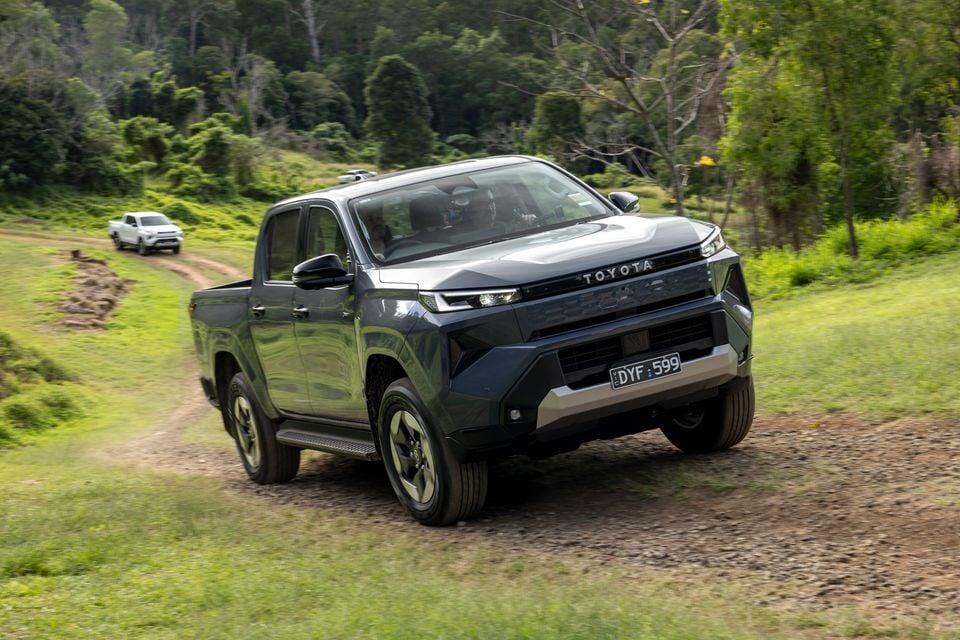
Ride comfort, on the other hand, is a genuine weakness. Unladen, the HiLux jiggles over smaller imperfections, with ripples regularly coursing through the chassis beneath you. Longer undulations can also see it bouncing down the road, resulting in noticeable head toss inside the cabin.
Things should settle down with a load in the tub, but unladen this electric ute isn't comfortable – certainly less so than the Ranger Hybrid – and you wouldn’t want to spend long periods behind the wheel without a break.
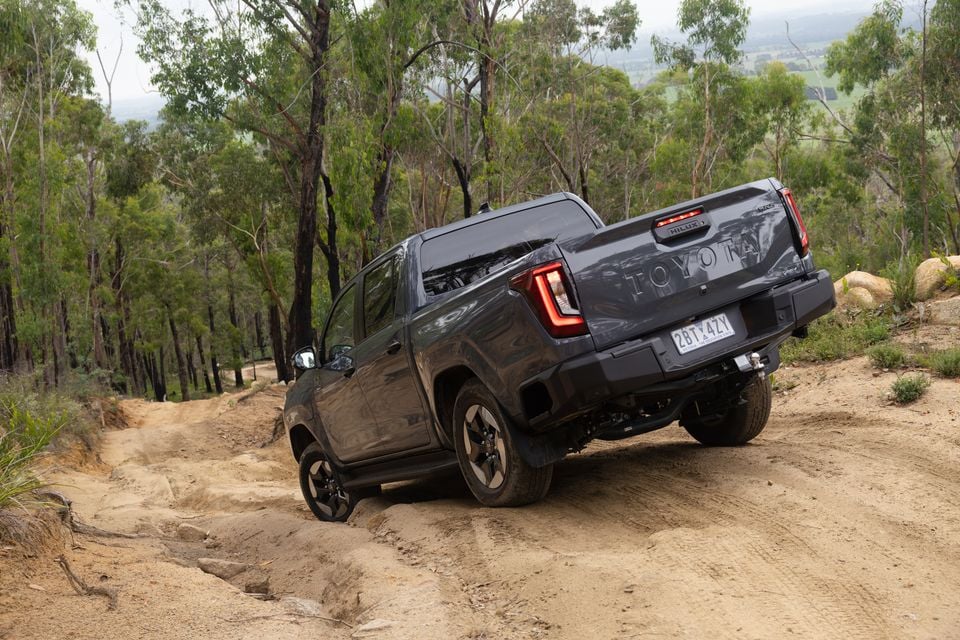
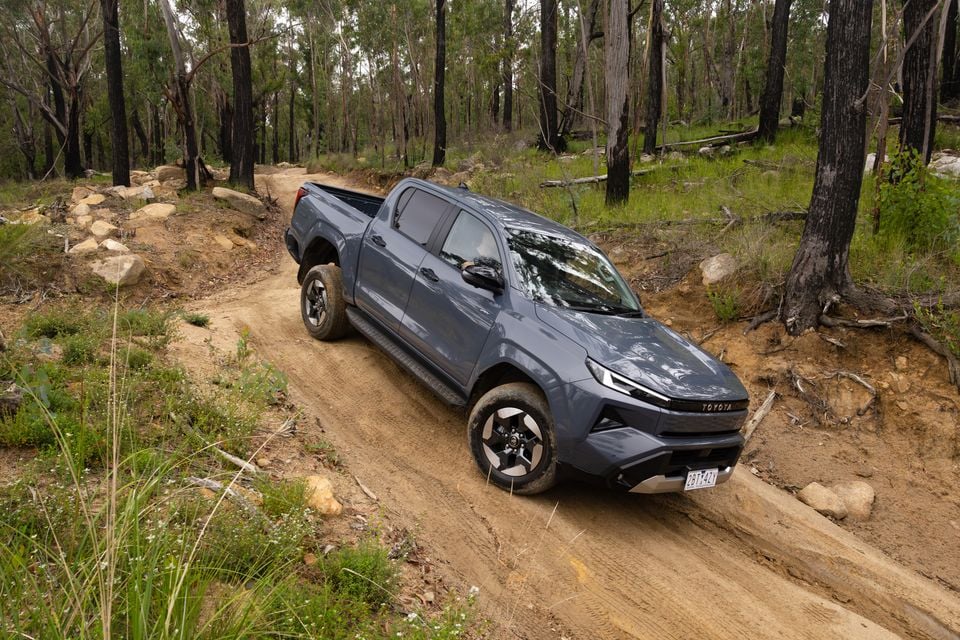
It's a similar story off-road, although here the HiLux makes up for its rough ride with decent capability – especially for an EV.
The HiLux BEV has full-time all-wheel drive, six terrain modes and downhill assist, although there’s no low-range gearing.
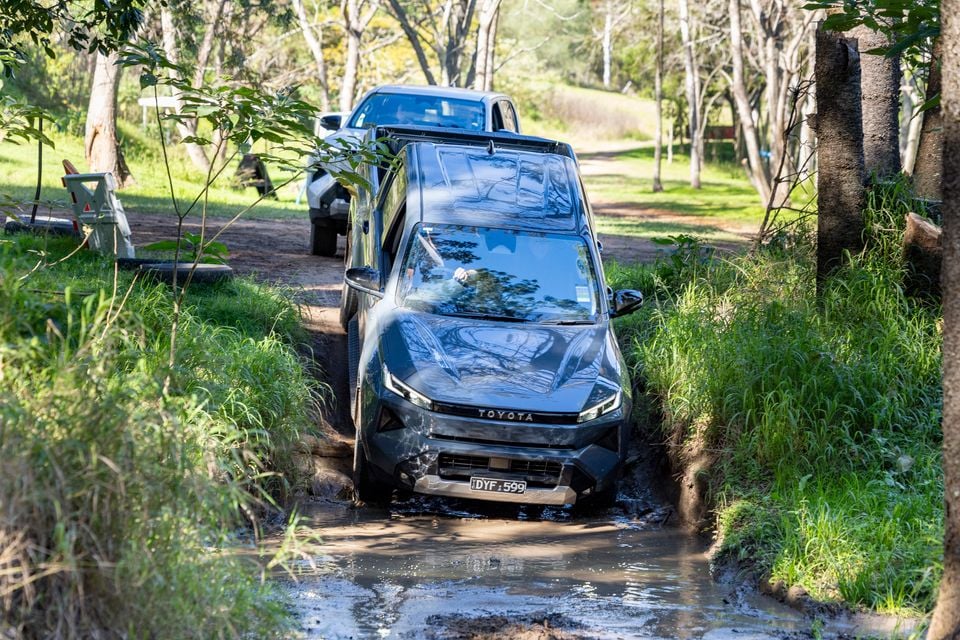
Ground clearance is down slightly compared with diesel versions, at 218mm versus 224-229mm, so you need to be a little more mindful over sharper obstacles. Water crossings shouldn’t be a major concern, though, as Toyota says it has taken “specific measures to protect the battery from damage or water ingress”, and quotes the same wading depth as the diesel model.
And on the whole, the BEV feels rugged enough to get most jobs done. Instant electric torque is useful when you’re working through loose or slippery terrain, helping the HiLux pick its way through troublesome trails without needing aggressive throttle inputs.
That said, the soft, doughy accelerator pedal can make it difficult to meter out that torque precisely, which isn’t ideal off-road.
Even so, the HiLux BEV understands its assignment: fleet work, including mine sites, construction sites and low-speed off-road environments where traction and control matter most.
| Off-road dimensions | Toyota HiLux BEV pickup |
|---|---|
| Track front and rear | 1530mm – front1550mm – rear |
| Ground clearance | 218mm |
| Approach angle | 29 degrees |
| Departure angle | 25 degrees |
| Ramp breakover angle | 20 degrees |
| Wading depth | 700mm |
To see how the Toyota HiLux lines up against the competition, check out our comparison tool
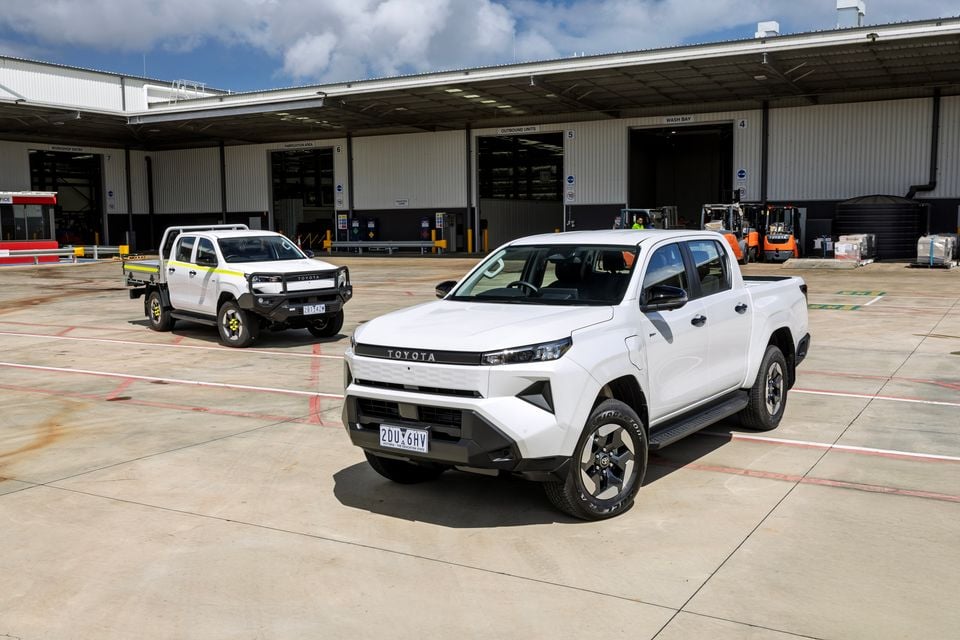
The HiLux BEV is distinguished from the diesel-powered range with a closed-off upper front grille and “aerodynamically enhanced” 17-inch alloy wheels.
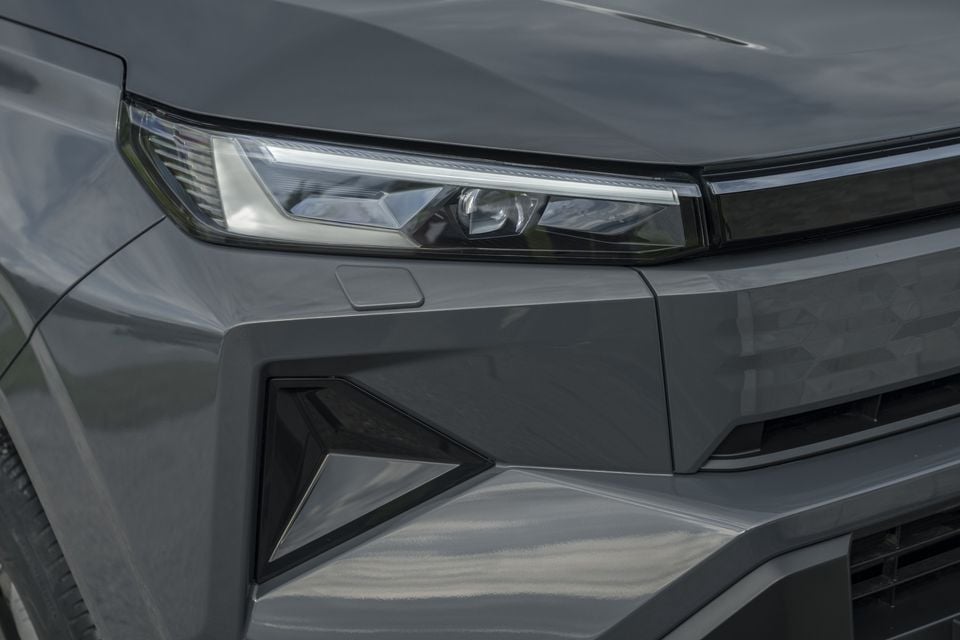
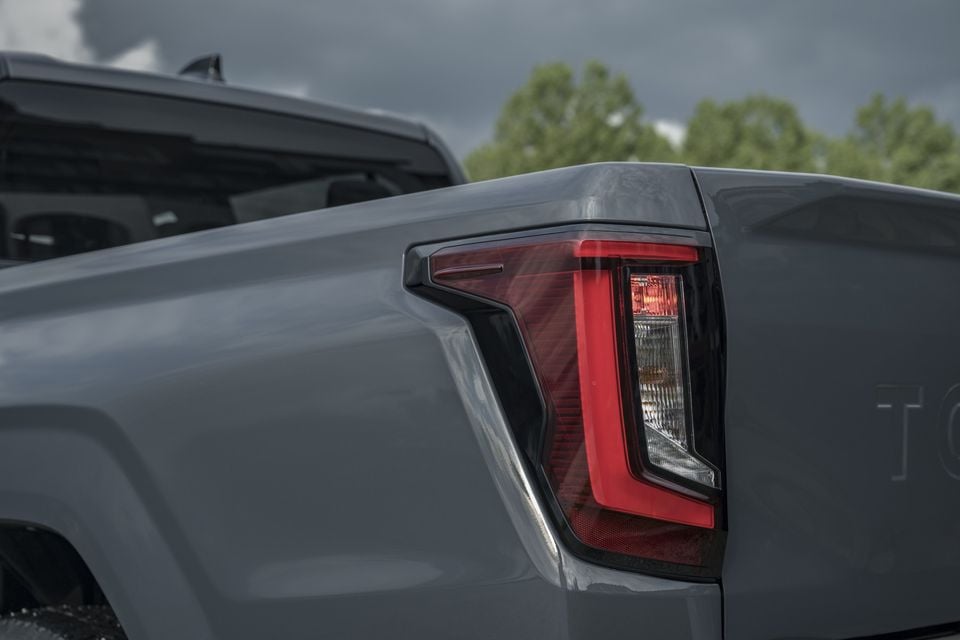
2026 Toyota HiLux BEV SR equipment highlights:
SR5 adds:
You can only get the HiLux BEV in Glacier White, Frosted White and Ash Slate exterior paint finishes, the latter two costing an extra $675.
To see how the Toyota HiLux lines up against the competition, check out our comparison tool
The HiLux BEV is the first, and currently only, electric ute to achieve a five-star ANCAP safety rating, with rivals such as the KGM Musso EV and LDV eT60 remaining unrated.
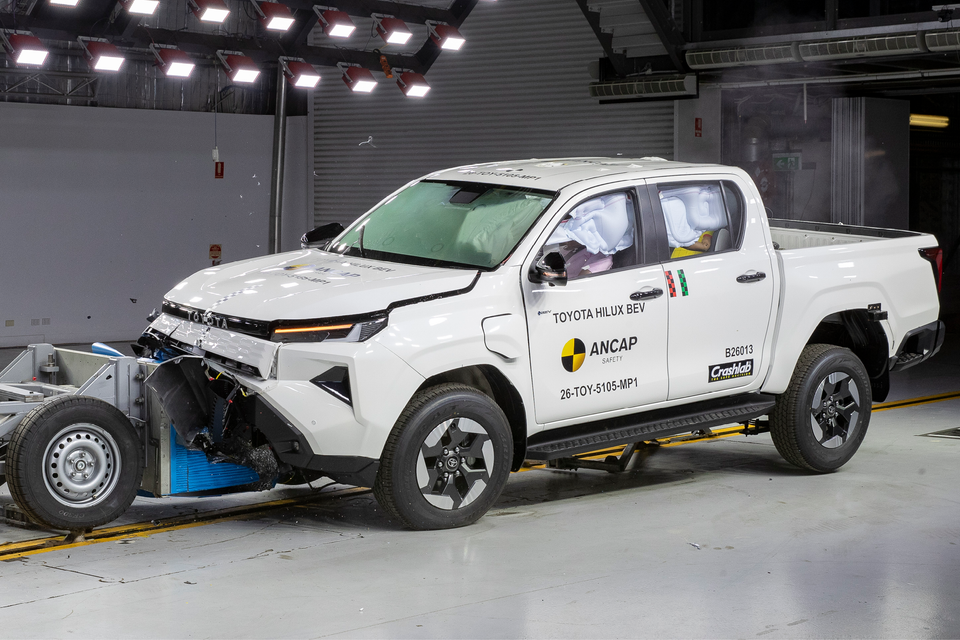
| Category | Toyota HiLux BEV |
|---|---|
| Adult occupant protection | 84 per cent |
| Child occupant protection | 89 per cent |
| Vulnerable road user protection | 82 per cent |
| Safety assist | 82 per cent |
While all diesel-powered versions of the new-generation HiLux, apart from the Rugged X, received a five-star ANCAP rating in December 2025, the arrival of the battery-electric HiLux prompted additional testing specific to the HiLux EV.
In a statement, ANCAP said this included assessments of battery integrity and high-voltage electrical system safety in severe crash scenarios.
Standard safety features include:
To see how the Toyota HiLux lines up against the competition, check out our comparison tool
Like all HiLux models, the HiLux BEV is covered by a five-year, unlimited-kilometre warranty with a five-year warranty on the traction battery that can be extended up to 10 years with an annual battery check.
| Servicing and Warranty | Toyota HiLux BEV |
|---|---|
| Warranty | 5 years, unlimited kilometres – vehicleUp to 10 years, unlimited kilometres – high-voltage battery |
| Roadside assistance | $99 per year |
| Service intervals | 6 months or 10,000km |
| Capped-price servicing | 5 years |
| Annual service cost | $440 |
| Total capped-price service cost | $2200 |
Running costs should be low thanks to electric power, but Toyota’s short six-month service intervals take some shine off the HiLux BEV’s ownership case. At $2200 over five years – or $2695 including roadside assistance – it isn’t as cheap to maintain as you might expect.
As for resale values, well it's hard to know how the HiLux BEV will fare given its relative uniqueness in the market.
To see how the Toyota HiLux lines up against the competition, check out our comparison tool
It's a HiLux, and it's electric. For some eco-conscious fleet operators, that will be enough.
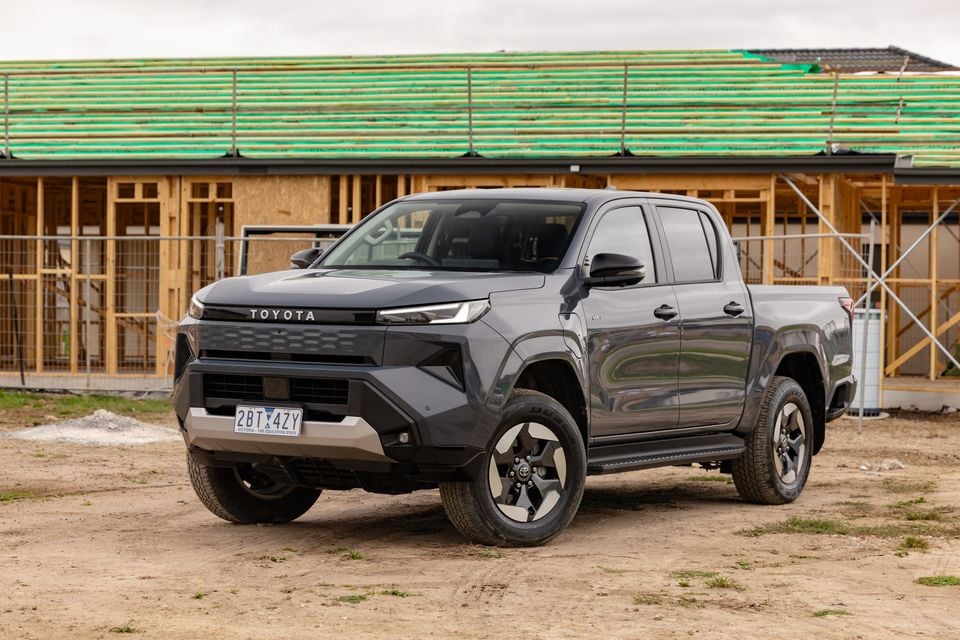
The HiLux BEV also benefits from being one of just three electric utes currently available in Australian showrooms.
Then there’s the Toyota badge, which carries an unmatched reputation for reliability and durability among fleet buyers.
More than two years of testing with mining companies in temperatures as high as 50 degrees should provide further reassurance for its intended business, government and resource-sector customers.
However, the vehicle itself is nothing special.
The electric powertrain is quiet and smooth, while full-time all-wheel drive gives the HiLux BEV genuine capability on and off the road. But those positives are overshadowed by a laughably short driving range, reduced towing and payload ratings, and an uncomfortable unladen ride.
Then there’s the price. At up to $82,990 before on-road costs, the HiLux BEV asks too much for a modest powertrain and an interior that’s basic, short on space, and less appealing than those of most modern dual-cabs.
If your fleet wants an electrified ute backed by a trusted brand, the Ford Ranger Hybrid is the better all-round package.
And if a pure EV is non-negotiable, the KGM Musso EV isn’t a Toyota, but it’s around $20,000 cheaper and just as fit for lighter-duty work.
That leaves the HiLux BEV with a narrow use case: short, predictable routes, limited loads, and reliable access to depot charging.
For fleets willing to pay a significant premium for peace of mind, it may work. For everyone else – including private buyers – the numbers simply don’t stack up.
CarExpert can save you thousands on a new Toyota HiLux. Click here to get a great deal.
Click the images for the full gallery
If this is the car for you, we’ll compare offers from trusted dealers, handle the back and forth and manage your purchase from enquiry to delivery.
Quickly see how this car stacks up against its competition. Select any benchmark to see more details.
Toyota HiLux
Toyota HiLux Sales rolling 12-months#
*Based on VFACTS and EVC data
Looking for complete Toyota HiLux price history?
Our Toyota HiLux Pricing Page shows exactly how prices have changed over time.
2026
$38,966
2026
$58,536
2026
$69,866
2026
$72,441
2026
$78,106
2026
$78,106
Josh Nevett is an automotive journalist covering news and reviews, with a background in motorsport journalism.
Add CarExpert as a Preferred Source on Google so your search results prioritise writing by actual experts, not AI.
Max Davies
7 Hours Ago

Damion Smy
3 Days Ago
Josh Nevett
3 Days Ago
Josh Nevett
4 Days Ago

William Stopford
4 Days Ago

Alborz Fallah
7 Days Ago
Add CarExpert as a Preferred Source on Google so your search results prioritise writing by actual experts, not AI.
# Based on VFACTS and EVC data
† Displayed prices are based on the drive-away price of the vehicle, which includes delivery charges, registration fees, number plates, and applicable road taxes, based on a Sydney location. However, prices may vary between states and territories, and additional costs such as compulsory third party (CTP) insurance, dealer delivery fees, and optional extras are not included. These prices are subject to change without notice and may not reflect current market pricing or dealer offers.
 Automotive Vehicle Spec Data & 4K images Powered by JATO Dynamics Ltd