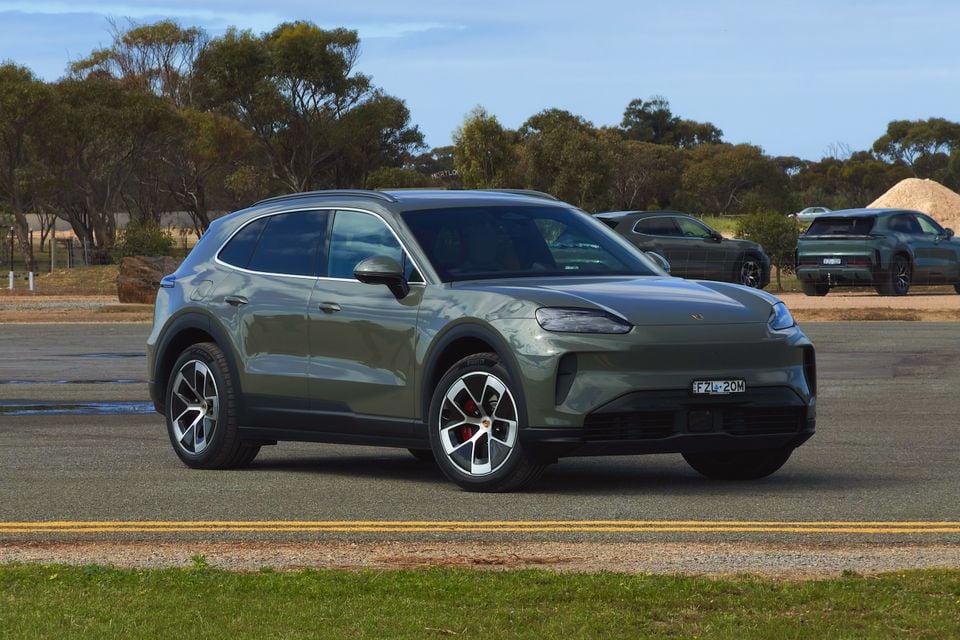
The 2027 Porsche Cayenne Electric range is hitting Australia now, and will sit alongside the existing combustion-engined version including plug-in hybrid models for the foreseeable future.
By offering the all-new, all-electric fourth-generation 'E4' Cayenne alongside its E3 predecessor, Porsche says its large SUV strategy is all about offering consumers choice.
First revealed almost 12 months ago, the Cayenne Electric moves to the Volkswagen Group's Premium Platform Electric (PPE) architecture, and boasts some manic performance figures in flagship 'Turbo' guise.
It arrives only a few thousand dearer than an equivalent Cayenne E-Hybrid, while the top-spec Cayenne Turbo Electric comes in $40,000 cheaper than the Cayenne Turbo E-Hybrid, and delivers acceleration to make a 911 Turbo S sweat.
Our overseas colleagues have driven both the electric Cayenne and Cayenne Coupe on European roads, and now we're among the first in Australia to drive local-spec cars on local roads.
We headed to Port Lincoln in South Australia to get a first drive of the fourth-generation Cayenne (Electric) on 'home turf', including some sand dune driving and towing.
How much does the Porsche Cayenne Electric cost?
Priced from $167,700 before on-road costs, the Cayenne Electric range starts more than $20,000 higher than the combustion-powered E3 Cayenne, and about $3000 higher than the most attainable plug-in hybrid E3 Cayenne E-Hybrid (PHEV).
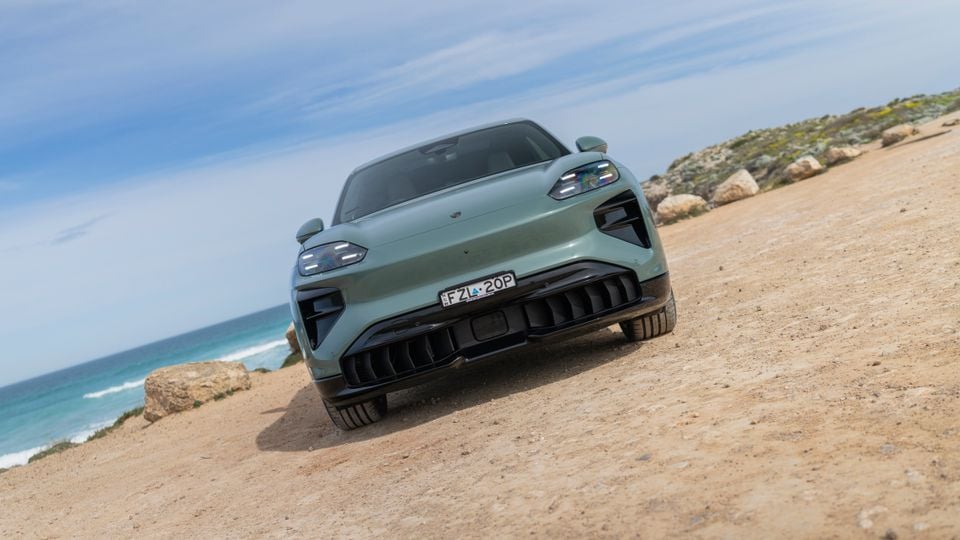
Cayenne Turbo Electric
Model
Price before on-road costs
Porsche Cayenne Electric
2027 Porsche Cayenne Electric
$167,700
2027 Porsche Cayenne S Electric
$193,100
2027 Porsche Cayenne Turbo Electric
$259,900
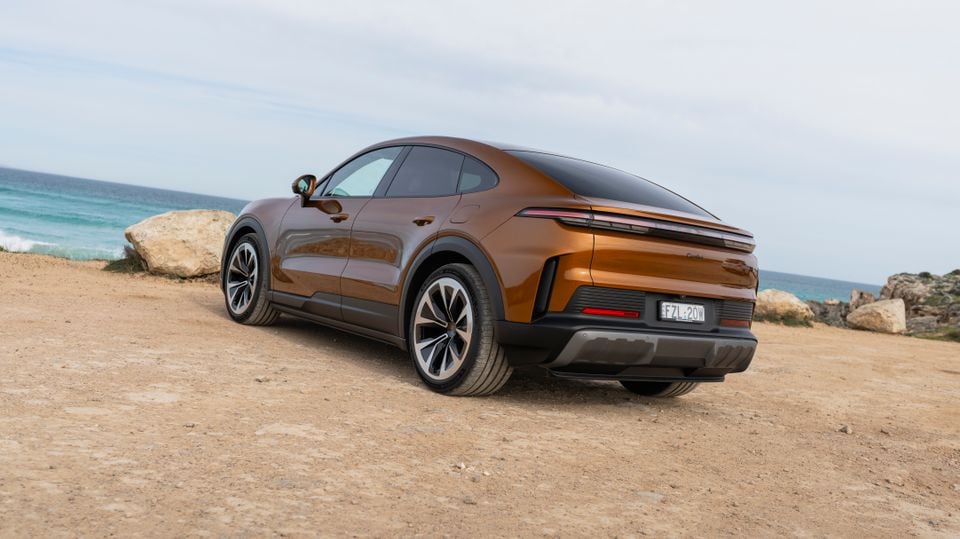
Porsche Cayenne Coupe Electric
2027 Porsche Cayenne Coupe Electric
$173,600
2027 Porsche Cayenne S Coupe Electric
$194,600
2027 Porsche Cayenne Turbo Coupe Electric
$272,100
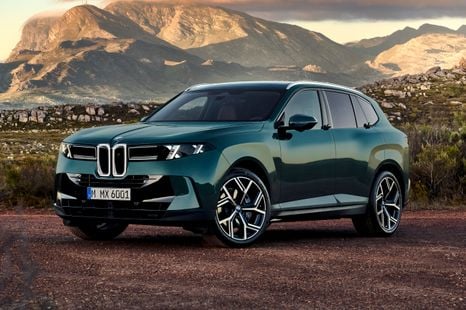
The Cayenne Electric doesn't have too many direct rivals in Australia at this stage, with the BMW iX (from $142,900) to be joined by the incoming iX5 which will be a more direct competitor to the E4 Cayenne, in the same way the combustion- and hybrid-powered X5 range is a competitor for the E3 Cayenne.
Mercedes-Benz doesn't currently sell the EQE SUV or the EQS SUV in Australia, while the Audi Q8 e-tron and SQ8 e-tron have been discontinued globally ahead of replacements based on the Cayenne's PPE architecture. Speaking of, Volkswagen Group subsidiary Bentley is about to reveal its first-ever EV, the Torcal, which is expected to be based on the Cayenne Electric's componentry.
Perhaps the most like-for-like competitor conceptually is the Polestar 3, which starts from $116,700 before on-road costs in Australia, but like the Cayenne focuses on a high-performance and engaging driver experience in a electric SUV.
In its most potent Performance guise, complete with its 500kW/870Nm dual-motor powertrain, the Polestar 3 still comes in for less than the base Cayenne Electric, at $146,700 plus on-roads.
To see how the Porsche Cayenne Electric lines up against the competition, check out our comparison tool
What is the Porsche Cayenne Electric like on the inside?
The interior of the Cayenne Electric brings one of the biggest wholesale changes to Porsche designs in quite some time.
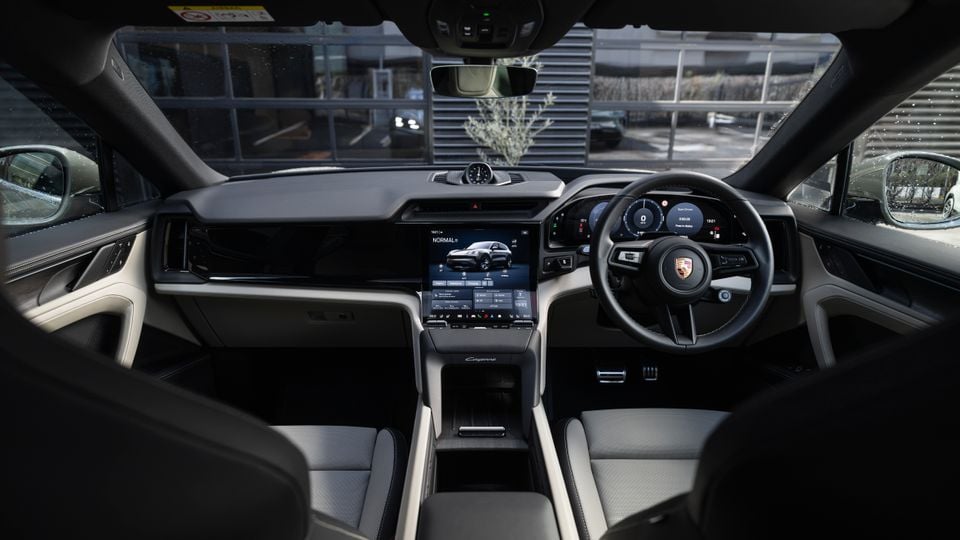
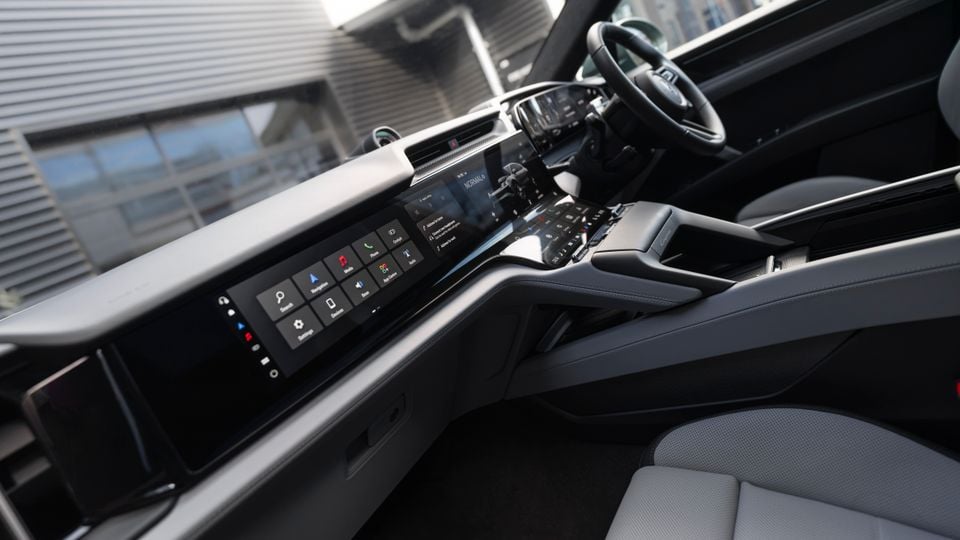
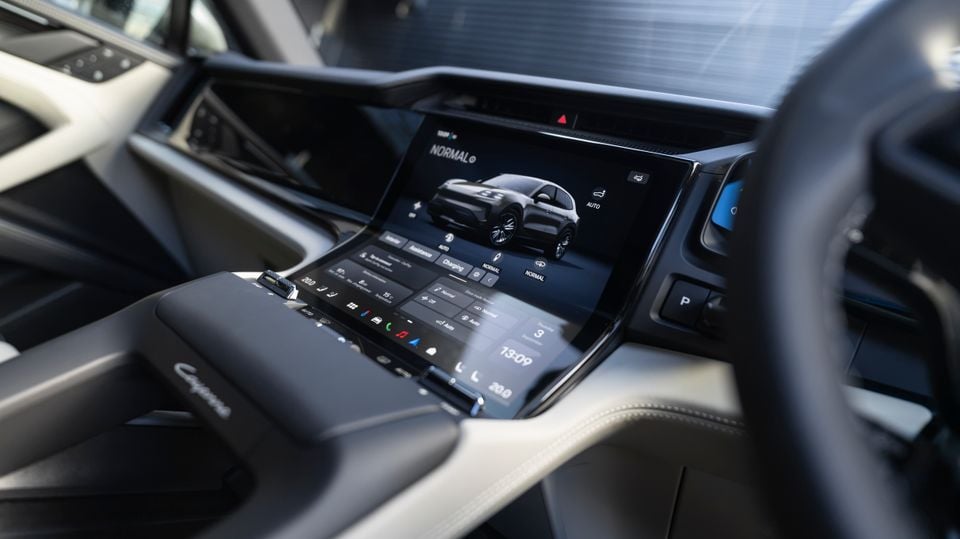
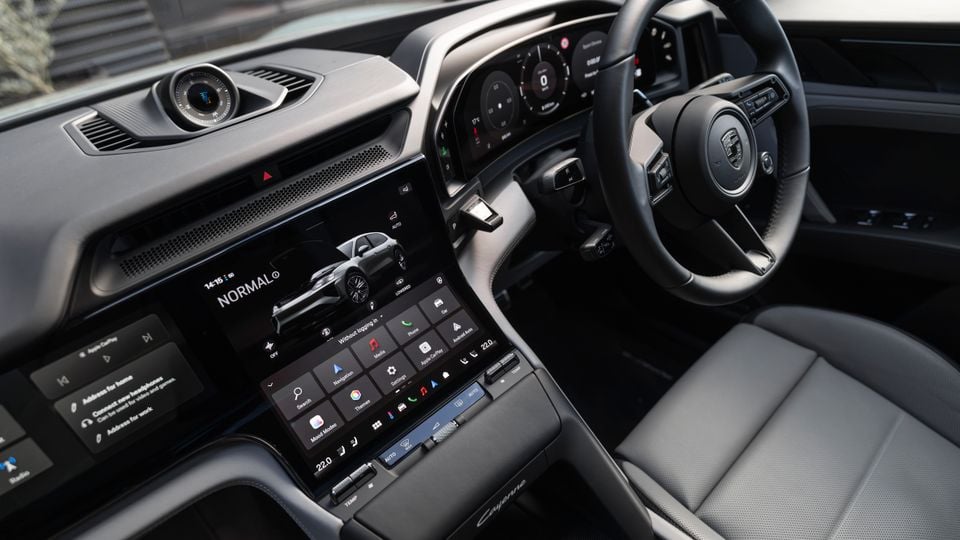
It's as digitised as a Porsche has ever been, with no fewer than (up to) three large high-definition displays, including two behind curved glass, by thankfully it's complemented by tactile physical switchgear for key functions on the dashboard and steering wheel.
The headline act is the new portrait-oriented 'Flow Display', spanning 12.25 inches and boasting OLED display technology. It's also curved along the crease of the dashboard, but still offers the sort of user experience you'd expect out of a high-end smartphone.
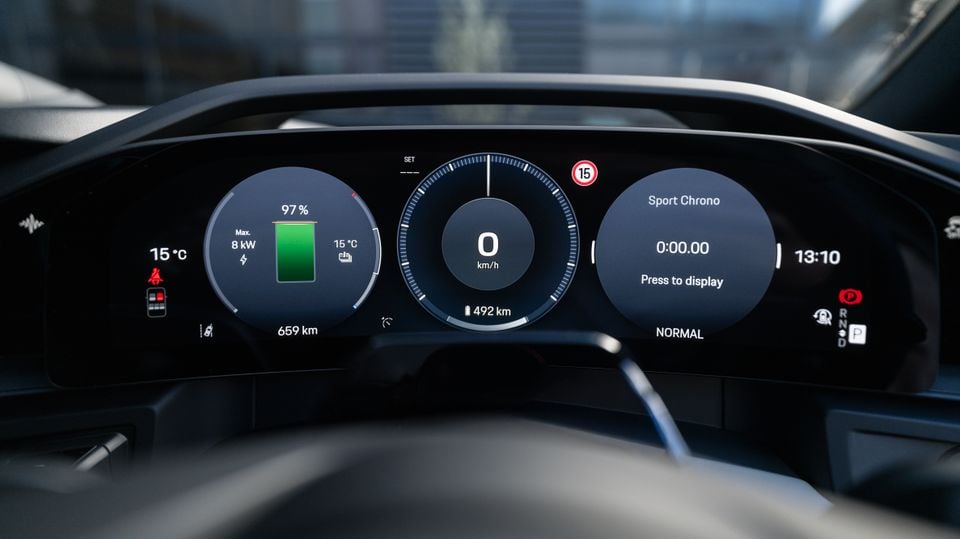
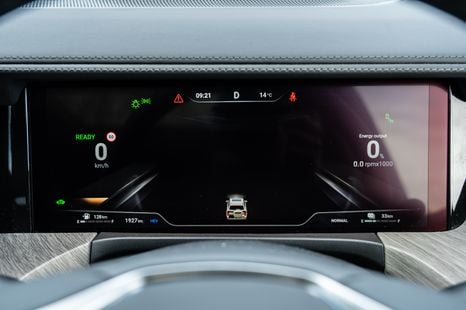
Ahead of the driver is a 14.2-inch OLED instrument cluster similar to what we've seen in other new Porsche models, offering several views and layouts, from conventional (but contemporary) Porsche to a bit more new-age.
Then there's the available 14.9-inch passenger display ($3790), which fills out the majority of the letterbox-shaped dashboard insert ahead of the front occupant, offering access to various navigation and infotainment functions, as well as streaming via third-party apps.
Given most of our time with the Cayenne Electric was spent either behind the wheel or alongside another journalist, we didn't really get a chance to properly play around with all of the embedded and connected infotainment functions.
That said, I can vouch for the clarity and quality of the driver's instrument cluster and central infotainment displays, as well as their buttery smooth animations and responses to inputs. The curved display also means the lower sections are angled towards the driver and are therefore easier to see.
Porsche has retained a small bank of physical toggles, rockers and touch-capacitive switchgear for key functions like climate control and volume, and as you'd expect they have a solid and tactile action – and same goes for the multifunction controls on the steering wheel.
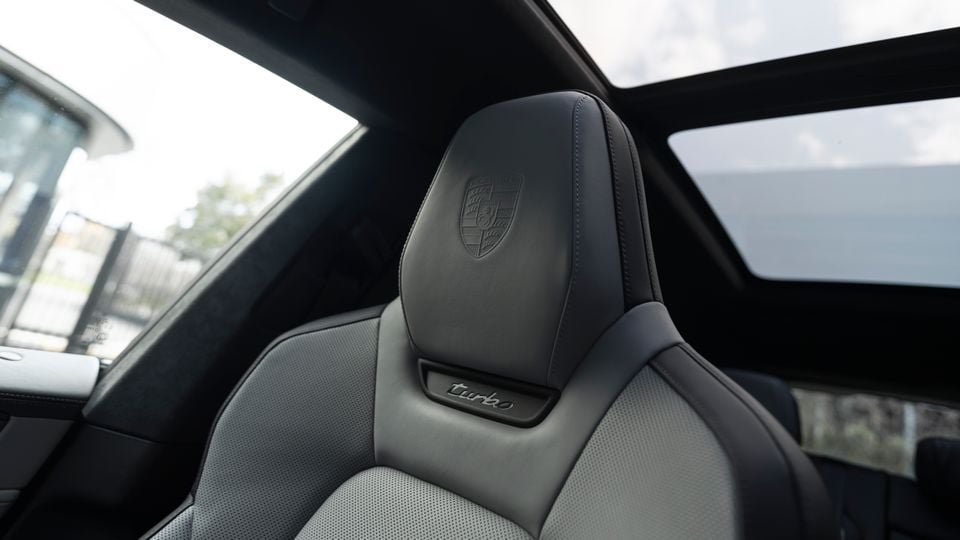
General quality and tactility of the interior materials and surfaces is up to Porsche standards – though our test vehicles were pretty much all highly optioned. There are soft-touch surfaces just about everywhere, and the option of extended leather upholstery with top-stitching across the dashboard, doors and centre console.
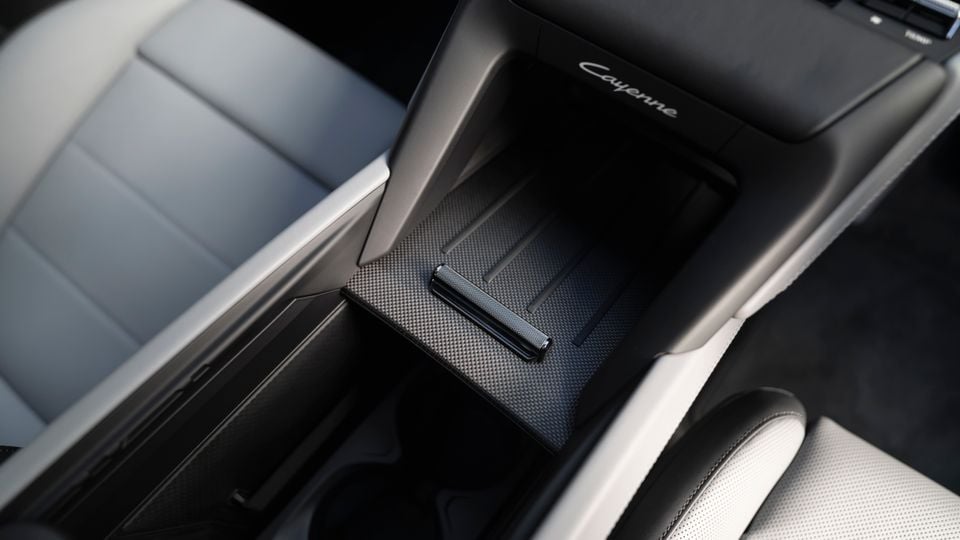
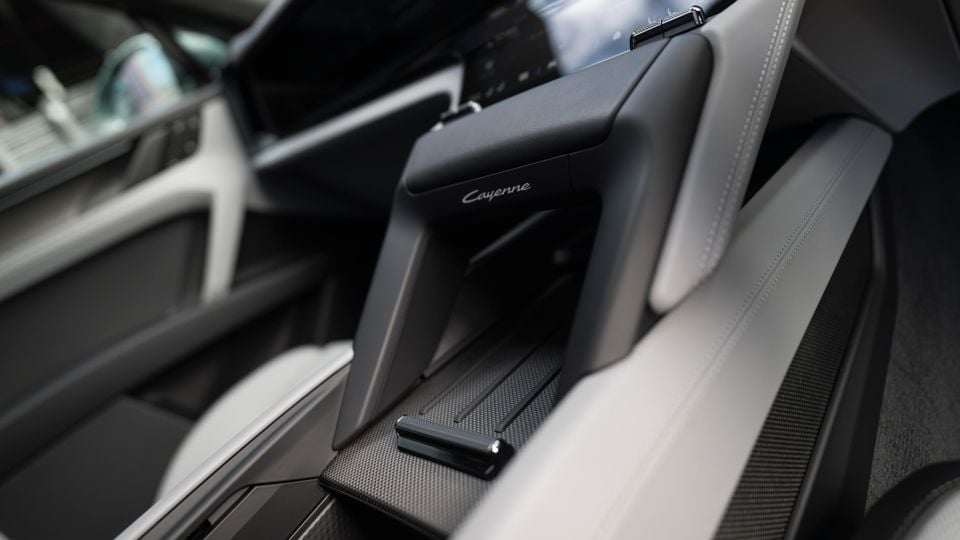
The bridged centre console design isn't really to my tastes, but is clearly a contemporary take on the Cayenne's signature centre grab handles that have been an integral part of the interior design since day one.
Storage is pretty plentiful throughout the cabin, with deep cubbies between the front seats as well as shelves and drawers aplenty.
There are gripped sections on the centre console lid if you're placing a phone or wallet on top, while the standard wireless 25W smartphone charger beneath is rubberised and has tabs to hold your smartphone in place.
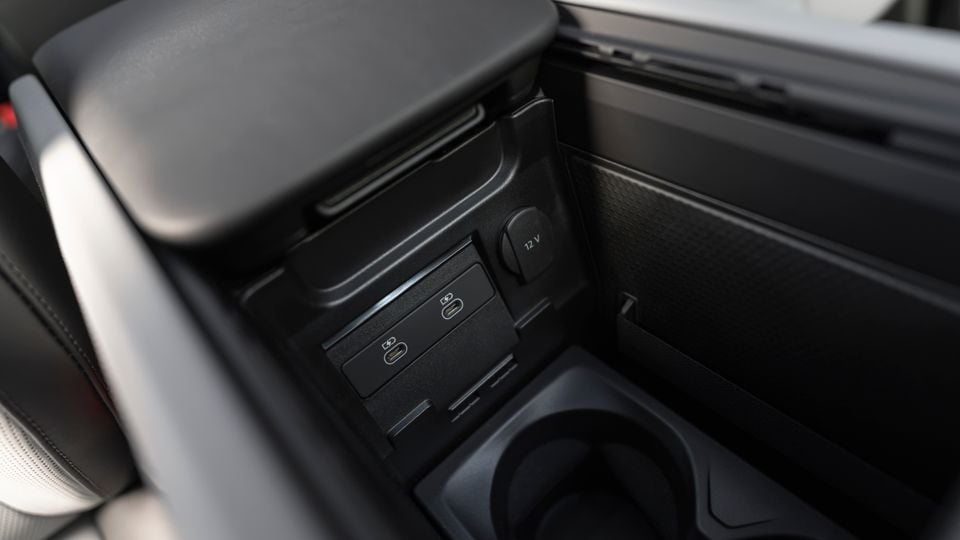
If you're looking for wired connections to charge your phone or other devices, you have a pair of 60W outlets up front, in addition to two 100W USB-C ports in the front-centre storage compartment, and then a further two 100W USB-C ports at the rear of the centre console in the second row.
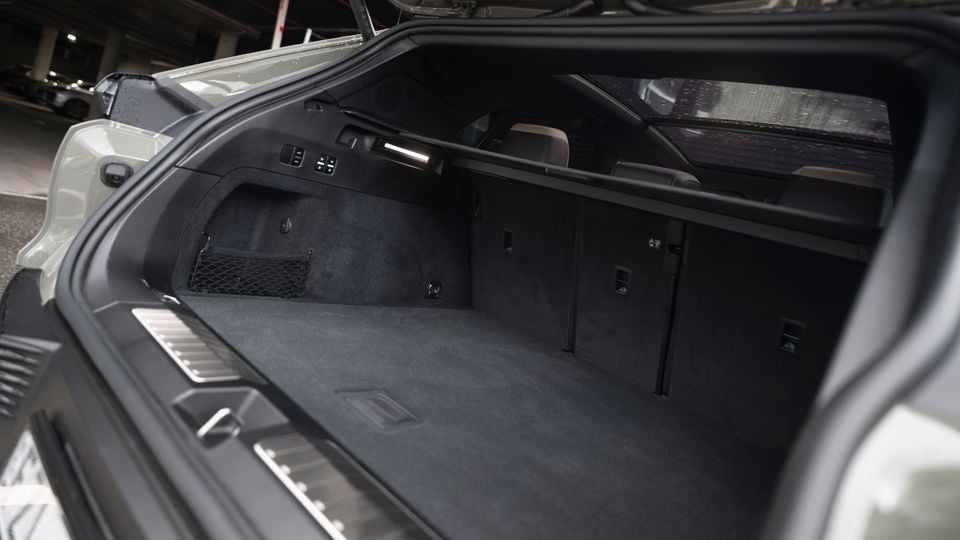
You've also got two 12V outlets, one in the front-centre console and then another in the boot area.
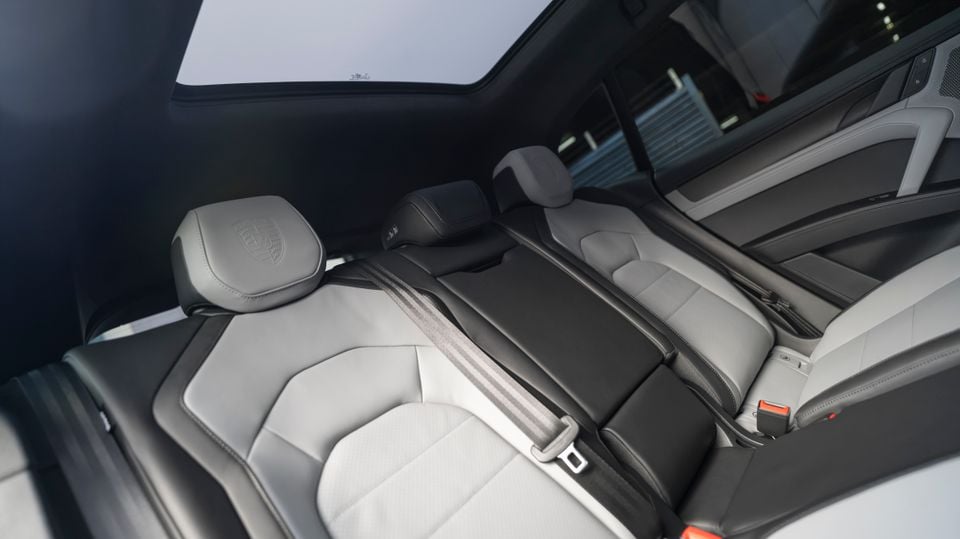
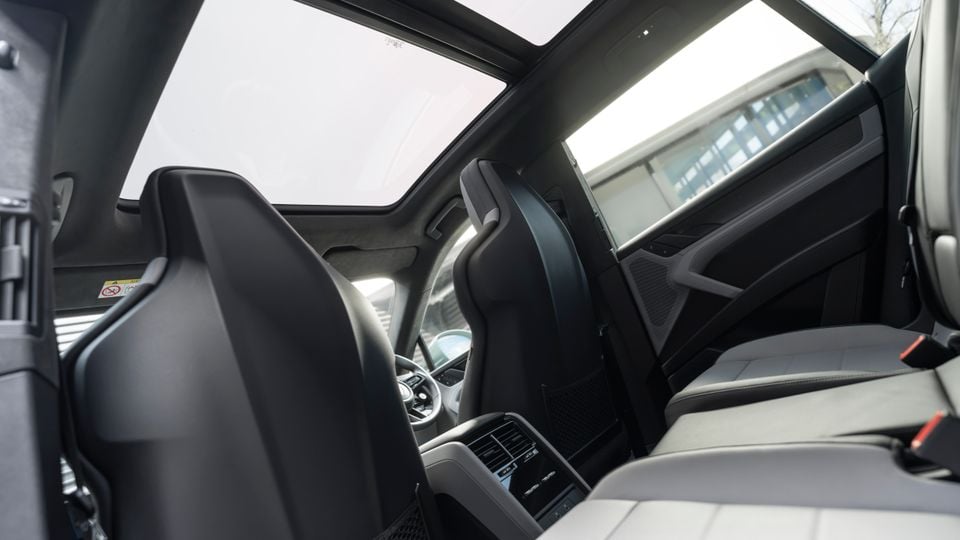
With its 3.0-metre wheelbase, the rear seat of the Cayenne is massive. Even behind a driver measuring over six-feet tall, there is heaps of room in the second row for taller passengers, with generous knee, leg and toe room as well as good headroom even in the Coupe.
All of the vehicles on test were fitted with a sliding panoramic sunroof ($3770 on Cayenne Electric), while the Coupe comes standard with a fixed glass roof and the option to add Porsche's Variable Light Control ($7220), which uses electrically adjustable liquid crystals to go from 60 per cent opacity to 100 per cent clear.
Further, with its multi-layer structure, Porsche claims the Variable Light Control sunroof not only lets in more light than a conventional unit, it also blocks up to 99 per cent of UV rays and reduces infrared heat input, eliminating the need for a conventional sunshade.
Rear amenities include air vents and the aforementioned power outlets, with S and Turbo models adding third and fourth zones of climate control. You also get electric recline adjustment for the rear seats.
The Cayenne Electric SUV quotes 747-781 litres of cargo capacity behind the rear seats (the Turbo is at the lower end of that scale), while the Coupe drops that to 500-534L.
Only a tyre repair kit is fitted as standard, as there's no spare wheel of any kind under the boot floor, despite Porsche touting its touring and overlanding capabilities on this launch.
Dimensions
Cayenne Electric
Cayenne Coupe Electric
Length
4985mm
4985mm
Width
1980mm
1980mm
Height
1674mm
1650mm
Wheelbase
3023mm
3023mm
Cargo capacity
747-781L – Rear seats up 90L – Frunk
500-534L – Rear seats up 90L – Frunk
To see how the Porsche Cayenne Electric lines up against the competition, check out our comparison tool
What's under the bonnet?
There's a 90L storage area under the bonnet, and the Cayenne and Cayenne Coupe Electric are available with three powertrain variants.
Specifications
Porsche Cayenne Electric*
Porsche Cayenne S Electric*
Porsche Cayenne Turbo Electric*
Drivetrain
Dual-motor electric
Dual-motor electric
Dual-motor electric
Battery
108kWh NMC lithium-ion
108kWh NMC lithium-ion
108kWh NMC lithium-ion
Power
325kW (launch control)
490kW (launch control)
850kW (launch control)
Torque
835Nm (launch control)
1080Nm (launch control)
1500Nm (launch control)
Drive type
All-wheel drive
All-wheel drive
All-wheel drive
Weight
2525kg
2555kg
2645kg
Payload
645kg
650kg
625kg
0-100km/h (claimed)
4.8 seconds
3.8 seconds
2.5 seconds
Energy consumption (WLTP)
19.7-21.8kWh/100km
19.5-21.6kWh/100km
20.4-22.4kWh/100km
Claimed range
542km
571km
537km
Max AC charge rate
22kW
22kW
22kW
Max DC charge rate
400kW
400kW
400kW
Braked tow capacity
3500kg
3500kg
3500kg
*Note quoted specs are for Cayenne Electric (SUV) models
Our varied drive program was very country highway-intensive, mixed in with towing as well as off-road driving, and therefore not very indicative of real-world consumption.
That said, we saw low- to mid-20kWh in the base Cayenne Electric Coupe during a highway-focused road loop, while the Cayenne S was doing high-20kWh to low-30kWh during off-roading and on the sand dunes.
Finally, the manic Cayenne Turbos were in the mid-30kWh/100km during towing, and showed 40kWh/100km after the acceleration runs. They're big numbers, but more time in everyday settings is needed to better gauge efficiency.
Also worth noting is the 400kW DC fast-charging cap, which is among the fastest you can buy, thanks to the Cayenne Electric's 800V electrical architecture.
The marque has also confirmed its trick new wireless REV battery charging technology will be coming to Australia too, with customers able to tick the hardware preparation option to ensure their vehicle is compatible with the inductive charging mat when they eventually arrive Down Under.
All Australian-delivered Cayenne Electric vehicles at launch will be fitted with the pre-wiring preparation for retrofitting the wireless charging option in the future when it becomes available. Further, all Australian models come fitted with a heat pump as standard equipment.
To see how the Porsche Cayenne Electric lines up against the competition, check out our comparison tool
How does the Porsche Cayenne Electric drive?
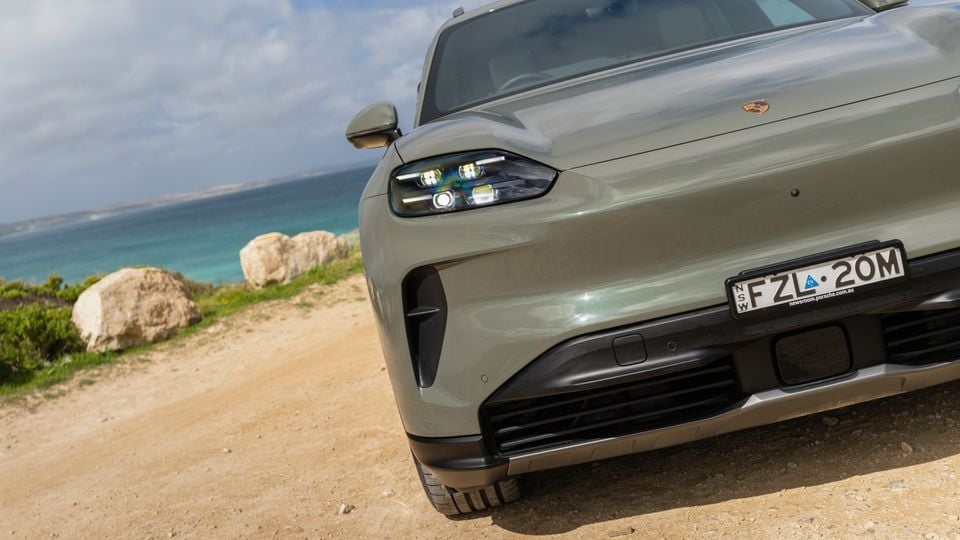
Port Lincoln is a beautiful place, and Porsche wanted to showcase the Cayenne Electric being used at several different extremes – including some that many owners may never even touch.
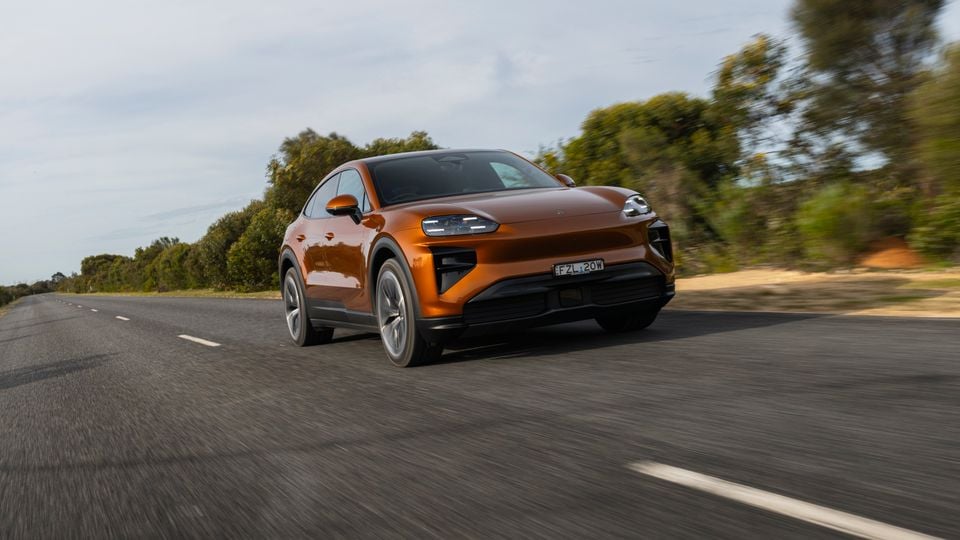
Cayenne Turbo Coupe Electric
Upon arrival at the Port Lincoln regional airport, we started off in the Cayenne Turbo Coupe Electric and spent almost an hour on the very straight, 110km/h signed highways that frequent this part of the world.
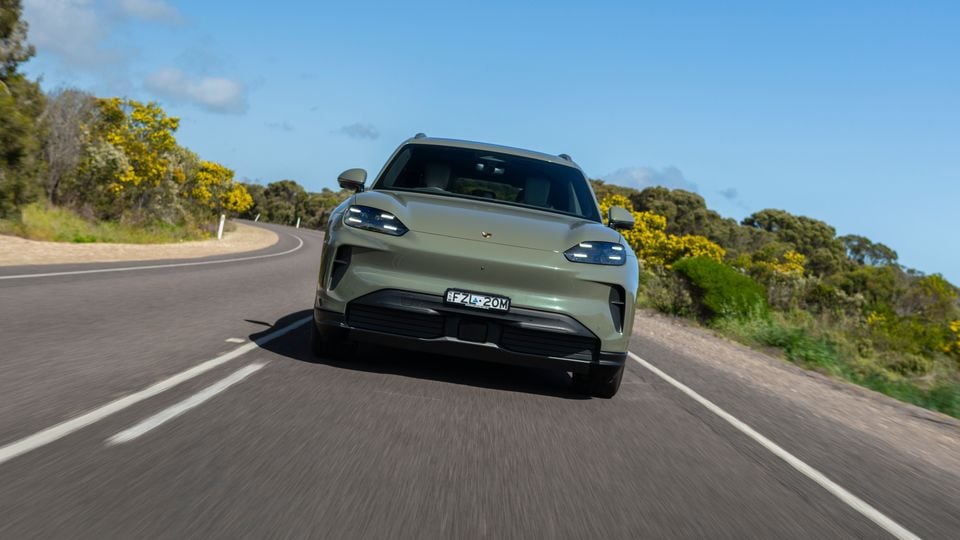
Very quickly it was apparent that the electric Cayenne has been tuned to feel much like the combustion-powered one in terms of steering and ride, with a beautifully accurate and communicative tiller teamed with a well-balanced, confident chassis.
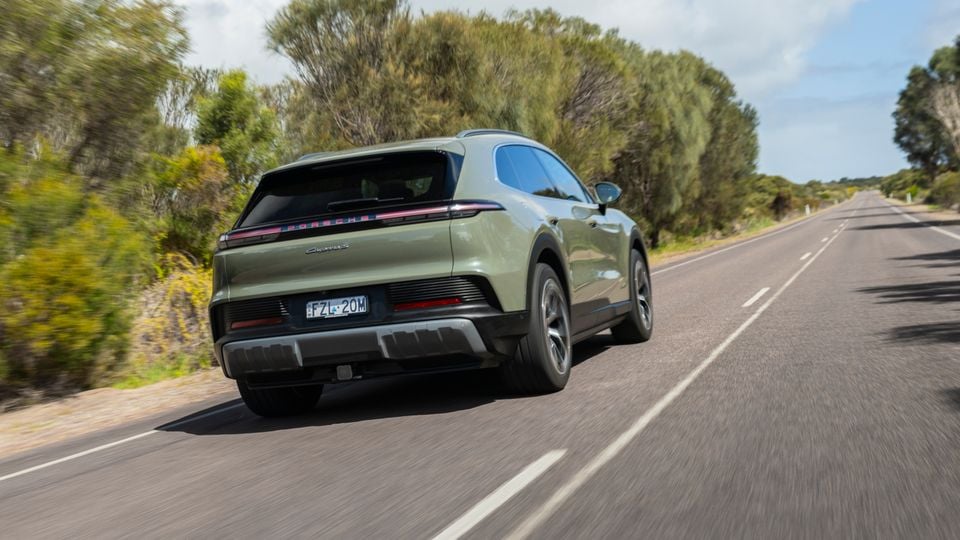
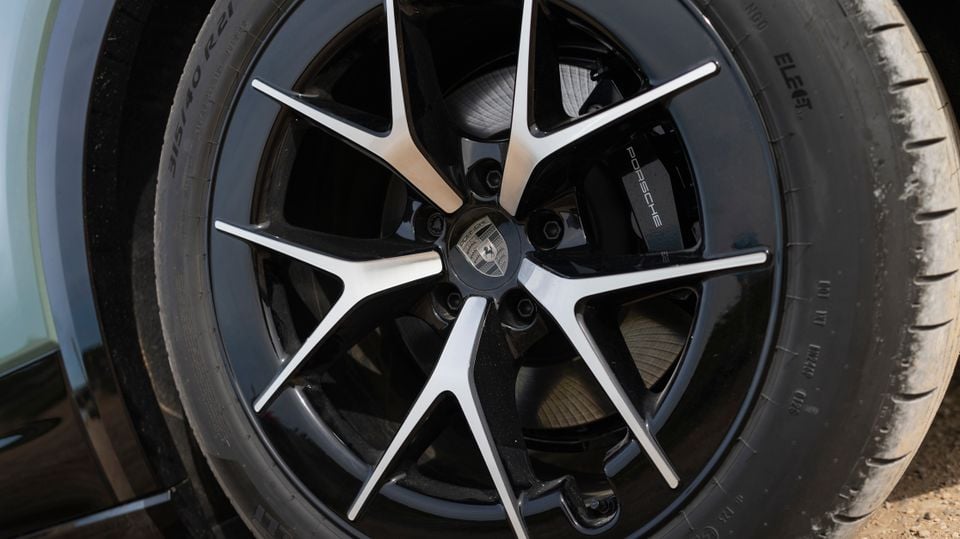
Road and wind noise are impressively suppressed despite the massive 22-inch wheels and low-profile tyres, and general ride compliance was also very good thanks to the standard adaptive air suspension.
Left in Normal or Comfort modes, even the most potent Cayenne drives like a big, comfortable luxury bus with an impeccably tuned steering rack – even if it can be ever so slightly vague about-centre in its more relaxed mode settings.
Our first stop was the Tumby Bay Airport, which was conveniently closed for the day for our 'private event'.
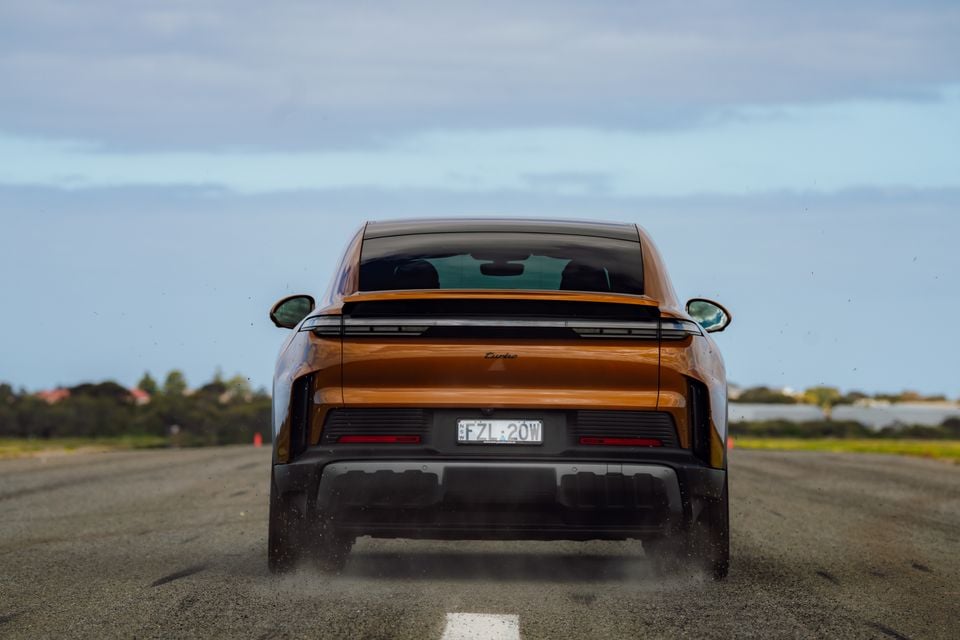
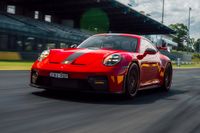
The Cayenne Turbo Electric bumps outputs to 850kW/1500Nm when Launch Control is engaged, and Porsche claims it'll do 0-100km/h in a blistering 2.5 seconds, and 0-200km/h in just 7.4 seconds.
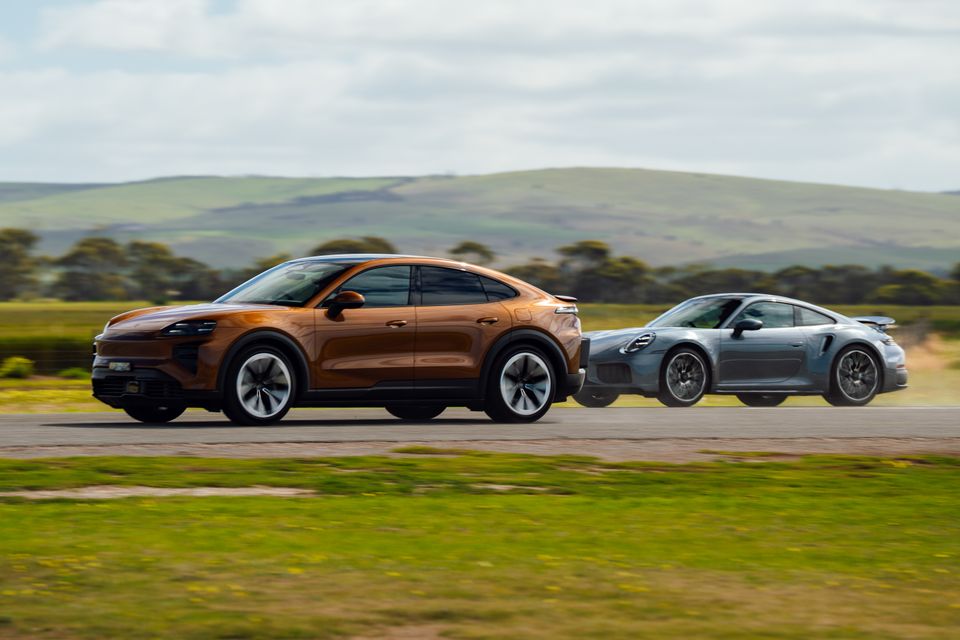
For reference, said 911 Turbo S coupe boasts 523kW/800Nm from its twin-turbo 3.6-litre flat six, good for a Cayenne Turbo-matching 2.5-second 0-100km/h claim, while 0-200km/h takes 8.5 seconds. Yep, the Cayenne is a whole second quicker to 200km/h than a 911 Turbo S.
So naturally, the two Turbos went out for acceleration runs on the airstrip, with the Turbo Coupe also being pitted against the 911 Turbo S by Porsche's event team.
As you may have seen on our social channels, the Cayenne Turbo Electric comfortably outpaced the Turbo S on the airstrip, before media then experienced the high-performance SUV at full tilt up and down the same runway.
Now I've experienced a lot of fast cars in my time, but there's something about the way the Cayenne Turbo Electric delivers its monstrous power that left a rather profound impression on me.
It's almost too easy to launch, and off the line there might be a slight scrabble from the tyres before you're firing towards the horizon at what feels like warp speed. As Matt Robinson described after his global launch drive, it's best described as being shot out of a cannon.
Indeed, for my second and third goes at this test, I had to start from different spots as the big EV had been digging out bits of tarmac as it launched. Keep in mind this large SUV weighs 2.6 tonnes.
Cayenne S Electric
After finishing day one with a brief beach drive and plenty more country highways that were either just straight or with long, sweeping curves, day two was a bit more interesting.
First up I took the base Cayenne Coupe Electric on a 30-minute road loop on much the same as the previous day's high-speed, straight country highways, though there was a section with a light gravel road which wasn't quite all dirt but still a good test of the Cayenne's ride on an unsealed surface, as well as sound insulation.
As I found on coarse-chip bitumen the day prior, the base Cayenne is a lovely, luxurious tourer, with the nameplate's core DNA coming through even in its base trim.
With up to 325kW and 800Nm from its dual-motor powertrain, even the standard Cayenne Electric has more than enough grunt for most, with its 0-100km/h claim being only a fraction of a second slower than that of the twin-turbo V8-engined 'E3' Cayenne GTS.
Ready to buy? We’ll help you get a great deal.
If this is the car for you, we’ll compare offers from trusted dealers, handle the back and forth and manage your purchase from enquiry to delivery.
That said, the optional Porsche Electric Sport Sound ($970) leaves me with mixed feelings.
On one hand I appreciate some aural feedback when driving a zero-emissions vehicle, and the fact that Porsche hasn't simply pumped fake ICE sounds into the cabin.
But, particularly in the more performance-oriented grades, I just don't know if the chosen sound really gels with the whole experience... It's just a little too Jetsons for me.
Also, given how quick even the base Cayenne Electric is, the Push-to-Pass function on the S and Turbo almost seems redundant – I don't think anyone is going to have trouble overtaking in this, even in Comfort mode.
Cayenne Turbo Electric
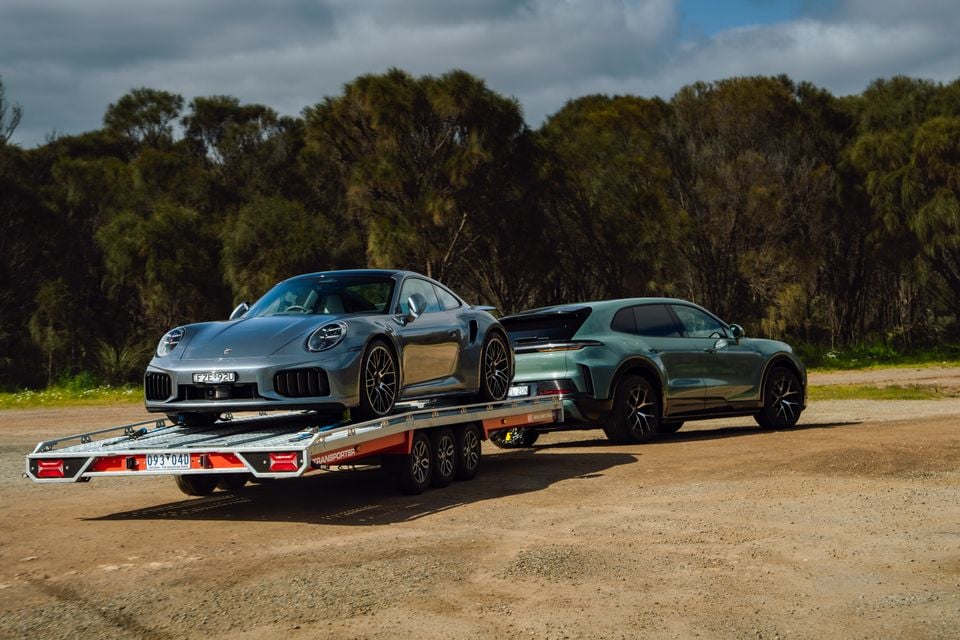
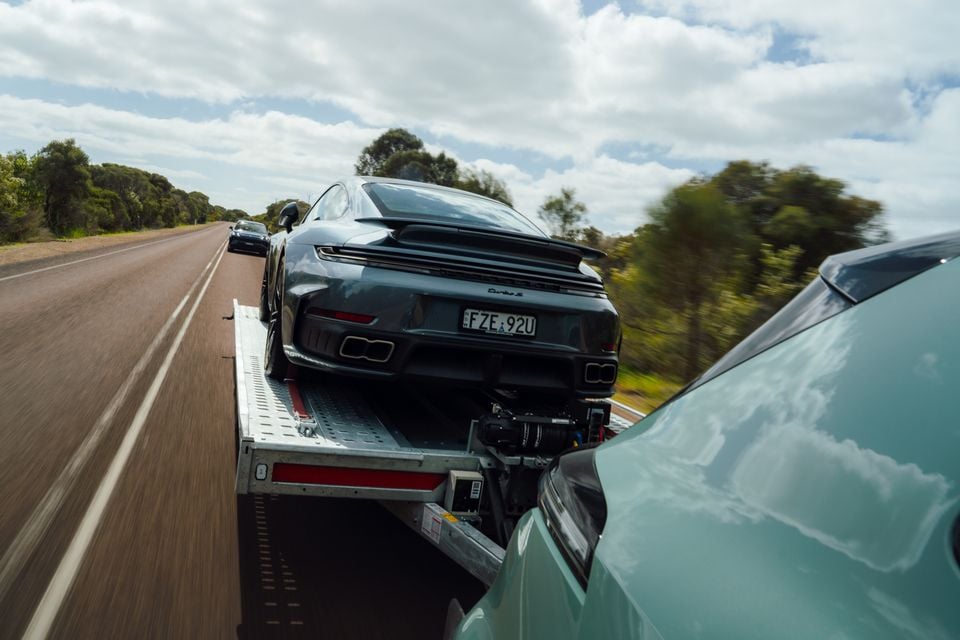
Moving to the towing test, we had the 911 Turbo S from the first day's drag race hooked up to the back of a Cayenne Turbo Electric on a trailer, which we were told equated to about 3.0 tonnes all up – the 911 on its own quotes an unladen weight of 1725kg.
A circa-20-minute drive loop on high-speed B-roads with plenty of uneven surfaces revealed the Cayenne EV to be rock-solid with a trailer on the back, with its bountiful reserves of power and torque making for smooth and effortless progress, while the air suspension balanced out the ride nicely.
Only on the odd occasion where the trailer bobbed over a bump were we alerted that there was anything on the back, but the energy consumption readout quickly ascended into the mid- to high-30kWh/100km realm – so if you're going to tow for long distances, best check there are chargers on your route.
As with its predecessors, the Cayenne Electric is more than capable of towing over 3.0 tonnes, and there are few electric vehicles with a maximum 3500kg tow rating like this that maintain such polished on-road manners.
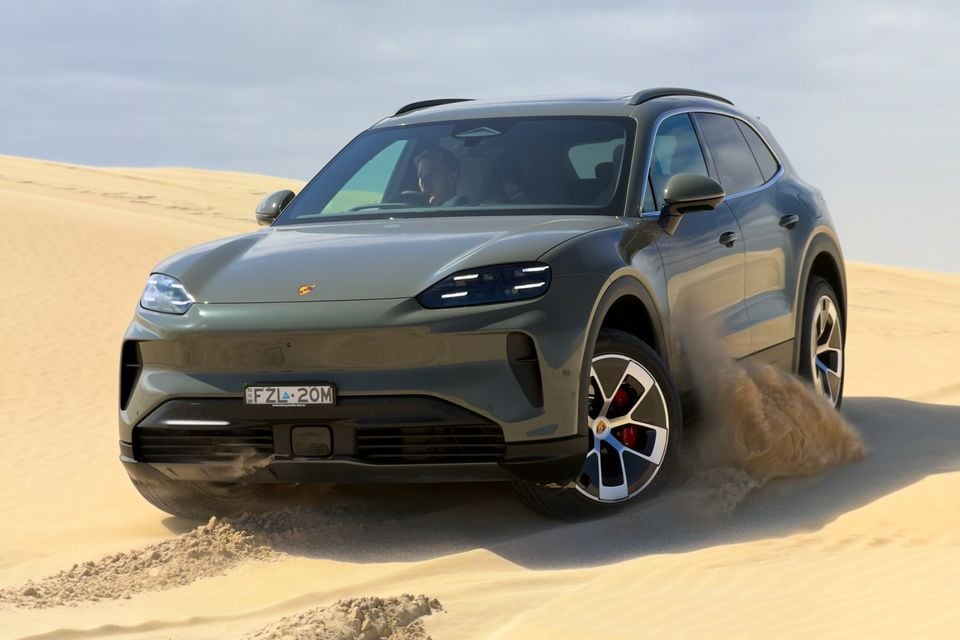
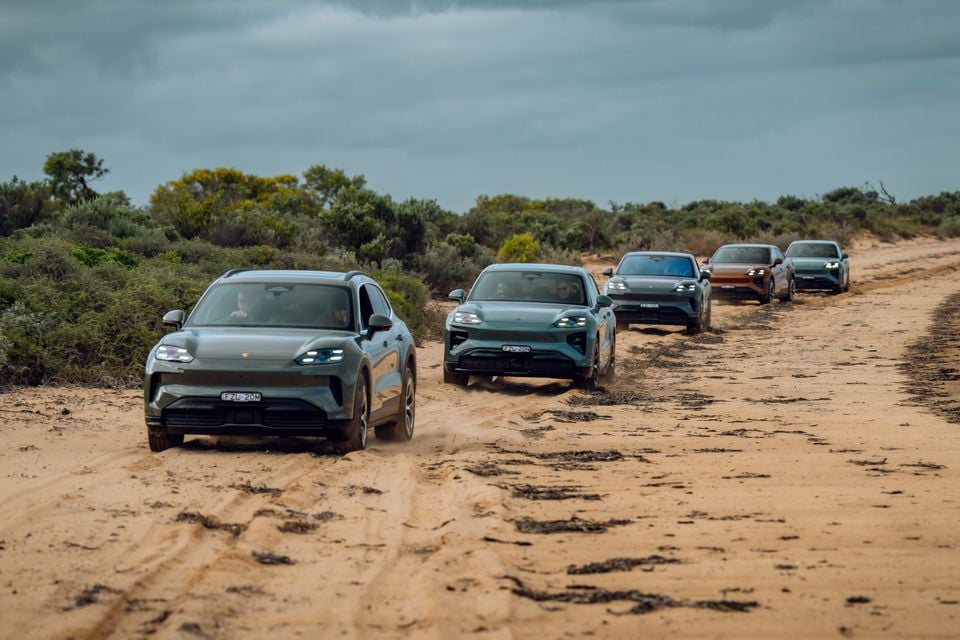
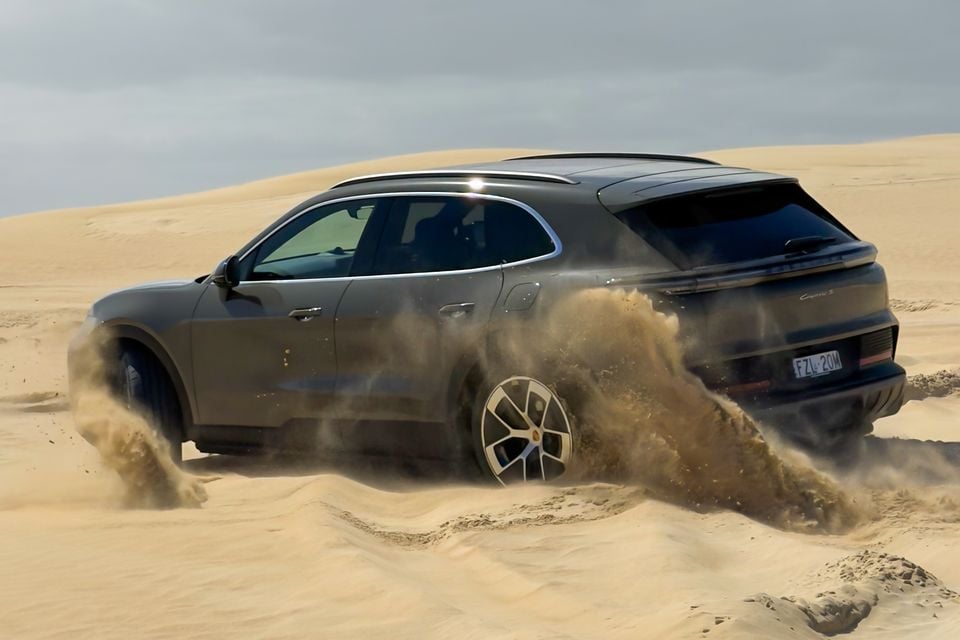
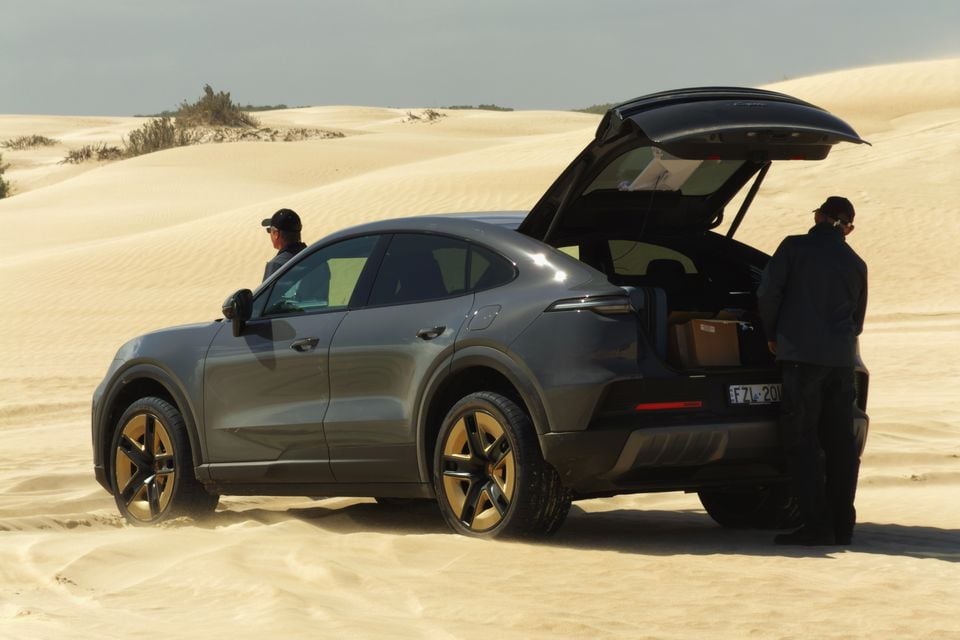
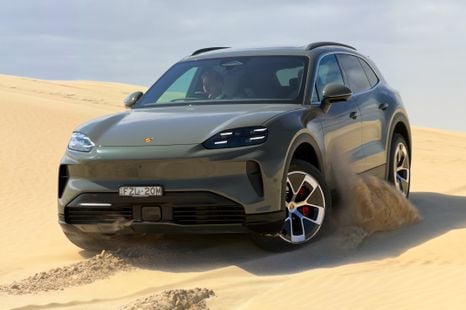
Our final activity saw us ascend the rocky trails into Coffin Bay National Park, where we were afforded the opportunity to have some fun throwing the Cayenne around the seemingly endless rolling dunes of sand.
We enjoyed doing sand doughnuts and climbing some of the taller mounds, though a couple of us did manage to beach the heavy SUV on some softer mounds – which would have bogged more serious 4WDs as well.
Considering we were driving vehicles with 22-inch wheels and road-biased tyres, the level of grip and ability these things have off-road is pretty impressive.
Most of the test cars were also fitted with the optional Off-Road Package ($3710) which adds a modified front apron that improves the approach angle to 25 degrees, as well as an Off-Road driving mode which also raises the air suspension even higher.
Off-road dimensions
Porsche Cayenne Electric*
Track front and rear
-
Ground clearance
190mm
Approach angle
14.9 degrees
Departure angle
18.7 degrees
Ramp breakover angle
14.6 degrees
Wading depth
-
*Not including optional Off-Road Package
Sadly, while the breadth of conditions during this launch drive was quite good, there wasn't much in the way of dynamic on-road driving scheduled in, bar the road loop I mentioned earlier.
Given Porsche's vehicles are pitched as driver's cars regardless of the variant, it seemed like an odd oversight that we didn't get a chance to take any of the Cayenne Electric range through some twisties.
Some may think it was an intentional ploy not to unearth any dynamic inadequacies, though by all accounts from global drives this Cayenne is a genuine Porsche SUV on a winding road.
Porsche's choice of location was partly to blame, as the bulk of roads in and around Port Lincoln are pretty boring B-roads as I mentioned earlier. So we'll withhold full judgement on the dynamics for now.
Cayenne S Electric
For the same reasons, the suite of assistance systems weren't tested in that much depth either, but we used a few here and there.
Adaptive cruise control works as you'd expect, and the lane-keep system wasn't too intrusive or overzealous on single-lane roads with jagged road edges.
The surround camera offers a good field of view and resolution, and there are plenty of views to play around with to help prevent you scraping a wheel or knocking something in the carpark.
It's just odd that, despite the excellent touring capabilities the electric Cayenne so clearly possesses, Porsche (and other VW Group brands more broadly) haven't figured out a way to get their latest semi-autonomous driver assists into its latest EV based on the PPE platform – there's no lane-centring or predictive speed assists here.
To see how the Porsche Cayenne Electric lines up against the competition, check out our comparison tool
What do you get?
The Cayenne Electric, like other Porsche models in Australia, gets a few extra bits of kit over the baseline standard global specification.
Standard equipment highlights include:
20-inch alloy wheels
255/55 front, 305/45 rear tyres
375mm front, 350mm rear brakes
Adaptive air suspension
incl. Porsche Active Suspension Management – PASM
Power steering Plus
Tyre pressure monitoring
Matrix LED headlights
Dual-zone automatic climate control
Parking pre-climatisation
Electric rear seats (2+1) with electric backrest angle
Comfort access incl. Porsche Digital Key
Soft-close doors
Partial leather interior, Black
Heated multifunction steering wheel, leather
Electric steering column adjustment
Door sill guards in Aluminium incl. model designation
14.2-inch curved OLED digital instrument cluster
12.25-inch Porsche Communication management – PCM
incl. online navigation
incl. Voice Pilot
Wireless Apple CarPlay, Android Auto
Porsche Connect
Emergency call systems – eCall and bCall
Sound Package Plus
10 speakers
150 Watts total output
Automatic tailgate incl. Gesture Control
Heat pump
Additional Australian specification includes:
Tyre fit set
Rear privacy glass
Parking Entry Package
Surround View cameras
Self-Steering ParkAssist
DAB digital radio
'Dreams' exterior paint range – Cayenne
14-way electric comfort seats incl. memory – Cayenne, Cayenne S
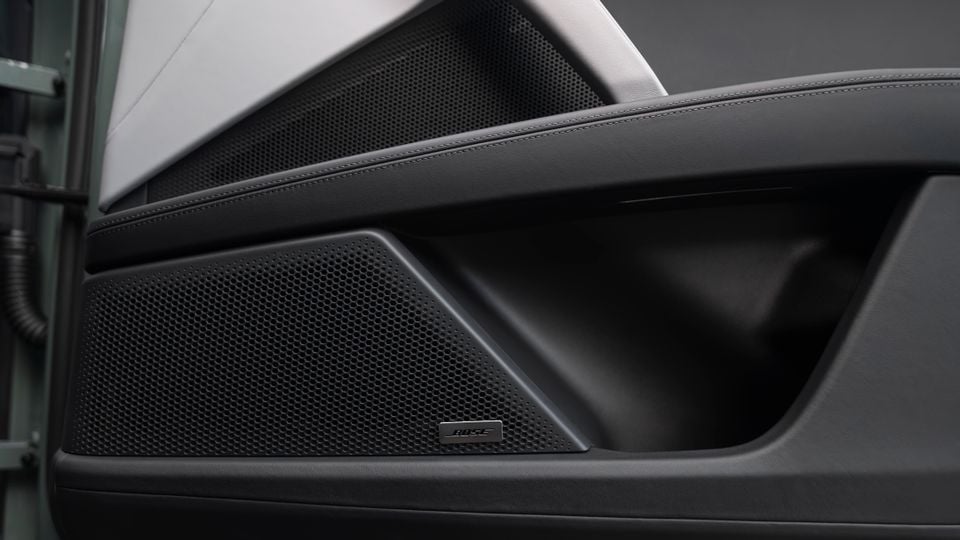
Bose surround sound system – Cayenne S
Panoramic roof – Cayenne S
Seat ventilation, front – Cayenne S
4-zone automatic climate control – Cayenne S
To see how the Porsche Cayenne Electric lines up against the competition, check out our comparison tool
Is the Porsche Cayenne Electric safe?
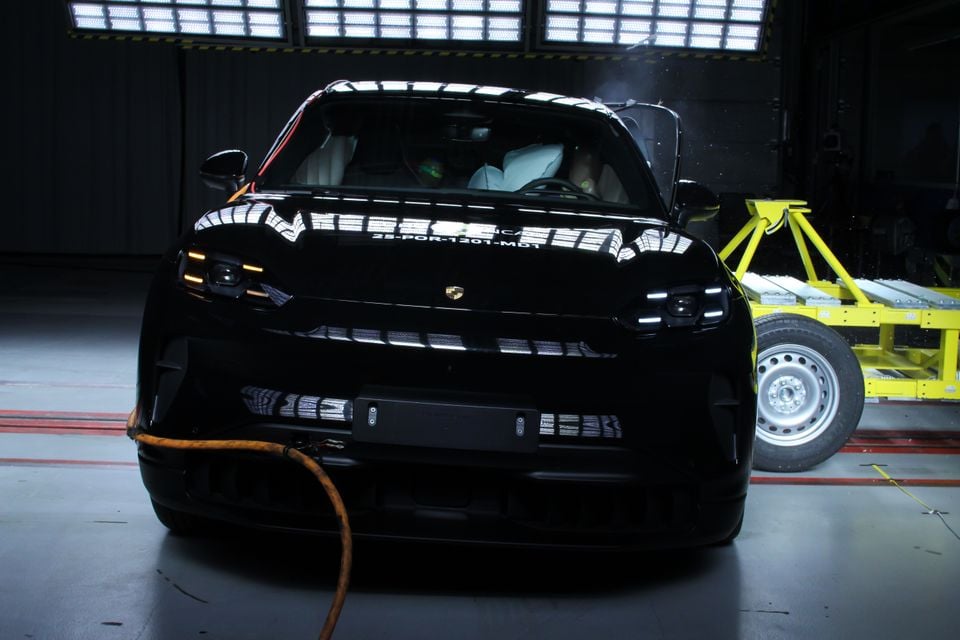
Porsche has never received a local ANCAP safety rating, though the Cayenne Electric has already scored five stars in Euro NCAP testing based on 2025 protocols.
Category
Porsche Cayenne Electric*
Adult occupant protection
91 per cent
Child occupant protection
89 per cent
Vulnerable road user protection
81 per cent
Safety assist
79 per cent
*Euro NCAP scoring
Standard safety equipment includes:
8 airbags
Adaptive cruise control
Autonomous emergency braking
incl. pedestrian detection
Driver fatigue detection
Forward collision warning
Intersection assist – AEB
Lane Change Assist – blind-spot monitor
Lane keeping assist
incl. emergency stop function
Swerve and Turn Assist
Traffic sign recognition
It appears local Cayenne Electric models aren't available with Porsche's InnoDrive Package, which adds active lane-centring as well as predictive speed control and traffic sign recognition to effectively deliver Level 2 semi-autonomous driving capability.
To see how the Porsche Cayenne Electric lines up against the competition, check out our comparison tool
How much does the Porsche Cayenne Electric cost to run?
Porsche Cars Australia continues with a short three-year warranty in Australia, with no mileage cap. There's no capped-price servicing program, with pricing available on request from your preferred Porsche Centre.
Servicing and Warranty
Porsche Cayenne Electric
Warranty
3 years, unlimited kilometres – Vehicle 8 years or 160,000km – Battery 12 years – Rust
Roadside assistance
3 years, then service activated
Service intervals
2 years or 30,000km
Capped-price servicing
-
Average annual service cost
-
Total capped-price service cost
-
The length of Porsche's warranty and a lack of advertised service pricing can be seen as lagging behind rival makes and models, though this doesn't appear to be that much of a deterrent for existing owners.
The high-voltage battery warranty and service intervals are lengthy and match the segment benchmarks, while the marque's roadside assistance program is free for the warranty period, and then renewed for 12 months with each service at an authorised Porsche Centre.
To see how the Porsche Cayenne Electric lines up against the competition, check out our comparison tool
CarExpert's Take on the Porsche Cayenne Electric
Like the smaller Macan Electric, the Porsche Cayenne Electric still feels mostly like a Cayenne in its transformation to battery-only power.
Save for the lack of a singing V6 or V8 soundtrack under acceleration, the new Cayenne Electric offers the sort of sports car performance and luxurious touring ability that Porsche's original SUV nameplate has always been known for.
The monstrous performance of the Turbo versions will no doubt pique the interest of traffic light dragsters obsessed with having an SUV that can outpace a 911 Turbo, but the 'purists' (can you even call Porsche SUV fans that?) will still lament the full electrification of Porsche's luxury overlander.
Said Turbo is tens of thousands cheaper than the go-fast versions of the petrol-fired 'E3' Cayenne range, while even the base grade delivers acceleration performance that's competitive with the V8-powered Cayenne GTS, which also costs tens of thousands more.
But performance, refinement and technology talents aside, those wanting a soulful Porsche experience may still be left wanting...
Cayenne Turbo Electric
The digitised interface and available synthesised powertrain sounds, while creative and a contemporary take on the Porsche formula, are a far cry from the traditional, tactile interiors of Cayennes of old, and there's no amount of immediate torque that can replace the smile-inducing experience of revving out a V6 or V8 powered Cayenne.
Personally, I'm also not the biggest fan of the interior design, which looks a little fussy and avant-garde for the sake of it. A refresh of the outgoing model's fine interior would have been more than enough to keep Porsche loyalists happy. And as is Porsche tradition, the breadth of options and personalisation is vast, but also incredibly expensive.
All that said, Porsche has honourably committed to continuing to offer customers choice, be it powertrain, body style, or specification. If you're not sold on the EV dream just yet, you can turn to the ICE and PHEV versions of the Cayenne that will likely be sitting alongside this new model on the showroom floor.
And while there may still be question marks over real-world efficiency and we're yet to verify our overseas appraisal of on-road handling, it must be said that Porsche has created a highly capable electric SUV which should be approached with an open mind and a deep wallet – whether you're a returning Porsche customer or new to the brand.
Cayenne Coupe Electric
CarExpert can save you thousands on a new Porsche Cayenne Electric. Click here to get a great deal.
The Porsche Cayenne's new 'Electric' chapter is a technological marvel, with stonking acceleration, beautiful steering feel and excellent on-road refinement. While loyalists may find the design and the powertrain polarising, and there's a question mark over real-world efficiency, it drives like a Cayenne should.
The Porsche Cayenne's new 'Electric' chapter is a technological marvel, with stonking acceleration, beautiful steering feel and excellent on-road refinement. While loyalists may find the design and the powertrain polarising, and there's a question mark over real-world efficiency, it drives like a Cayenne should.
† Displayed prices are based on the drive-away price of the vehicle, which includes delivery charges, registration fees, number plates, and applicable road taxes, based on a Sydney location. However, prices may vary between states and territories, and additional costs such as compulsory third party (CTP) insurance, dealer delivery fees, and optional extras are not included. These prices are subject to change without notice and may not reflect current market pricing or dealer offers.
Automotive Vehicle Spec Data & 4K images Powered by JATO Dynamics Ltd













 Automotive Vehicle Spec Data & 4K images Powered by JATO Dynamics Ltd