





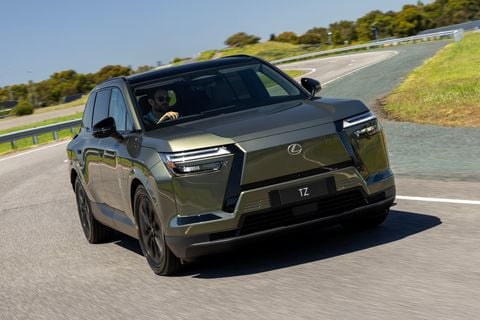
2027 Lexus TZ review: Quick drive
The new three-row Lexus TZ electric SUV isn't due to arrive in Australia until late 2027, but we've had a quick spin to see what's in store.

CarExpert's take on the TZ

What we love
- Incredibly spacious in all three rows
- Smooth and composed on the move
- Something new for Lexus Australia
Worth a thought
- Likely to be very expensive
- Underwhelming base-spec driving range
- Not here for another year
Introduction
Lexus is gearing up to revitalise its presence in Australia's three-row crossover SUV segment, and it's doing so with an electric vehicle (EV) for the first time.
This is the Lexus TZ, a big new three-row, six-seat, car-based luxury SUV that'll be available exclusively as a dual-motor EV. The Japanese premium brand isn't new to three-row vehicles, fielding the RX, GX, and LX for several years, but there are some caveats.
The RX is smaller and currently sold only as a five-seater despite offering seven-seat capacity in the previous-generation RX L, and the more rugged GX and LX are built more for off-road capability and feature body-on-frame construction. The TZ is monocoque-based and designed exclusively to be a three-row SUV, prioritising passenger comfort.
However, it's not the first time Lexus has made such a vehicle. The TX has been a regular model in the US since 2023, but it isn't electric and it's only ever been built in left-hand drive.
But while the TZ was initially revealed in left-hand drive for the US market, it'll also be built in right-hand drive in Japan for domestic sale. This has paved the way for an Australian launch, and incoming models will indeed be sourced from Japan.
Like the only electric Lexus SUV currently sold in Australia, the RZ, the TZ also has siblings from Toyota and Subaru.
These are the Toyota Highlander EV – effectively an electric replacement for the North American Kluger – and the Subaru Getaway. Weirdly, the Lexus is the only one of this trio confirmed for RHD production.
And so, Lexus Australia invited media to Toyota's test track in Altona, Melbourne, for an incredibly brief first look. The TZ won't actually arrive in Australian showrooms until the second half of 2027, so this preview almost feels a bit premature.
Still, here's what Lexus has in store.
How much does the Lexus TZ cost?
As was the case for the updated NX, Lexus Australia has given no indication of pricing for the TZ. All we know is that there will be at least two variants, with only TZ450e Luxury and TZ550e Sports Luxury trims confirmed for local showrooms so far.
We can't even offer an accurate estimate, as Lexus has never sold a model like the TZ in Australia before. The best we can do is look at its existing electric SUV, the RZ, and its existing three-row SUVs, the GX and LX.
The permanent RZ range – excluding the limited-edition RZ600e F Sport Performance flagship – tops out at $104,920 before on-road costs for the RZ550e F Sport.
The GX, meanwhile, starts at $118,320 plus ORCs, while the LX starts at $164,200 plus ORCs. As such, it's reasonable to expect the TZ to start above $100,000.
When it lands here, the TZ will compete with other large electric three-row SUVs like the Kia EV9 (from $97,155 plus ORCs), the Volvo EX90 (from $106,990 plus ORCs), the Cadillac Vistiq (from $116,000 plus ORCs), and the Hyundai Ioniq 9 (from $119,668 plus ORCs).
For some context, the base TZ450e Premium starts at $64,050 in the United States, roughly $96,500 AUD. However, the TZ450e Luxury is listed at US$80,550 – roughly AU$121,000.
Compare the Lexus TZ
Want to see how the Lexus TZ lines up against the competition?
Use our comparison tool for a side-by-side look at the specs, features and prices of the TZ and its rivals.
What is the Lexus TZ like on the inside?
We saw it first with the ES sedan, then the new NX mid-size SUV, and now the TZ – Lexus interiors are becoming very same-same.
Interestingly, this interior doesn't feel quite as jarring in the TZ as it did in the two models before it, and we think that's because there's nothing to compare it against. The ES and NX had sleek, recognisable interiors in the past, but the TZ has no past.
It therefore feels as fresh as the nameplate does, even if it's far from characterful. It's actually somewhat clinical with its straight edges and minimalist vibe, even if Lexus has been careful to avoid the full button-less Tesla treatment.
Gracing the TZ cabin are the brand's drawcard 'hidden' interior buttons. These are a unique solution to a problem that didn't really exist, as the array of physical buttons vanishes into the steering wheel and dashboard until you wave your hand nearby to light them up.
It's a bit of a gimmick, sure, but at least they are real buttons that click when pressed. If you prefer, you can tick a box in the vehicle settings menu to keep them illuminated permanently. Generally, though, we expect a small learning curve here.
In contrast, the TZ's infotainment system appears to be fairly intuitive. The latest generation of Lexus infotainment software is housed within a prominent 14.0-inch touchscreen, and it's all quite attractive and lacks any input lag.
However, some physical controls, like the large temperature dials in older Lexuses, have been discarded. In their place is an always-on climate ribbon at the bottom of the screen, and dedicated hidden buttons in a thin strip below the infotainment unit.
It's not quite as stylish as before, but it gets the job done. We'd still like to see a bit more physicality back in Lexus cars, because this feels like it's getting a bit too close to the screen-heavy focus seen in far cheaper models from brands that Lexus wouldn't even consider rivals.
That said, it's laid out more logically than in the EV9 with its inconvenient three-screen approach, and Lexus still holds a considerable advantage in terms of build quality and material choice. Even in pre-production form, everything in the TZ feels rock-solid.
And the materials are undeniably plush, with no shortage of soft-touch surfaces up front. A highlight is the steering wheel, because its small-diameter rim and smooth leather wrap feel excellent to hold.
Additionally, the seats are fairly comfortable, and there's a strong range of powered adjustment for both the driver's seat and steering wheel. The fundamental touchpoints all seem well-considered, as they should be in any Lexus.
Still, the steering wheel has a huge number of hidden buttons that'll take a moment to learn. They're all real buttons, complemented by a pair of large bi-directional switches, and the lack of glossy black plastic means it should all be fairly durable.
And to round out the tech, we'll touch on the 12.3-inch instrument display. This odd-shaped screen looks good graphically, and fits the more techy ambience of the TZ's cabin nicely. You can flick through a couple of different layouts and info readouts using the wheel's buttons.
As its exterior proportions might suggest, there's plenty of space inside the TZ. Interestingly, though, storage options up front are pretty much on par with the smaller NX, limited to cupholders and wireless phone chargers on the centre console, along with door-card bottle holders and a central storage box, albeit complemented by a large tray under the console.
Moving further towards the rear of the vehicle reveals more of the TZ's passenger focus. Fitted in the second row as standard are two captain's chairs in lieu of a full-width bench, which are nicely padded and very comfortable.
They're accented with ratcheting armrests, and international information suggests they'll also have heating, ventilation, and power-adjustable ottomans. There's a good range of adjustment in all directions, and a helpful box on the floor between the seats offers a bit of storage space.
To access the third row, you have to lift a flap on the side of each captain's chair and manually slide it forward. We couldn't identify another method during our limited time with the car.
Still, both seats slide forward massively, and third-row ingress is easy enough. There are even small plastic handles on the interior walls below the C-pillars to help pull yourself in.
Once seated, we found the bench seat was surprisingly soft for a back-row pew. Adults could easily spend time back here, and at 173cm tall I had ample headroom – even the standard panoramic glass roof had no major impact. The sliding captain's chairs help to open up some legroom, too.
Unfortunately, there's a lot of scratchy plastic back here, and the armrests on the interior walls are very hard. Some more padding would be very welcome here, but at least some comfort is restored by the roof-mounted air vents.
The third row folds electrically and can be controlled via several switches in various places for added convenience. However, they move very slowly, which might be annoying if you're trying to load or unload in a hurry, or if it's raining.
While still workable with the rear seats in place, the boot is properly cavernous when they're folded neatly into the floor. There isn't a whole lot to unpack here, but there is a power tailgate as standard.
And although Lexus hasn't confirmed spare wheel details, we don't expect the TZ to offer one. Every other EV from Lexus and Toyota only gets a tyre repair kit, so this one will almost certainly follow suit.
Oh, and there's no under-bonnet storage.
| Dimensions | Lexus TZ |
|---|---|
| Length | 5100mm |
| Width | 1990mm |
| Height | 1705mm |
| Wheelbase | 3050mm |
| Cargo capacity (VDA) | 290-2017L |
To see how the Lexus TZ stacks up against the competition, check out our comparison tool
What's under the bonnet?
At least two TZ variants will be available in Australia, with two different batteries confirmed so far. Very few details have been published for the base TZ450e globally, so the table below is primarily based on the TZ550e.
| Specifications | Lexus TZ550e |
|---|---|
| Drivetrain | Dual-motor electric |
| Battery | 95.82kWh Li-ion (76.96kWh Li-ion – TZ450e) |
| Front motor outputs | 167kW / 268Nm |
| Rear motor outputs | 167kW / 268Nm |
| Peak system outputs | 300kW Torque TBC |
| Drive type | All-wheel drive |
| Weight | 2630kg |
| 0-100km/h (claimed) | 5.4 seconds |
| Claimed range (WLTP) | 540km (440km – TZ450e) |
| Max AC charge rate | 22kW |
| Max DC charge rate | 150kW (35min 10-80 per cent) |
| Braked tow capacity | 1500kg |
The above specifications are based on global information and may not necessarily reflect Australian-delivered models. So far, the only confirmed Australian specifications are battery capacity and claimed driving range for both trims.
According to US specifications, the TZ450e has a reduced peak power output of 308hp (230kW), and the Australian-delivered version may be the same.
To see how the Lexus TZ stacks up against the competition, check out our comparison tool
How does the Lexus TZ drive?
Our first taste of the TZ was limited to a 15-minute drive around Toyota's short test course in Altona, Melbourne, so our initial impressions aren't exactly comprehensive.
In addition to the burden of very strict speed limits, the circuit is incredibly smooth and has zero elevation change. It was therefore impossible to push the TZ's limits beyond acceleration and braking, and we only drove the base TZ450e.
Even so, we found some commendable aspects. We quite enjoyed the driving position, because the high driver's seat provides strong vision out and over the huge sculpted bonnet.
In fact, it feels somewhat like the GX in this sense. Both SUVs have narrow (read: 'fast') windscreens relative to their overall size, yet the commanding vantage point mitigates any visibility limitations that could arise from that and the large bonnet.
Yet the TZ feels more planted than the GX, thanks to its reduced ground clearance and considerably lower centre of gravity. Lexus explicitly mentioned this trait, but it's something we'd have expected anyway, given the heavy battery pack is mounted in the floor.
As a result, the TZ doesn't quite feel as large as we expected on the move, and its relatively low roofline helps a lot here. It's up to 230mm lower than the GX and 190mm lower than the LX, and fundamentally different from both thanks to its monocoque rather than ladder-frame construction.
Of course, we don't have a full picture of the TZ's ride and comfort compared to those two off-road SUVs just yet, but we'd expect it to be smoother and less jittery on rougher sealed roads. It almost certainly won't be as capable off-road, but that's not what it's for.
We can, however, assess the steering, which feels considerably more car-like than in the other big Lexus SUVs, with a direct feel and a relatively short ratio. The smaller-diameter steering wheel also makes the TZ feel more agile and less bloated.
Body roll doesn't seem too bad, and it generally seems capable of handling its 2.6-tonne heft well. It's a big rig, so we're interested to see how well Lexus has masked that weight penalty when we drive one at length.
As for the powertrain, it seems as well-calibrated as any other Toyota/Lexus EV. Power delivery is smooth and predictable, and the throttle is easy to read in Normal mode. Naturally, Sport mode sharpens things up nicely.
Performance is strong in the TZ450e, but it didn't feel like we had 300kW on tap, suggesting the base trim will indeed be limited to 230kW. That's no big deal, as it's still more than capable of getting up and going without much effort.
Initial acceleration is a highlight, as it is in most EVs. It's just that as the speed climbs the TZ450e seems to need a bit more power, a deficit the TZ550e's additional 70kW will almost certainly fix.
Braking, meanwhile, feels good. The physical pedal feels solid and, in typical Toyota fashion, the steering wheel paddles control regenerative braking strength. While there's no true one-pedal drive mode, we love the convenience of being able to adjust regen without diving into the touchscreen.
You do still have to use the touchscreen to flick between the different drive modes, as there are no dedicated buttons on the centre console. The ES and NX are the same, and it can be fiddly, even if you can customise the infotainment home screen to feature a huge drive mode shortcut.
But all up, the TZ seems quite solid. On first acquaintance it behaves well, and we couldn't find anything genuinely alarming. There are still question marks over weight management and safety technology, but even the pre-production cars seem to have the fundamentals sorted.
The challenge will be keeping all this in mind until the model's local launch, because a year is an awfully long time to wait.
To see how the Lexus TZ stacks up against the competition, check out our comparison tool
What do you get?
Lexus Australia has confirmed the TZ450e Luxury and TZ550e Sports Luxury grades for local sale, but standard equipment has yet to be confirmed. The list below is based on global information.
2027 Lexus TZ equipment highlights (preliminary):
- 20- or 22-inch alloy wheels
- Rear-wheel steering – variant-specific
- LED headlights and tail-lights
- Steering wheel paddle shifters – regenerative braking
- Synthetic leather seat upholstery
- Heated and ventilated front seats
- Second-row captain's chairs
- Heated and ventilated second-row seats
- Power-adjustable ottomans for the front passenger and second row
- Simulated gears and synthesised engine noise – variant-specific
- 12.3-inch digital instrument display
- 14.0-inch touchscreen infotainment system
- 21-speaker Mark Levinson sound system – variant-specific
- Panoramic glass roof
- Power tailgate
- Power-folding third-row seats
- Interior ambient lighting
- Rear Comfort mode – variant-specific
- 'Sensory Concierge' interior modes – variant-specific
- Five interior fragrances
To see how the Lexus TZ stacks up against the competition, check out our comparison tool
Is the Lexus TZ safe?
The Lexus TZ has yet to be crash-tested by any independent safety authority and is therefore unrated.
Safety equipment highlights (preliminary):
- Autonomous emergency braking
- Adaptive cruise control
- Blind-spot monitoring
- Driver attention monitoring
- Emergency Driving Stop System (autonomous safety stop if driver is unresponsive)
- Lane-change assist
- Lane-trace assist
- Traffic sign recognition
- Surround-view monitor
To see how the Lexus TZ stacks up against the competition, check out our comparison tool
How much does the Lexus TZ cost to run?
Lexus Australia backs its range with a five-year, unlimited-kilometre warranty, and its high-voltage batteries are warranted for eight years or 160,000km. TZ servicing information has yet to be announced.
| Servicing and Warranty | Lexus TZ |
|---|---|
| Vehicle warranty | 5 years, unlimited kilometres |
| High-voltage battery warranty | 8 years, 160,000km |
| Roadside assistance | 5 years (Lexus Encore) |
| Service intervals | TBC |
| Capped-price servicing | TBC |
| Average annual service cost | TBC |
| Total capped-price service cost | TBC |
To see how the Lexus TZ stacks up against the competition, check out our comparison tool
CarExpert's Take on the Lexus TZ
There's plenty to like about the TZ, and it's good to see Lexus branching into an unfamiliar segment in Australia.
It's as smooth as we've come to expect from Lexus EVs, and was pleasant enough to drive during our short time behind the wheel. Interior build quality is strong, and the third row is far more comfortable than we expected.
That doesn't mean the interior is particularly characterful in the same way as Lexus models of old, and it's interesting to now see the exact same interior treatment across the brand's vehicles in multiple different segments.
There are also still some sticking points. The 440km driving range in the TZ450e doesn't sound particularly competitive for a vehicle like this, and it's likely to be very expensive when it lands here next year.
Still, Lexus knows this model won't be a volume-seller, and the TZ's fundamentals are where they need to be for the time being. It'll be interesting to see how that develops – a lot can happen in 12 months.
CarExpert can save you thousands on a new Lexus TZ. Click here to get a great deal.
Click the images for the full gallery







 Automotive Vehicle Spec Data & 4K images Powered by JATO Dynamics Ltd