





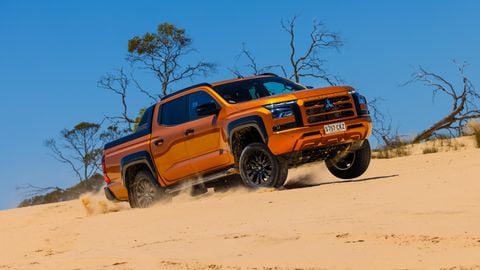
2024 Mitsubishi Triton review: First drive
There's a brand new Triton just around the corner. We had the chance to drive pre-production vehicles before it goes on sale early next year.

- Model tested
- 2024 Mitsubishi Triton
- Drive-away from
- $48,666†Better deals with CarExpert
Introduction
It’s one of the most important new models for Mitsubishi – the all-new Triton.
We’ve finally had our first chance to get behind the wheel of the new Triton at an off-road setting in regional South Australia – it’s also the same place the team from Mitsubishi spent time developing the vehicle’s off-road controls earlier in the year.
We had the chance to drive the 2024 Mitsubishi Triton GLS (with leather option) and the 2024 Mitsubishi Triton GSR. It was only a brief drive on sand and over rocks, with a proper drive coming ahead of the car’s launch in February 2024.
How much does the Mitsubishi Triton cost?
2024 Mitsubishi Triton pricing:
- 2024 Mitsubishi Triton GLX 4×2 dual-cab ute: $43,690 (+$3250)
- 2024 Mitsubishi Triton GLX+ 4×4 club-cab ute: $50,340 (+$4900)
- 2024 Mitsubishi Triton GLX 4×4 dual-cab ute: $50,940 (+$6250)
- 2024 Mitsubishi Triton GLX+ 4×4 dual-cab ute: $53,290 (+$6100)
- 2024 Mitsubishi Triton GLS 4×4 dual-cab ute: $59,090 (+$7600)
- 2024 Mitsubishi Triton GSR 4×4 dual-cab ute: $63,840 (+$6900)
You can see more detail in our 2024 Mitsubishi Triton pricing and specifications article.
What’s under the bonnet?
All 2024 Mitsubishi Triton models use a 2.4-litre bi-turbo four-cylinder diesel engine with 150kW of power at 3500rpm and 470Nm of torque from 1500 to 2750rpm.
It’s mated with an updated six-speed automatic transmission. A six-speed manual will be offered on some variants after the Triton’s launch.
GLX and GLX+ models offer an Easy Select 4WD system with selectable low- and high-range gearing; the GLX+ also features a locking rear differential.
GLS and GSR models get the Super Select 4WD II system, which also features a full-time four-wheel drive mode for use on tarmac. They also receive terrain control and hill descent control.
How does the Mitsubishi Triton drive?
Our time behind the wheel was only brief, with a short stint at Mitsubishi’s sand test facility. Immediately off the bat you can feel that the Triton has become significantly sharper in terms of throttle response.
Peak torque of 470Nm kicks in from 1500rpm – it’s not as doughy as the outgoing generation, and it feels quite eager to get up and move. The other thing you’ll notice almost immediately is the improved ride.
Local ride and handling work resulted in larger diameter dampers and more effort put into ride compliance both with and without a load. Australia has now been deemed a core market for the Japanese brand, which means the door is open far earlier in terms of product development and input.
It also means they get greater involvement in terms of ride and handling customisation for our market. This dates back to when Mitsubishi used to manufacture cars in Australia and even had its own proving ground (which has now fittingly been turned into a race track).
Gone is the old hydraulic steering system that lacked feel and purpose. The new electrically assisted rack offers a greater deal of communication and feedback through the wheel – there’s enough weight in the rack to make it feel like things are happening, but it’s not prohibitively heavier.
So how did Mitsubishi achieve the added throttle response? The new engine now gets an additional turbocharger, which helps service the lower end of the rev band. This teams with a secondary turbocharger at the top end that sounds off that sharper feel as you lay into the throttle.
Like the previous Triton, new generation gets Super Select, which is Mitsubishi’s branding for its four-wheel drive system.
This newest version offers two-wheel drive high-range for economy (front axle disconnected), 4H that engages the front axle, but importantly allows the vehicle to drive in four-wheel drive on sealed surfaces, which can’t be done in most regular dual-cab utes.
There’s then a four-wheel drive high-range mode that locks the centre differential (called 4HLc) and finally there’s a low-range mode. You’ll also find a rear differential lock and hill descent control.
Further to these manually selected drivetrain modes, there are seven drive modes to choose from – one of them is Sand mode.
We flicked over to 4HLc and entered Sand mode for our drive. The tyres were also deflated to under 20psi to help with traction in the sand. The GLS we first tested was on a set of all-terrain tyres.
The calibration work done to achieve sign off for sand mode at this test area in Peake, South Australia, focussed on how the traction controls work with throttle applications. The vehicle needed to be able to supply enough wheel spin to free itself from sand, but also limit gearshifts that kill momentum.
The end result is a noticeable change between on- and off-road drive modes. As always, these drive modes are there to support a driver that already understands the basics of the terrain they’re driving on.
I’ve driven on sand a number of times (but certainly no expert) and found that the Sand mode was a decent help. It allowed enough wheel slip and enough vehicle rotation before stability control or traction control kicked in again.
I was pretty surprised at how punchy the engine was with revs on board. It was happy to deliver torque sharply and quickly whenever it was required.
It leads me to believe the 470Nm torque figure, despite being down on some of the competitors in the segment, is probably being aided by the vehicle’s weight – given it tips the scales lighter than a Ranger, which packs more torque.
CarExpert’s Take on the Mitsubishi Triton
Our first drive of the new Triton was not only brief, but with pre-production cars and only on sand.
But, based on that very brief first drive, I’m really looking forward to seeing how it performs on the road.
The engine feels markedly different to the outgoing model and that should mean better driving characteristics on-road in comparison.
Let’s see how it all pans out when we get a proper drive early in the new year.
Click the images for the full gallery
BUY: Mitsubishi Triton MORE: Everything Mitsubishi Triton





 Automotive Vehicle Spec Data & 4K images Powered by JATO Dynamics Ltd