





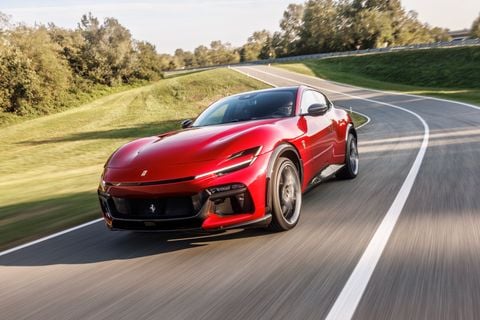
2027 Ferrari Purosangue Handling Speciale review: Quick drive
Ferrari's V12 family hauler gets a sharper chassis, quicker shifts, and a louder exhaust. We tested it at one of Europe's biggest proving grounds.

- Model tested
- 2026 Ferrari Purosangue
- Drive-away from
- $766,518†Better deals with CarExpert
Introduction
The Ferrari Purosangue has had a touch-up. Nothing too crazy, but Ferrari's first four-door, four-seat model now has a new option called the Handling Speciale.
Ferrari has recalibrated the active suspension, sharpened the transmission's shift strategy, and given the exhaust more bark.
Externally, there's not much to set it apart, but the changes underneath are meant to make the big V12 SUV – sorry, Ferrari, 'four-door, four-seater' – feel tighter and more alert.
To find out whether it works, we headed to the Balocco Proving Ground in northern Italy. Owned by Stellantis, it's an enormous facility with a mix of country roads, high-speed bowls, and several circuits. Ferrari does a stack of testing here because it can drive cars without camouflage away from prying eyes. It's the perfect place to see whether the changes hold up.
How much does the Ferrari Purosangue Handling Speciale cost?
Australian pricing for the Handling Speciale hasn't been confirmed yet.
The standard Purosangue is priced from $728,000 before on-road costs. In Italy, the Handling Speciale costs around €430,000 including on-roads – about €40,000 more than the regular car. That works out to roughly A$65,000 at current exchange rates, though local pricing will likely differ.
The first Australian cars are expected to arrive between March and June 2027.
Compare the Ferrari Purosangue
Want to see how the Ferrari Purosangue lines up against the competition?
Use our comparison tool for a side-by-side look at the specs, features and prices of the Purosangue and its rivals.

What is the Ferrari Purosangue Handling Speciale like on the inside?
Inside, the Purosangue remains the same four-seat car as before, with rear-hinged back doors and a 473-litre boot. The Handling Speciale adds a dedicated sill plate and an interior plaque identifying the configuration.
From the outside, you'll need to be a trainspotter to pick one. The giveaways are unique diamond-turned alloy wheels – 22 inches at the front on 255-section tyres, and 23 inches at the rear on 315s, which gives you an idea of how much torque it needs to get to the ground.
There's carbon-fibre trim along the sides and a black rear Prancing Horse emblem.
Probably the biggest giveaway is the matte-black exhaust outlets.
Keep an eye out for what look like headlights up front, too. They're not – they're part of some very cool aero work.
| Dimensions | Ferrari Purosangue |
|---|---|
| Length | 4973mm |
| Width | 2028mm |
| Height | 1589mm |
| Wheelbase | 3018mm |
| Cargo capacity | 473L |
To see how the Ferrari Purosangue lines up against the competition, check out our comparison tool
What's under the bonnet?
There are no changes to the engine itself. The Purosangue is powered by Ferrari's F140 naturally aspirated 6.5-litre V12, mounted front-midship behind the front axle. It produces 533kW (725cv) of power at 7750rpm and 716Nm of torque over 3000-5750rpm.
| Specifications | Ferrari Purosangue Handling Speciale |
|---|---|
| Engine | 6.5L V12 |
| Power | 533kW @ 7750rpm |
| Torque | 716Nm @ 3000-5750rpm |
| Transmission | 8-speed dual-clutch auto |
| Drive type | All-wheel drive |
| Weight | 2033kg |
| 0-100km/h (claimed) | 3.3 seconds |
| Top speed | 310km/h |
| Fuel economy (claimed) | 17.3L/100km |
| Fuel tank capacity | 100L |
| Fuel requirement | 98-octane premium unleaded |
| CO2 emissions | 393g/km |
Drive is sent to all four wheels through an eight-speed dual-clutch transmission mounted at the rear in a transaxle layout, giving the car 49:51 front-to-rear weight distribution. Ferrari claims a 0-100km/h time of 3.3 seconds, 0-200km/h in 10.6 seconds, and a top speed of more than 310km/h.
The changes come in the transmission calibration. Shifts are faster and more decisive, particularly in Race and ESC-Off modes, and in manual mode they're more aggressive above 5500rpm. Ferrari has also sharpened kick-down response, so if you're cruising along in Drive and put your foot down to overtake, it'll drop through the gears much quicker.
The in-cabin sound has also been reworked, with a dedicated setting that's more pronounced at start-up and under acceleration.
To see how the Ferrari Purosangue lines up against the competition, check out our comparison tool
How does the active suspension work?
The suspension is the real party piece, so it's worth explaining.
The Purosangue uses Multimatic's TrueActive Spool Valve dampers. Each corner has its own 48-volt motor connected to a ball screw, which can push and pull the damper independently of what the road is doing. Spool valves inside the damper body manage the flow of oil. If you stand next to the car, you can hear it whirr as it raises and lowers the body.
The system reacts at up to 200Hz, so it can make an enormous number of adjustments every second. It actively fights body roll, pitch, and dive, and the Purosangue makes do without conventional anti-roll bars as a result.
Ferrari says this is the first generation of the technology. The F80 hypercar has a second-generation version, and the electric Luce runs the latest iteration.
For the Handling Speciale, Ferrari has recalibrated the system to reduce body movement under load by 10 per cent. The aim is a tighter, more compact feel through corners and quick direction changes, without wrecking the ride.
To see how the Ferrari Purosangue lines up against the competition, check out our comparison tool
How does the Ferrari Purosangue Handling Speciale drive?
We started on Balocco's slower country-road section.
The Purosangue is bought by many people as a family car and luxury cruiser, so it has to be comfortable. A handling pack that ruins the ride wouldn't go down well with its owners, and Ferrari has clearly tried to strike a balance.
In Comfort mode, on those enormous wheels, the ride is still genuinely comfortable. Balocco's roads are fairly smooth, so I'd reserve judgement until we get it on a broken Australian back road. But having driven plenty of Prancing Horse cars at home, it's remarkable how Ferrari can make a car on wheels this size feel like a cruiser rather than a hardcore sports car.
The Manettino switch on the steering wheel moves between drive modes, while pushing it in changes the suspension setting. In Comfort mode you can pick soft or medium. Switch to Sport, and you can choose between soft, medium, and hard.
On a tight road, the Purosangue holds on beautifully for something so big. It feels like a family car first and a sports car second, and that's exactly what it should be.
Then we moved to the high-speed circuit. I switched to Sport with the hard suspension setting and followed one of Ferrari's test drivers in a pace car, who was absolutely flying.
This thing is outrageous for its size. The track has a lot of compressions and crests that get the car moving around, but the body stays remarkably composed. Mid-corner bumps that should unsettle a 2000kg-plus vehicle barely trouble it. In one section the whole front-end lifts over a crest, and it simply lands and carries on.
There's a big dipper section with heavy compressions on the way down and back up, the kind of thing that makes your stomach drop. The Purosangue handles it without fuss.
It's very stable under brakes, too, and you can roll back on the throttle confidently on corner exit. It gives you plenty of feedback through the steering and seat.
And the sound. In Sport mode, the faster shifts and extra bellow from the exhaust make it sing. Emissions regulations mean Ferrari is a bit more limited in what it can do with noise these days, but above 5500rpm you can hear this thing coming from a mile away. Ferrari's naturally aspirated V12 sounds so good.
I'll admit I haven't driven a standard Purosangue in anger, so I can't directly compare the two. But if this is as big an improvement as Ferrari claims it is, it shows how much breadth this platform has.
To see how the Ferrari Purosangue lines up against the competition, check out our comparison tool
How much does the Ferrari Purosangue Handling Speciale cost to run?
The Purosangue comes with Ferrari's seven-year Genuine Maintenance program, covering all scheduled servicing for the first seven years.
Service intervals are 12 months or 20,000km.
Ferrari claims combined fuel consumption of 17.3L/100km on the WLTP cycle, and fuel capacity is 100 litres.
To see how the Ferrari Purosangue lines up against the competition, check out our comparison tool
CarExpert's Take on the Ferrari Purosangue Handling Speciale
The Handling Speciale is a subtle upgrade on paper, but it adds up on the road.
On a proving ground with plenty of crests and compressions, the Purosangue felt composed, quick, and genuinely engaging. That's remarkable for a big four-seater that still has to function as a family car. Quicker shifts and a louder exhaust add a welcome layer of drama.
Most importantly, Ferrari hasn't sacrificed comfort to get there. In Comfort mode it's still a plush cruiser, which is what most owners will care about day to day.
We'll need to wait for local pricing and a drive on Australian roads to deliver a final verdict.
But if you're buying a Purosangue and want it to feel a little more like a Ferrari, this looks like an easy box to tick.
CarExpert can save you thousands on a new Ferrari Purosangue. Click here to get a great deal.
Click the images for the full gallery





 Automotive Vehicle Spec Data & 4K images Powered by JATO Dynamics Ltd