


2027 Audi RS5 review
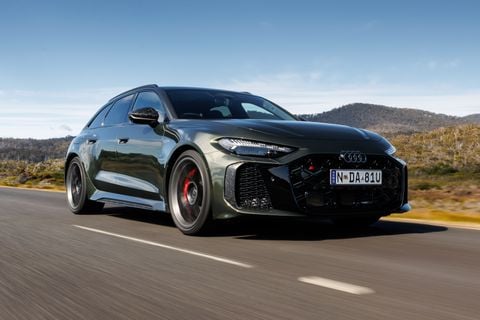
The new Audi RS5 matches its beastly looks with muscular electrified performance and adept handling, but it has a bit of a weight problem.

CarExpert's verdict on the RS 5
Very Good
The boffins at Audi Sport have done a great job of masking the new RS5's extra weight with clever torque vectoring and adaptive suspension tech, while also creating arguably one of the best-looking wagons on sale. It's an impressive high-po GT with enough handling chops to be a hoot on the track – even if it won't be setting faster lap times than a BMW M3 Touring. We'd also like a more raucous soundtrack and a little more steering feel.
What we love
- Traffic-stopping looks
- PHEV tech hasn't slowed it down
- Impressive long-haul capability
Worth a thought
- Small boot
- Needs more V6 sounds
- Steering feel is lacking
Are there other rating labels?
- Excellent
- An outstanding car in almost every way. A joy to drive, packed with great features, and highly recommended.
- Very Good
- A well-rounded car that's enjoyable to drive, offers great value or features, and is easy to recommend.
- Good
- A solid choice that does most things well. Comfortable, capable, and worth considering in this segment.
- Average
- Meets the standard for this segment. May not stand out, but still a dependable and reasonable option.
- Below Average
- Falls a bit behind others in the segment, but still passes safety checks and may suit specific needs or budgets.
Introduction
#SaveTheWagons
The new 2027 Audi RS5 range has hit Australia, serving as the German marque's first high-performance plug-in hybrid vehicle (PHEV) and a glimpse at what's to come from the Audi Sport division's next generation of hi-po halo models.
On looks alone, the wagon version of the new mid-size premium performance car in particular is already a winner. Using the A5 Avant and its sleek hatchback or shooting brake form factor as its basis, the RS5 Avant is certainly a sight for sore eyes thanks in part to its signature RS blistered wheel-arches and aero-focused body kit.
Although Audi did it first with the B7-generation RS4 (2006-2008) before it reverted to being wagon-only and the A4 then morphed into the A5, offering both 'Sedan' and 'Avant' body styles of the latest RS5 matches BMW and its successful strategy with the M3 Sedan and Touring, perhaps giving Mercedes-AMG a lesson in offering broader choice at this very enthusiast-driven end of the market.
The RS5 Avant also continues a long line of supercar-killing Audi wagons, a bloodline that dates back to 1994 with the original RS2 Avant, which eventually morphed into the first RS4 Avant of 2000.
Like BMW and unlike AMG, after dropping its naturally aspirated 4.2-litre V8 in favour of turbocharged V6 power for the second-generation (B9) RS5 in 2017, Audi has attempted to retain a large-capacity performance engine in the age of electrification by incorporating a plug-in hybrid (PHEV) system.
As, as a result, the on-paper debate around weight and dynamics has been raging since the car was revealed – much as it did when BMW decided to PHEV-ify the V8-powered M5, and when Mercedes-AMG decided to fit a four-cylinder PHEV powertrain to its direct rival for the RS5, the C63.
Audi insists the latest chapter in its mid-size performance hero's story remains true to its DNA and isn't hampered by the addition of hybrid technology.
To find out if the German brand's claims are true, we travelled to Tasmania for the national media launch, where we put the new RS5 Avant to the test on Targa Tasmania roads and Symmons Plains Raceway.
How much does the Audi RS5 cost?
The new Audi RS5 range kicks off from $179,900 before on-road costs for the Sedan, with the Avant wagon commanding a $3000 premium.
| Model | Price before on-road costs |
|---|---|
| 2027 Audi RS5 Sedan | $179,900 |
| 2027 Audi RS5 Avant | $182,900 |
Despite its technological overhaul, the Audi RS5 Avant still undercuts the 3.0-litre inline six-cylinder petrol-only BMW M3 Competition Touring (from $189,400), as well as the sedan-only, 2.0-litre four-cylinder PHEV-powered Mercedes-AMG C63 S E Performance (from $195,228).
It's also worth noting the RS5 is around $60,000 dearer than the equivalent S5 with its mild-hybrid 3.0L turbo V6 engine, which based on claimed times is 0.9 seconds slower from 0-100km/h.
Compare the Audi RS 5
Want to see how the Audi RS 5 lines up against the competition?
Use our comparison tool for a side-by-side look at the specs, features and prices of the RS 5 and its rivals.

What is the Audi RS5 like on the inside?
Imagine an A5 smattered with RS bits – and then you've got the picture.
As you'd expect, the RS5 builds on the classy interior architecture of the A5 and S5, with higher levels of standard specification and an array of model-specific trimmings.
There are RS logos on the steering wheel and front bucket seats, in addition to flourishes of the Audi Sport division's signature red highlights for things like the RS mode buttons on the steering wheel, the starter button surrounds, and within the 11.9-inch virtual cockpit (digital instrument cluster).
You also get RS-specific displays within the latter, as well as the 14.5-inch MMI infotainment touchscreen and the standard 10.9-inch passenger display, which includes a drift angle readout and lap timer function, adding a video game-like element to those riding along shotgun on track days.
On first impressions, it's quite nice without being the standout cabin we've previously come to love from Audi.
There's a hint of chintziness from the screen-heavy dashboard, which isn't as nicely integrated as in the brand's previous-generation models, while the virtual cockpit in particular feels overly simplified and too slim compared to the bigger and more timeless 12.3-inch cluster in Audis of old.
Further, the thick display bezels and piano-black centre console look clean in the showroom but will quickly pick up fingerprints and other marks, and the former in particular just make the 'digital stage' appear to have a tonne of underutilised blank space in the display housing.
My other gripe with Audi's latest products is the cheap-feeling multifunction panel for the door locks as well as the seating and mirror adjustments. They just seem cheap to look at and use. At least there are now physical click wheels on the steering wheel in place of touch controls.
Anyway, I still reckon the RS5's cabin feels more upmarket than the AMG C63's interior, though the BMW M3 has a more classic and plush ambience. That said, the Bimmer's tacked-on digital displays don't offer classic dials for the tacho, and aren't as well integrated into the cabin.
As we've found with other variants in the A5/S5 range, the latest generation of Audi's infotainment system is not as simple or user-friendly as the old one, but is generally agreeable.
There's haptic feedback to touch inputs and the interface offers slick graphics and pretty snappy response, though the menus have more layers than before and the climate controls are frustratingly buried in the touchscreen – but always accessible via a permanent virtual toolbar at the base of the display.
We didn't get a chance to really test the standard Bang & Olufsen premium sound system, which offers 16 speakers including the subwoofer, a 16-channel amplifier and total output of 685 Watts. However, based on my previous experience with a similar system in the S5 with its head restraint-integrated speakers, it's pretty good.
The RS performance displays, like the lap timer and drift angle meter, are cool additions over other variants in the A5/S5 lineup, and we actually trialled the timer around Symmons Plains where it showed us a time split between laps. The surround camera system also appears to have had an uplift in clarity and quality compared to previous-generation Audis.
While the heavily bolstered front buckets hold you firmly in place, and the second row offers adequate space for adults behind adults, the chunky front seats, raised rear centre seat base, protruding rear console and pronounced driveline hump make this more of a 4+1-seater than a full five-seater.
Audi does quote a 77mm increase in wheelbase over the old A4, which opens up more leg and knee room for rear passengers, though that's perhaps more an indication of how small the old RS4 Avant was. The Avant's taller roofline is better for headroom than the RS5 Sedan's, though the sloping roofline of the Avant and its shooting brake-like design still means it can feel a little closed in back there.
Opening up the cabin somewhat is a panoramic glass roof with 'switchable transparency' as standard in the RS5. Usually an expensive option further down the range, in lieu of a physical sunshade it uses a liquid crystal layer activated by electric current to switch between opaque and clear views.
While Tasmania isn't known for sweltering temperatures, its southern latitude means the intensity of the sun's UV rays are often higher than you'd expect. Considering how much time we had in the car during lovely sunny and warm weather, we didn't feel like we were struggling with excessive heat or sun exposure through the roof.
Back to the second row, rear amenities include a third zone of climate control, dual USB-C charge points, net-type map pockets behind the front seats, bottle holders in the doors, and a fold-down centre armrest with cupholders. There are ISOFIX anchors for child seats in the outboard rear seats, as well as top-tether points behind all three rear positions.
Further back, the PHEV battery under the boot floor and the Sportback-style tailgate reduces the RS5 Avant's boot capacity to a less-than-impressive 361 litres – less than the small front-wheel drive A3 Sportback hatch.
You do get a square and flat load space, as well as netting and hooks to hold stuff down, but the sloping tailgate clearly eats into the height of the cargo area. Fold the rear seatbacks down (and they do so almost flat) and the capacity ups to a more impressive 1302L behind the front seats.
As you may expect given the rear-end packaging, there's no spare wheel of any kind under the cargo floor, with just a tyre repair kit fitted instead.
| Dimensions | Audi RS5 Avant |
|---|---|
| Length | 4896mm |
| Width | 1952mm |
| Height | 1446-1472mm |
| Wheelbase | 2906-2907mm |
| Cargo capacity | 361-1302L |
To see how the Audi RS5 lines up against the competition, check out our comparison tool
What's under the bonnet?
The Porsche-developed 2.9-litre bi-turbo petrol V6 from the previous RS5 carries over, though it's now teamed with a 130kW/460Nm electric motor powered by a 26.9kWh (gross) lithium-ion battery pack.
| Specifications | Audi RS5 |
|---|---|
| Engine | 2.9L V6 bi-turbo petrol |
| Engine outputs | 375kW at 6300-6800rpm 600Nm at 2000-5000rpm |
| Electric motor outputs | 130kW + 460Nm |
| System outputs | 470kW + 825Nm |
| Battery | 25.9kWh – gross Lithium-ion |
| Transmission | 8-speed auto |
| Drive type | AWD |
| Weight (unladen) | 2422kg – Sedan 2442kg – Avant |
| 0-100km/h (claimed) | 3.6 seconds |
| Fuel economy (claimed) | 4.2L/100km – Sedan 4.4L/100km – Avant |
| Fuel economy (as tested) | 12.6-16.9L/100km |
| Electric driving range | 76-78km – WLTP |
| Fuel tank capacity | 48L |
| Fuel requirement | 98-octane premium unleaded |
| CO2 emissions (claimed) | 97-101g/km |
| Emissions standard | Euro 6e-bis |
| Braked tow capacity | - |
Our drive program focused primarily on dynamic driving on high-speed B-roads used by Targa Tasmania, mixed in with time on the race track. As a result, our indicated fuel consumption isn't indicative of real-world, combined-cycle conditions.
In fairness, we did see the indicated readout hover between 4-6L/100km during more balanced driving in Hybrid mode with sufficient charge in the battery, suggesting Audi's consumption claim should be achievable in day-to-day driving if you regularly charge and don't stay in one of the RS modes.
From a PHEV perspective, that big battery certainly adds weight but it also means the RS5 offers substantially more zero-emissions driving range than the AMG C63 S E Performance, which uses a much smaller 6.1kWh lithium-ion battery and quotes only 15km of EV-only range – while also quoting an only marginally quicker 3.4-second 0-100km/h sprint time.
To see how the Audi RS5 lines up against the competition, check out our comparison tool
How does the Audi RS5 drive?
If you were coming into this review with cynicism, let me dispel any fears – the new RS5 is still a wonderful performance car, both on road and on track.
The launch drive program led by Steve Pizzati took us from Launceston to Coles Bay via numerous curated targa stages through the stunning Tasmanian countryside.
Shared with another journalist, our RS5 Avant spent most of its time in RS Individual mode with the powertrain, steering and exhaust in their most aggressive settings, and the suspension set in the more middling 'balanced' mode to account for the varied nature of Tasmania's regional blacktop.
Having the powertrain in 'dynamic' will immediately fire up the 2.9L bi-turbo V6 for maximum attack, while maintaining around 90 per cent of battery charge and actively cooling it to 20 degrees Celsius for peak performance at any given moment. So, as you can imagine, this contributed greatly to our indicated fuel consumption figures.
The standard Audi Sport exhaust system features the largest exhaust outlets fitted to any RS model in history, with variable flaps and veins to optimise the V6's bark at various speeds.
But those line items on paper don't stop it from feeling quite muffled and constricted, particularly in normal driving conditions, at least from inside the cabin.
From the outside you can hear a lovely, brassy V6 note which has a bit of bark to it, and with all systems dialled to 11 on the road or track you can really hear it sing when you get it higher into the rev range. There are cracks on upshifts and pops and bangs on the overrun, too.
But whether it's the big battery underneath the boot floor or a massive amount of sound deadening throughout the vehicle, I was left wanting a bit more sound to match the new RS5's menacing looks.
It also made me wonder what the standard model in Europe sounds like without the RS sports exhaust, which is standard on the Australian-spec car.
GIven this car now weighs over 2.4 tonnes, some of the tighter and more technical sections would surely put Audi's chassis technologies to the test. Can it defy the laws of physics and still be a truly athletic and engaging performance car?
Hitting the steering wheel-mounted RS button allows you to cycle between RS sport and RS individual modes – as well as RS torque rear, which is effectively 'drift mode' and not for public roads – so we configured RS individual to have the powertrain, steering and exhaust in max-attack mode, and kept the suspension in 'balanced' to cope with the varied nature of Tasmania's spaghetti-like targa roads.
What quickly became apparent is that the RS5 is an impressively capable GT that combines monstrous performance with keen handling, as well as a well-rounded ride quality and a surprisingly well-insulated cabin.
The widened stance, grippy 285/30 R21 Pirelli PZero R tyres and rear-biased quattro all-wheel drive system with locking centre differential and electromechanical rear torque vectoring all work together seamlessly underneath you to keep the RS5 Avant's nose pointing where you turn the steering wheel, and also make this 2.4-tonne performance wagon feel more nimble and responsive than it ought to.
That said, in typical Audi fashion, steering feel and feedback just isn't as communicative as it should be in a car like this.
To be fair, steering response is quick and accurate, so the RS5 feels keen to turn in and points faithfully in the direction you point the 12 o'clock marker, while body control and bump absorption is generally well managed even as the intensity rises.
However, the Audi's size and weight made themselves apparent in the tightest and most technical sections, and the stiffness of the suspension and mass of the vehicle made the RS5 skip a little on occasion.
But through high-speed, sweeping bends the RS5 was a genuine delight. It feel planted and responsive, and flicking the transmission into manual mode allows you to hold gears and really let that bi-turbo V6 sing.
The eight-speed automatic is now the sole non-dual-clutch transmission in the A5 lineup, but on the road it shifts with the speed and crispness of most of Audi's 'S tronic' DCTs.
With the electric motor integrated into the transmission, there's no discernible feeling of turbo lag off the line or when on the boil, and the more conventional torque converter auto pretty much alleviates the elastic sensation of the VW Group's dual-clutch transmissions from a standstill.
You also get some fun kickback on upshifts, which amplifies the drama, and response via the paddles is pretty sharp – though it'd be nice if they were larger or more prominent behind the wheel. You do get shift lights in the virtual cockpit and, in a very cool motorsport-inspired touch, it's fun to watch them build up when you're shifting manually.
When you dial it back a bit, it operates pretty seamlessly in EV mode, wafting along in silence and minimising the transmission of gear shifts through the driveline into the cabin. For reference, you can drive in electric-only mode at speeds of up to 140km/h – though a firm prod of the loud pedal will quickly see the V6 fire up to assist.
The Push-to-pass function is also worth noting, and is another Porsche-derived performance feature. A press of the 'BOOST' button on the steering wheel primes the powertrain for 10 seconds of maximum power, and can be activated in any drive mode.
It's particularly useful for quick overtakes on single-lane carriageways, as we found on our drive.
Australian-market RS5s come standard with RS sport suspension with adaptive two-valve dampers, which Audi claims balances a comfortable ride with a sporty feel by reducing pitching and rolling movements.
As I noted earlier, the ride is really nicely calibrated for both everyday and dynamic driving, which makes the RS5 liveable for the daily slog and not too firm for the sort of lumpy high-speed country roads we drove on in Tassie.
On day two we drove the RS5 on track at Symmons Plains, an interesting circuit with a series of technical bends and chicanes combined with a tight hairpin and long straights.
It gave us a chance to stretch the RS5's legs beyond the restrictions of public roads, as well as fling it through a series of turns at high speed to test its dynamics at the limit.
Again, I was pleasantly surprised at just how much fun can be had behind the wheel of this 2400kg wagon, and impressed with its performance capabilities on a racetrack.
We know it's fast, but the instant response from the electric motor and confidence-inspiring traction from the active quattro all-wheel drive really allows you to point and shoot early out of bends.
As on the road drive, push it hard into a tight corner and you'll notice the heft as its weight shifts laterally, but at no point did the RS5 feel unwieldy or out of its depth on-circuit.
What's more, the rear torque vectoring system combined with the variable AWD system, which defaults to a 40/60 front/rear split, gives the RS5 a more dynamic 'push' rather than 'pull' character, to the point where the rear-end will playfully kick out at the limit in a nicely controlled manner.
The electromechanical rear torque vectoring system is claimed to be a world-first, with a small 8kW/40Nm electric motor preloading the rear differential to distribute torque to either rear wheel within 15 milliseconds.
When conditions permit, you can use the RS torque vectoring function as effectively a drift mode to deliver even more tail-happy action. Sadly, we weren't able to give this a go.
Braking performance was also impressive. The massive 420mm steel front brake discs with whopping 10-piston calipers (400mm rear) as standard offered dependable stopping power both on the road and track, pulling up the weighty RS5 with impressive urgency, and on track there didn't appear to be much brake fade after four or five laps at the limit.
Carbon-ceramic brakes with even larger (440mm front, 410mm rear) discs – which weigh 30kg less than the standard steel units – will be available as a special-order option, though Audi Australia didn't provide much more detail on availability or pricing. Given the performance of standard units on road and track, we'd wager you probably won't need them unless you regularly track your RS5 or just hate brake dust enough to justify them.
While the RS5 proved to be a stack of fun to drive hard on the circuit, its steering feel (or lack thereof) remains the only real blight on its rap sheet. Again, the quick and responsive nature is juxtaposed by relatively light weighting and minimal feedback from the front axle, adding a degree of separation to the driving experience and dulling engagement levels a bit.
If it's maximum steering feel and agility you want, the all-wheel drive BMW M3 Competition xDrive remains the leader in this segment. And while I'm complaining, the RS5's transmission occasionally fumbled the shift between first and second gear when trying to exit the tight hairpin at the end of the first long straight at Summons at full throttle.
Given the massive amount of torque on tap, Steve suggested using manual mode to keep the vehicle in second when firing out of the hairpin, though this was retrospective advice as I'd completed the guided track session with the transmission in S.
All told, however, I was pretty impressed with the new RS5. It continues to offer the neat balance for which Audi Sport's RS models are lauded, being equally praiseworthy for its solid high-performance road/track capability and pleasant everyday comfort, which is now blended with a hybrid system that can dramatically improve fuel efficiency or further bolster vehicle performance.
Is it the sharpest tool in the shed? No. But that's probably where the appeal lies for buyers: you can drive the RS5 to work in comfort and then have loads of fun at the track, straight out of the box. While you won't set any lap records, you'll have a tonne of laughs while testing out its dynamic limits.
But while it's well controlled and masked by the dynamic talents and technical prowess under the skin, the RS5's undeniable weight problem will still come to the fore if you're really pushing it.
To see how the Audi RS5 lines up against the competition, check out our comparison tool
What do you get?
The RS5 comes in one grade with increased standard specification over the global base equipment set.
2027 Audi RS5 equipment highlights:
- 21-inch RS alloy wheels in 6-twin spoke design, matte platinum grey
- RS red brake calipers
- Matrix LED headlights with RS-specific light design
- Digital OLED tail-lights with RS-specific spoiler light
- RS sport suspension with controlled 2-valve dampers
- quattro all-wheel drive with sport differential
- RS sport exhaust
- Convenience key with anti-theft alarm
- Audi drive select
- Heated, folding, dimming exterior mirrors incl. memory
- Metallic/pearl-effect paint
- RS exterior features in gloss black
- RS projection light, exterior mirrors
- Rear privacy glass
- Panoramic glass roof with switchable transparency
- Head-up display
- 11.9-inch Audi virtual cockpit plus digital instrument cluster
- 14.5-inch MMI navigation plus infotainment touchscreen
- 10.9-inch MMI front passenger touchscreen display
- Bang & Olufsen 3D premium audio incl. head restraint speakers
- Audi connect plus
- Audi smartphone interface
- Wireless Apple CarPlay
- Wireless Android Auto
- Audi phone box light – Qi wireless charging
- RS Sport front seats with integrated head restraints
- Perforated leather combination seat upholstery, honeycomb stitching
- RS door sill trims with aluminium inlays, illuminated front
- Inlay in carbon micro twill
- Dinamica microfibre interior elements
- RS 3-spoke sport leather steering wheel with RS emblem
- Perforated leather
- Shift paddles
- 12 o'clock marker in leather
- Heating function
- Electrically adjustable steering column
- Heated, ventilated front seats incl. massage function
- Heated outboard rear seats
- Colour ambient interior lighting
- Manual sunshade, rear windows
To see how the Audi RS5 lines up against the competition, check out our comparison tool
Options
A handful of packages and single options are available for both the RS5 Sedan and Avant.
Audi Sport package: $4400
- RS bumper plus, front and rear
- Top speed increased to 285km/h
Carbon Styling package: $6350
- RS rear lip spoiler in carbon – Sedan
- Side sill inserts and front bumper blades in carbon
- Exterior mirror housings in carbon
- Inlay in rear diffuser in carbon
Carbon Camouflaged Matt Styling Package: $9300 – only in conjunction with Audi Sport package
- RS rear lip spoiler in carbon – Sedan
- Side sill inserts, front bumper blades, exterior mirror housings in carbon
- Interior inlay inn carbon camouflage matte
- Inlay in rear diffuser in carbon
RS interior design package, black with red accents: $NCO
- Leather combination, perforated with honeycomb pattern, black with express red stitching
- Red-coloured seat belts for front and outboard rear seats
- Steering wheel in perforated leather, black with express red stitching, inlay trim in red, 12 o'clock marker in express red
- Floor mats in black with express red piping, contrast stitching and RS logo
- Centre armrest front in black grained artificial leather with express red stitching
RS interior design package, deep black with serpentine green accents: $NCO – only in conjunction with Audi Sport package
- Leather and Dinamica combination, perforated with honeycomb pattern, deep black with serpentine green stitching
- Brass-coloured seat belts for front and outboard rear seats
- Steering wheel in Dinamica microfibre, deep black with serpentine green stitching, inlay trim in bronze, 12 o'clock market in black
- Floor mats in black with serpentine green piping, contrast stitching and RS logo
- Centre armrest front in Dinamica microfibre, deep black with serpentine green stitching
Single-item options include:
- Ascari blue metallic – Audi Sport paint: $1200
- Audi exclusive individual paint: $9700
To see how the Audi RS5 lines up against the competition, check out our comparison tool
Is the Audi RS5 safe?
The Audi A5 range (including the S5) has received a five-star ANCAP safety rating with a 2024 date stamp, however, the RS5 is currently unrated by the independent auto safety body.
| Category | Audi A5* |
|---|---|
| Adult occupant protection | 87 per cent |
| Child occupant protection | 87 per cent |
| Vulnerable road user protection | 78 per cent |
| Safety assist | 79 per cent |
*Rating does not apply to Audi RS5
Standard safety equipment includes:
- Adaptive cruise assist
- Active lane assist – lane-centring
- Stop and go function
- Autonomous emergency braking incl. pedestrian detection
- Blind-spot monitoring
- Driver attention monitoring
- Front cross-traffic assist
- Front and rear turn assist
- Lane departure warning
- Lane-keep assist
- Park assist pro
- incl. reversing assist
- incl. trained parking
- Parking sensors – front, rear
- Rear cross-traffic assist
- Surround-view camera incl. 3D view
- Swerve assist
- Traffic sign recognition
- Tyre pressure loss indicator
- Vehicle exit warning
To see how the Audi RS5 lines up against the competition, check out our comparison tool
How much does the Audi RS5 cost to run?
Like the wider Audi model lineup, the RS5 is covered by a five-year, unlimited-kilometre warranty with complimentary roadside assistance, while the high-voltage PHEV battery is warranted for up to eight years or 160,000km.
| Servicing and Warranty | Audi RS5 |
|---|---|
| Warranty | 5 years, unlimited kilometres – Vehicle 8 years or 160,000km – HV battery 12 years – Corrosion perforation |
| Roadside assistance | 5 years |
| Service intervals | 12 months or 15,000km |
| Capped-price servicing | 5 year Service Plan |
| Average annual service cost | $726 |
| Total capped-price service cost | $3630 |
Audi Australia offers a pre-paid five-year Service Plan for $3630, which is less than half of what you'd pay Mercedes-AMG to maintain a C63 S E Performance for the same period ($7510). BMW doesn't list pricing for its Service Inclusive packages for its M range.
To see how the Audi RS5 lines up against the competition, check out our comparison tool
CarExpert's Take on the Audi RS5
Audi's RS models have long been lauded for their split-personality combination of supercar-rivalling performance and everyday usability – and the latest RS5 certainly embodies that philosophy.
The 2027 Audi RS5 Avant is a technical masterclass. The German marque should be applauded for how seamlessly it has incorporated powertrain hybridisation and chassis wizardry to offset the weight of its newfound PHEV system, at least for the most part.
It's genuinely comfortable as a daily driver and long-distance cross-country tourer, both in terms of ride comfort and suppression of road and wind noise. The PHEV system may add weight, but it also adds new dimensions to the driving experience, such as everyday EV driving capability and dramatically improved fuel efficiency when used as designed, while also improving powertrain response when demanded.
The fact it's also more affordable than both of its direct German rivals is another plus, and it's arguably one of the best-looking wagons on sale right now.
It also retains its V6 engine thanks to hybridisation, rather than succumbing to emissions regulations by reducing the cylinder count.
But the extra weight is felt at 10-10ths, despite all the technical wizardry going on under the skin. On the road, the RS5 Avant feels like a larger and more substantial vehicle than RS4s of old, while also offering substantially less cargo capacity despite being billed as a practical estate.
I'd hoped for more more of a soundtrack from that RS sports exhaust, because while it still sounds pretty good from the outside it's far too muted from behind the wheel given its performance intent. I also don't really gel with Audi's current approach to digital display tech, given how universally loved its previous-generation interior designs were.
Prospective buyers should also be aware that the official fuel economy claim is only achievable when using the RS5 in its more modest drive modes, and with a measured right foot. And the Bedford green paint in the press images here requires spending some $14,000 in options packages. Also, like most models in this segment, you're rarely going to be able to utilise its full performance capabilities away from the racetrack.
Make no mistake though: the latest RS5 brings Audi's fast wagon DNA into the modern electrified world in a very convincing way – and it goes every bit as hard as it looks. Oh, and #SaveTheWagons!
CarExpert can save you thousands on a new Audi RS5. Click here to get a great deal.
Click the images for the full gallery





 Automotive Vehicle Spec Data & 4K images Powered by JATO Dynamics Ltd