




William Stopford
Range Rover and Range Rover Sport recalled
Certain MY2024-25 Range Rover and Range Rover Sport vehicles may have a rear seatbelt that doesn't latch properly.
43 Minutes Ago

Marketplace Journalist
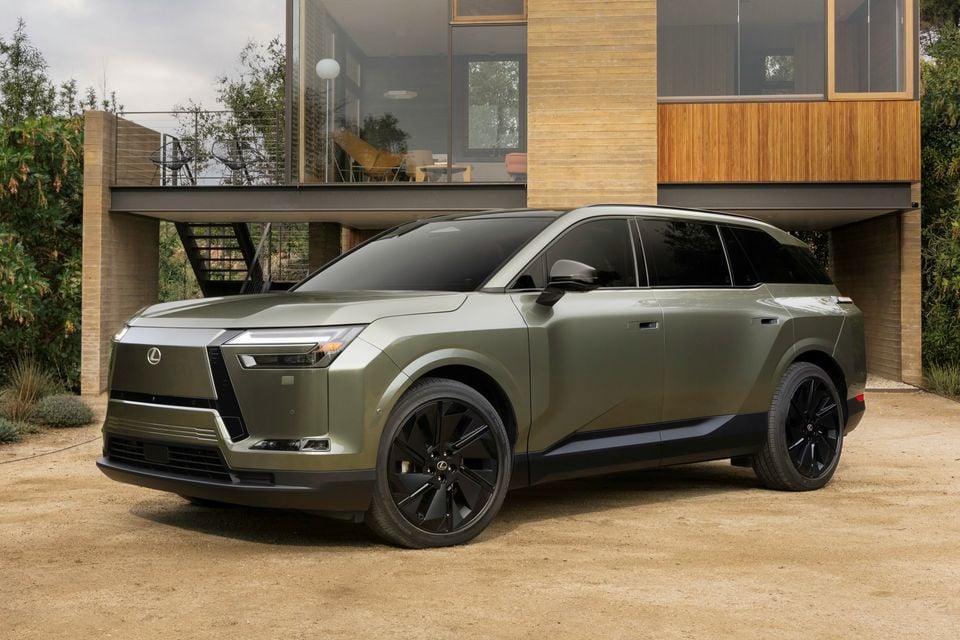
Lexus has unveiled the TZ: its first-ever three-row electric SUV, set to take on the likes of the Volvo EX90 and Cadillac Vistiq when it launches in the US in late 2026.
The Lexus TZ is claimed to offer up to 300 miles (482km) on a charge with a dual-motor all-wheel drive powertrain as standard, and will serve as the electric alternative to the North American-exclusive three-row Lexus TX – much like the relationship between the Lexus RX and RZ sold in Australia.
As expected, it's effectively the Lexus cousin of the Toyota Highlander EV revealed earlier this year, which means it's built on the TNGA platform, shares batteries, and is dimensionally similar. It's therefore also a cousin to the three-row Subaru Getaway.
Unlike those two US-built models, however, the TZ will reportedly also be built and launched in Japan this year, which means it's possible it'll be produced in right-hand drive, opening the door for an Australian launch.
CarExpert can save you thousands on a new car. Click here to get a great deal.
Further, when asked whether the TZ would be brought to Australia, a Lexus spokesperson said the door was wide open.
"Lexus Australia welcomes the unveil of the new TZ, which marks an exciting evolution and next chapter in the Lexus design story," the spokesperson said.
"Lexus Australia continually reviews opportunities to enhance our local lineup and is currently assessing the TZ for potential introduction."
Full specifications have yet to be confirmed, though Lexus has announced it'll be available with two lithium-ion batteries – with capacities of 76.96kWh or 95.82kWh – that are identical to what's offered in the Toyota Highlander EV.
These batteries both offer preconditioning to optimise battery temperature before charging and while driving, plus an intelligent charging schedule suggestion function that's based on driver habits.
Unlike the Highlander, however, the TZ will only be available in a dual-motor all-wheel drive configuration. Therefore, the TZ is likely to be a closer performance match to the Subaru Getaway than to the Toyota Highlander.
The Getaway, which is also all-wheel drive-only, offers up to 313kW of power – dwarfing the Highlander AWD's 252kW – in models fitted with the 95.82kWh battery option, with Subaru claiming it can get from 0-60mph in "less than five seconds".
Subaru and Lexus both claim a maximum driving range of 300 miles, and the Lexus is set to be fitted with a handful of features already detailed for other Subaru EVs, such as the Uncharted. Its 'DIRECT4' all-wheel drive system is said to dynamically distribute torque during cornering, ranging from 60:40 (front:rear) to 0:100 to "optimise handling".
Naturally, there are some bespoke Lexus features. It features standard drive modes like Normal, Sport, and Eco, but it also adds 'Range' and 'Rear Comfort' modes – the latter is claimed to coordinate "Dynamic Rear Steering, brake force optimisation, and drive force distribution to minimise pitching and lateral motion" to prioritise passenger comfort.
The TZ's four-wheel steering system will enable the rear wheels to steer up to four degrees in coordination with the front wheels. That has not yet been seen on any other Toyota EV and is even very rare on any of the brand's modern internal combustion models.
There will also be five levels of regenerative braking strength, operated via paddles mounted to the steering wheel. It's unclear whether it will incorporate a one-pedal drive mode.
Inside, the TZ is claimed to be among the most luxuriously appointed Lexus models to date. The brand says its front passenger and second-row captain's chairs offer ventilation and, in a first for a Lexus SUV, power-adjustable ottomans. The third-row seats "provide sofa-like cushioning", while all seats in the cabin are heated.
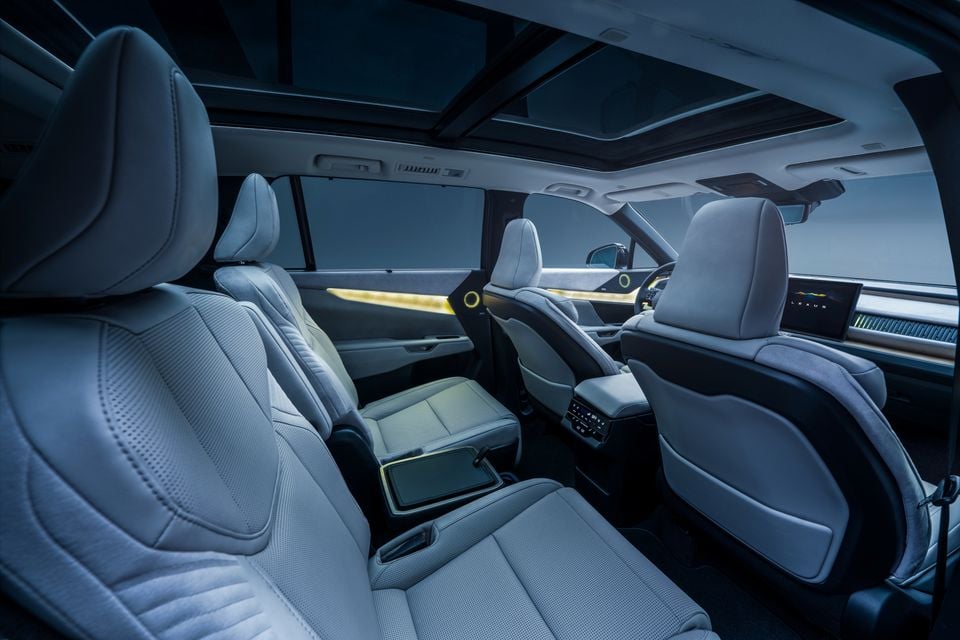
There's also a centre console between the second-row seats with a two-tier tray system, which can be removed for easier access between the second and third rows.
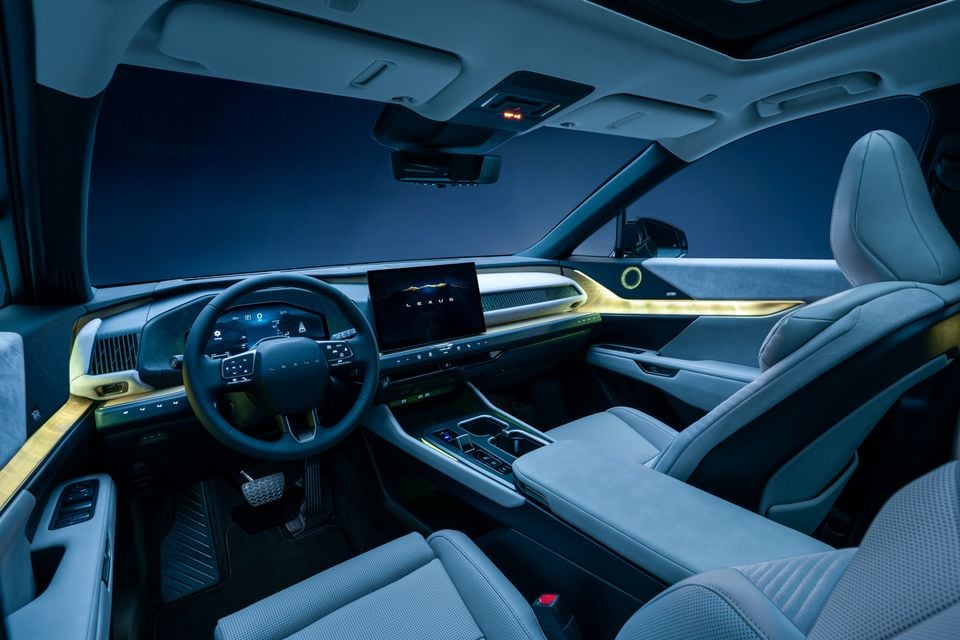
Up front is the "latest-generation Lexus Interface" infotainment system (likely a 14-inch unit, as in the Highlander), which includes customisable home screen widgets, an improved 'Hey Lexus' voice assistant, EV charge management with a range map, Spotify integration, and wireless smartphone mirroring, among other features.
Naturally, this is supplemented by a 21-speaker Mark Levinson sound system.
There's also a fresh digital instrument display that can display satellite navigation, a new steering wheel featuring the 'LEXUS' wordmark rather than the brand's badge, and what appear to be a multitude of touch-capacitive buttons on the dashboard.
Lexus says it has integrated "social responsibility into the TZ" by using a raft of sustainable materials. This includes 'forged bamboo' surfaces in the cabin made from Shikoku bamboo, 'bio-based UltraSuede' plant-derived upholstery, and recycled aluminium elements inside and out.
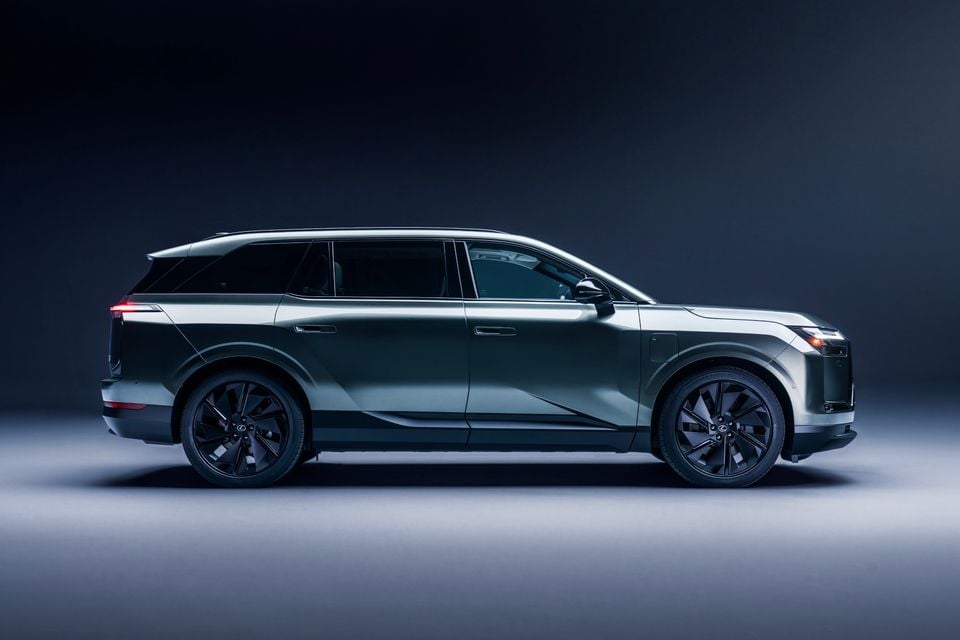
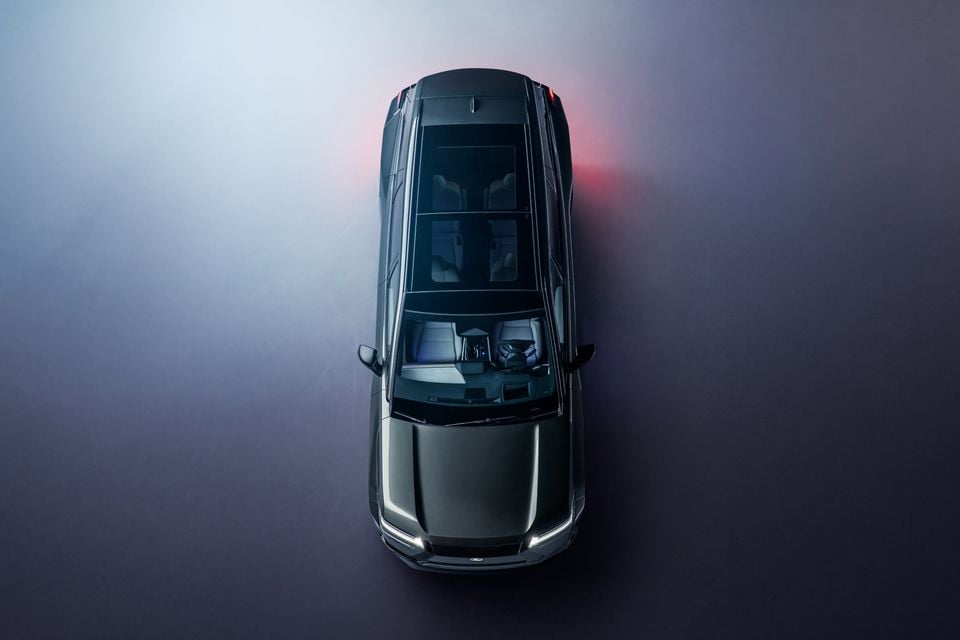
Externally, the TZ's design resembles that of the Lexus GX and is clearly distinctive from the Highlander. It features GX-like shapes on its front grille and headlights, while its bonnet looks almost identical.
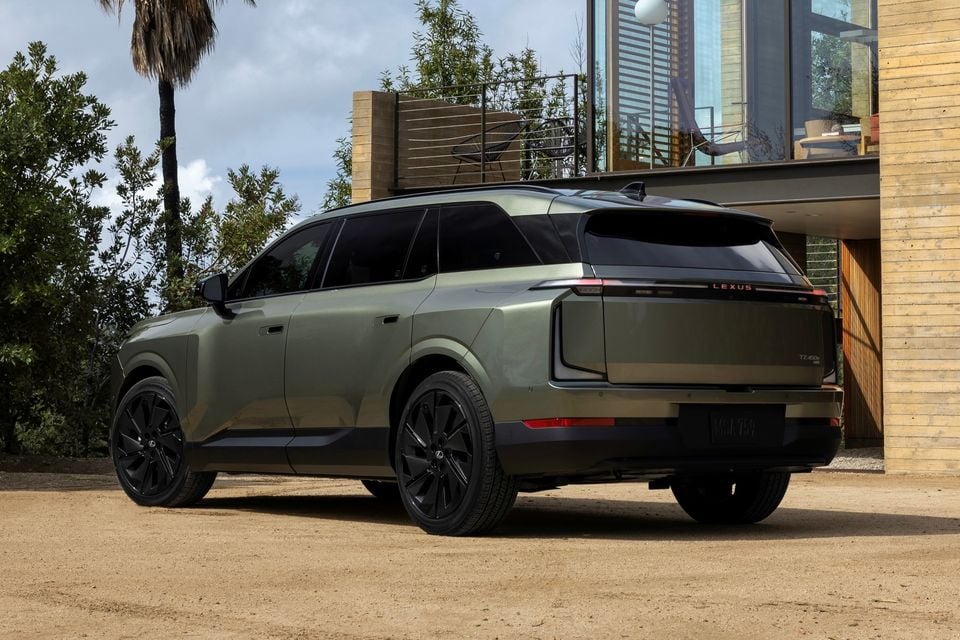
It also features a full-width LED light bar at the rear that again incorporates the 'LEXUS' wordmark, with the slim tail-light profile reminiscent of the GX. Compared to the Highlander, the TZ's wheel arches also appear far more pronounced.
There's a panoramic glass roof, and the TZ will be available with either 20-inch or 22-inch alloy wheels, depending on the variant.
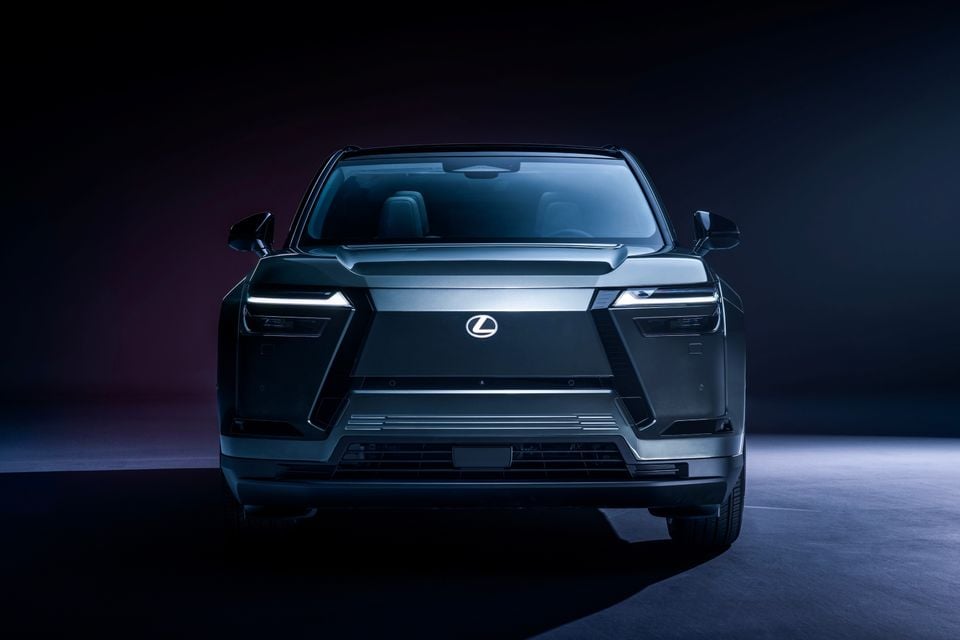
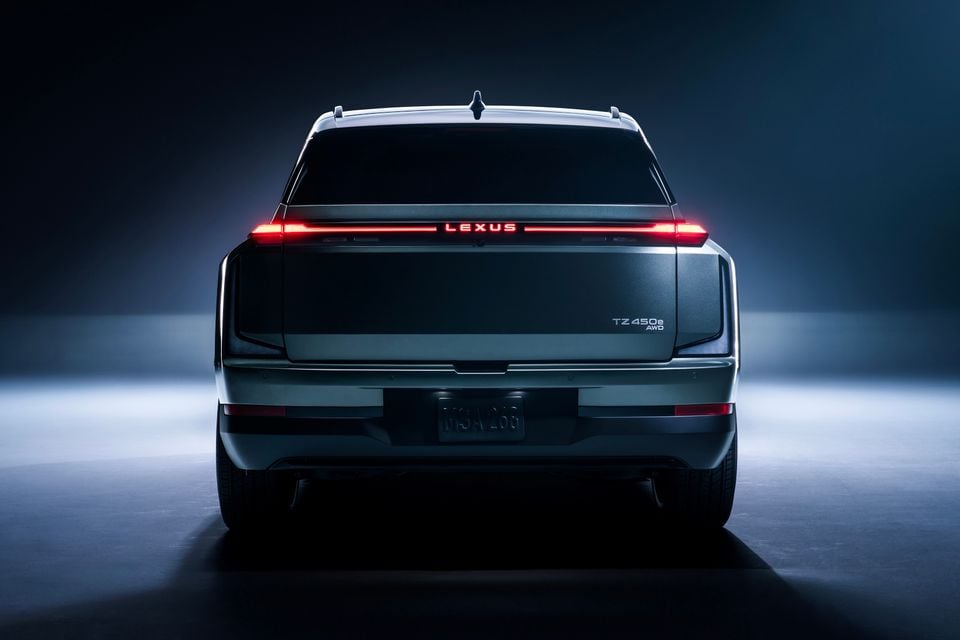
As for the model lineup, the visible 'TZ450e' badge in Lexus's imagery is consistent with a trademark filed in Europe in mid-2023, which also indicates a higher-spec 'TZ550e' will be introduced. This has yet to be formally confirmed by Lexus.
All models will ride on the same 120.1-inch (3050mm) wheelbase as the Highlander and Getaway, though the TZ's body is the longest. It measures 200.8 inches (5100mm) long – 50mm more than the Highlander – 78.3 inches (1989mm) wide, and 67.1 inches (1704mm) tall.
Cargo capacity is quoted at 13.8 cubic feet (390 litres), likely with all three rows upright, and Lexus says it can tow up to 3500 pounds (1587kg) – matching the Getaway.
A raft of safety tech will also be available, including emergency steer assist, junction assist, adaptive cruise control with lane-centring, traffic sign recognition, lane-change assist, and rear pedestrian detection. A head-up display will be available in specific grades.
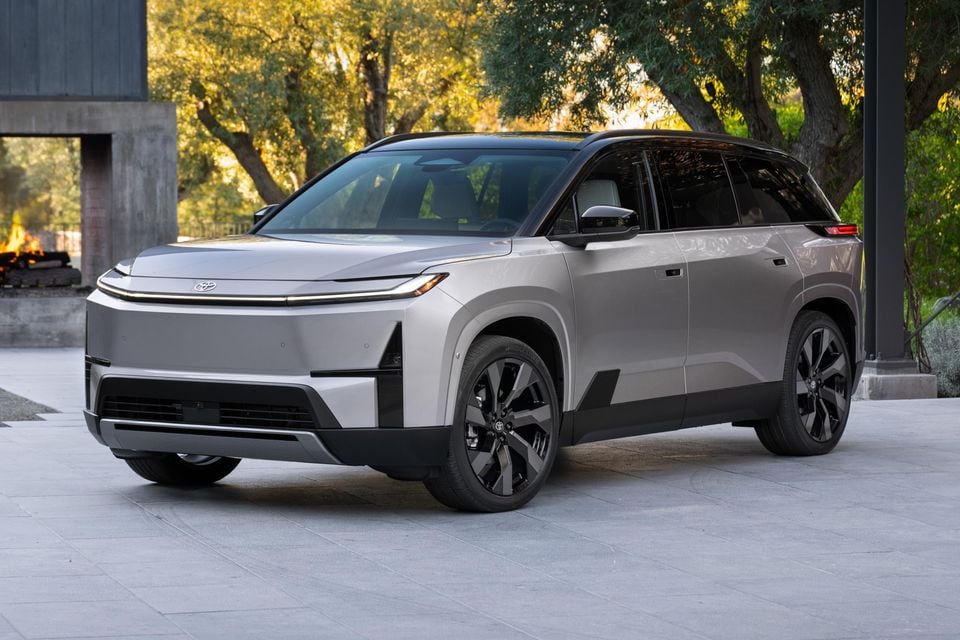
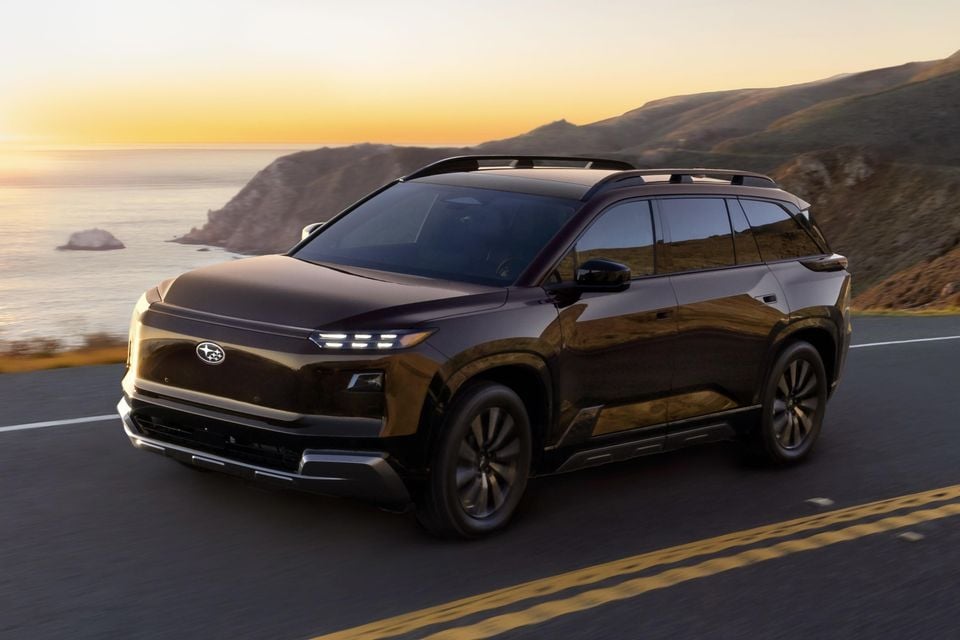
The reveal of the TZ completes the second Toyota/Subaru/Lexus EV trio, the first being the bZ4X, Solterra, and RZ.
If Lexus does bring it to Australia, it will be the first three-row electric SUV from any of those three brands sold locally. Given the TX isn't sold here, it'd be an EV alternative to the three-row LX, though it's difficult to predict if it'd be similarly expensive.
The LX starts at $164,200 before on-roads, which is well above the EVs the TZ would compete with. Those include the Volvo EX90, which starts at $124,990 before on-road costs in Australia; the Cadillac Vistiq, priced from $116,000 before on-roads; and the Kia EV9, which tops out at $129,250 before on-roads in GT guise.
An 'affordable' three-row Lexus EV isn't that far out of the question, though, given Lexus Australia last month slashed the RZ's starting price by $36,559, to $84,500 plus on-roads.
Full US specifications and pricing will be revealed later in 2026.
MORE: 2027 Toyota Highlander is the electric Kluger that Australia can't have
MORE: 2027 Subaru Getaway revealed: There can be only two Toyota Highlander EVs
Go deeper on the cars in our Showroom, compare your options, or see what a great deal looks like with help from our New Car Specialists.
Max Davies is a CarExpert journalist with a background in regional media, with a passion for Japanese brands and motorsport.
William Stopford
43 Minutes Ago

Damion Smy
43 Minutes Ago
William Stopford
1 Hour Ago

Derek Fung
2 Hours Ago
Max Davies
9 Hours Ago
Damion Smy
16 Hours Ago
Add CarExpert as a Preferred Source on Google so your search results prioritise writing by actual experts, not AI.