




William Stopford
Honda ZR-V, Civic and Accord recalled
The seatbacks in some current-generation Honda ZR-V, Civic and Accord vehicles don't meet local regulations, increasing the risk of injury in a crash.
16 Hours Ago
While it's a niche proposition, Hyundai's latest high-performance EV is a proper driver's car for the digital age.

Deputy Road Test Editor
Deputy Road Test Editor
Deputy Road Test Editor
Deputy Road Test Editor
If this is the car for you, we’ll compare offers from trusted dealers, handle the back and forth and manage your purchase from enquiry to delivery.
Expectation is the enemy of the Hyundai Ioniq 6 N.
When the Ioniq 5 N electric SUV – Hyundai’s first high-performance EV – arrived back in 2023, everyone was utterly wowed by its retro-cool looks, supercar performance, simulated gearbox, and sporty soundtrack.
In a world of silent, lifeless EVs, the 5 N was fresh. And, most importantly, it was fun to drive.
But at the end of the day, it was still an SUV – a body style that carries with it inherent dynamic limitations.
Enter the 6 N. Based on the standard Ioniq 6 space banana – sorry, I mean sedan – the 6 N takes the core ingredients of its SUV sibling and presents them in a lower-slung, more purposeful package.
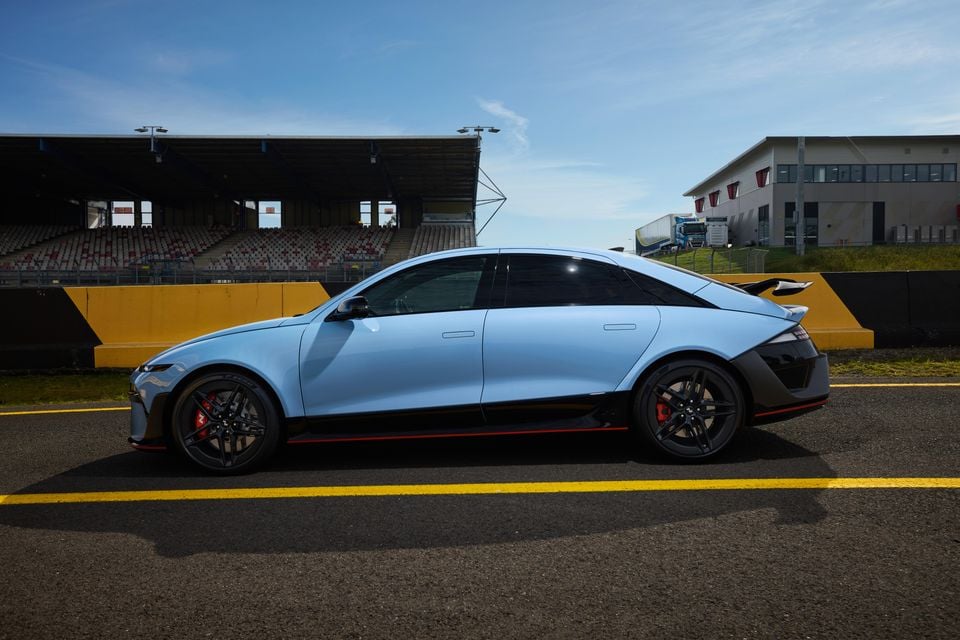
Hyundai is also keen to stress that many of the groundbreaking features that debuted in the Ioniq 5 N have since been enhanced for this sedan follow-up.
As such, the Ioniq 6 N has but one option. Is the sequel better than the original, or does it fall victim to the burdensome weight of expectation? No pressure, right?
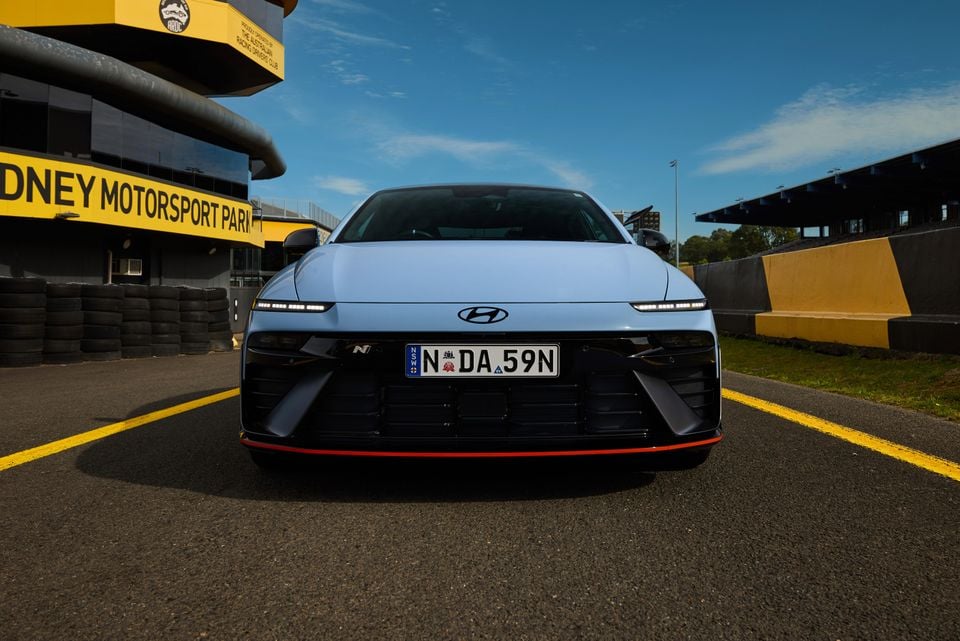
The price of the Ioniq 6 N sedan likely rings a bell, because it mirrors that of the Ioniq 5 N SUV.
| Model | Price before on-road costs |
|---|---|
| 2026 Hyundai Ioniq 6 N | $115,000 |
Direct rivals for Hyundai’s mid-size electric super-sedan are thin on the ground, and that’s especially true when you consider its price point.
At one end of the spectrum you have cheaper ‘value’ options like the BYD Seal Performance and Tesla Model 3 Performance, priced at $61,990 before on-road costs and $80,900 plus on-roads respectively.
Above them slots the Hyundai, and then there’s well… nothing, until you get to $200k premium players such as the Porsche Taycan, Audi RS5, Mercedes-AMG C63 S E Performance, and BMW M3, only the first of which is a pure EV.
To see how the Hyundai Ioniq 6 N lines up against the competition, check out our comparison tool
It may look space-age from the outside, but the interior of the Ioniq 6 N is relatively conventional, albeit not as practical as you might expect.
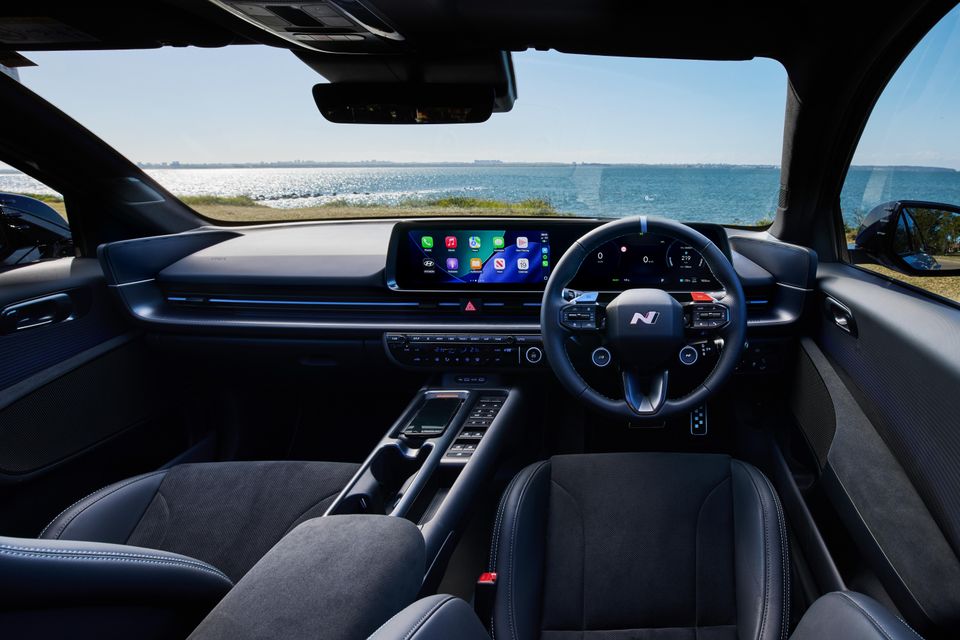
You’ll find a circular steering wheel, two 12.3-inch screens and loads of physical controls – a familiar setup that’s refreshingly user-friendly – well, mostly. I say that because it took a moment to find the window switches and mirror controls, neither of which are integrated into the door cards as is customary. Otherwise, everything else is where you expect it to be.
Further, the cabin is quite mature in its sportiness (ignoring the corny guitar solo that plays through the speakers every time you exit the car). Hyundai’s trademark Performance Blue isn’t overused, and anything you could perceivably class as overtly racy or silly is embedded in the infotainment system.
That’s not to say the N presents exactly like a standard Ioniq 6, because of course it doesn’t.
The sculpted lightweight seats up front are the first clear giveaway of its N-tentions, both in appearance and feel. Visually, the buckets look smart with their integrated head restraints, premium trimming, and illuminated N logos. And functionally, they wrap tightly around the torso, offering ample bolstering as well as strong under-thigh support to hold you in place during enthusiastic driving.
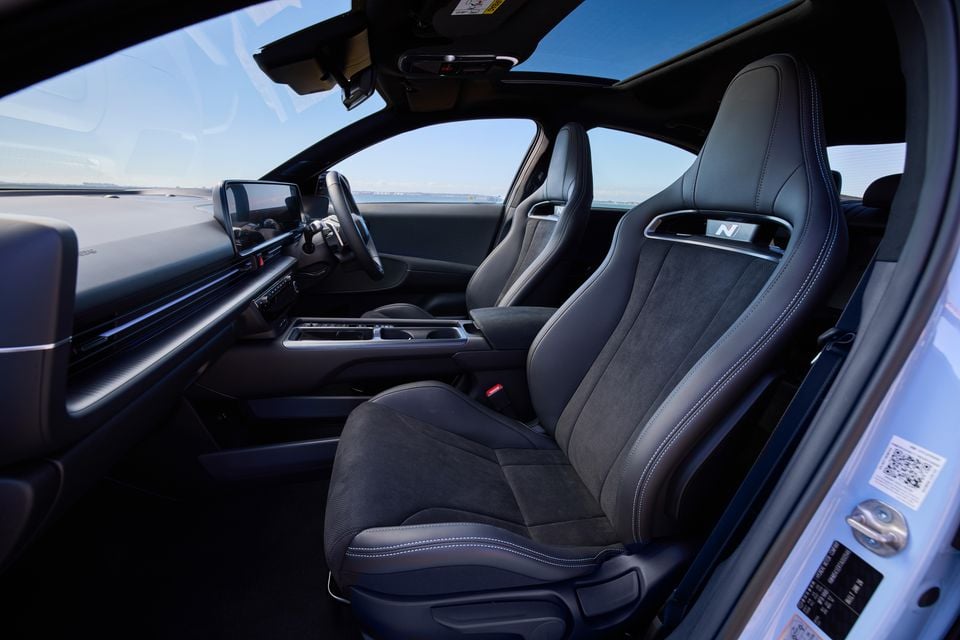
Better yet, three-stage heating and ventilation ensure comfort regardless of the climate. It’s not all good, though. The front seats require manual adjustment – you’d expect electric controls in a $115k car – and no amount of tinkering can fix the driving position, which proves too high for taller types. I’m not just speaking from a visibility and car control perspective, either, as headroom becomes a real issue for those topping six-two.
Deletion of the standard single-pane sunroof increases the real estate overhead, but it also deprives the cabin of natural light, which itself improves perceived space.
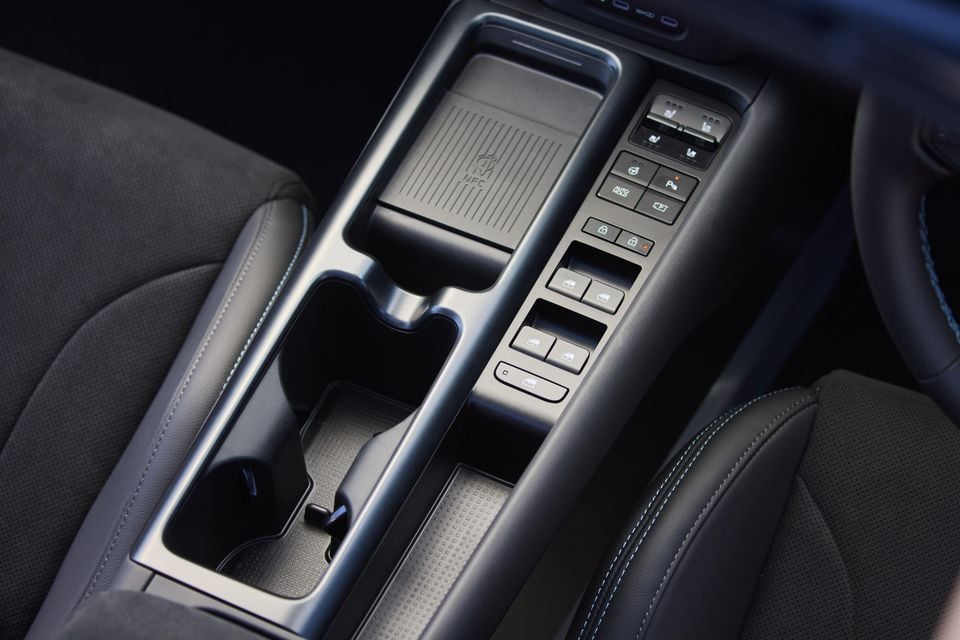
The selection of dark materials found throughout the Ioniq 6 N don’t help with that sense of space, although there’s plenty to be said for their quality – the leather is real and textured, as is the Alcantara that adorns the seats, centre console, and door cards. Most of the buttons are suitably clicky, including the many that reside on the steering wheel.
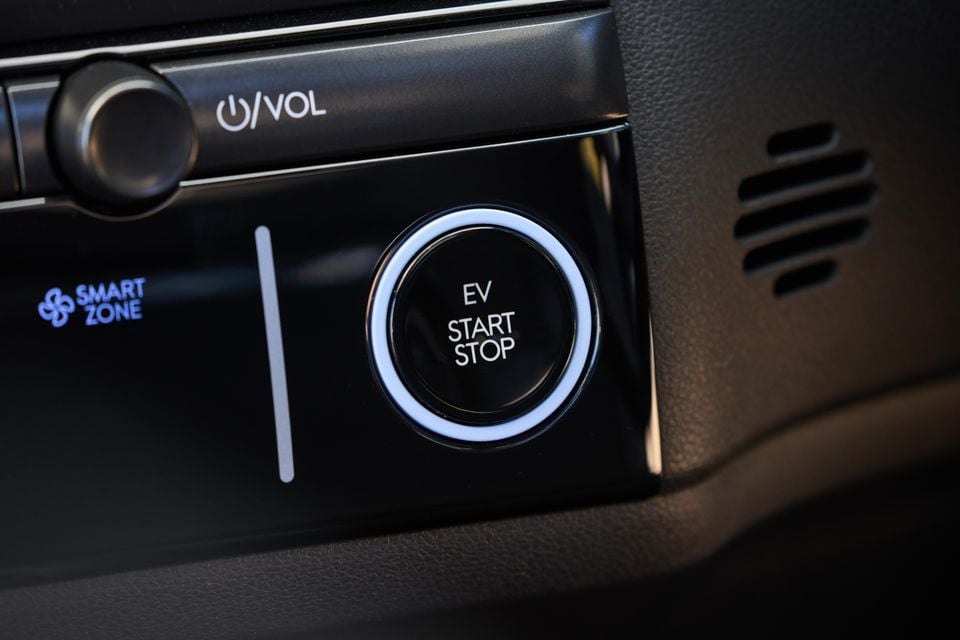
Nothing screams performance like colourful satellite buttons, and the Ioniq 6 N boasts four of them – a blue drive mode selector, red ‘N Grin Boost’ control, and two blue-ringed actuators linked to custom drive modes and the fake gearbox. Two plastic regen/shift paddles stick up from behind the steering wheel.
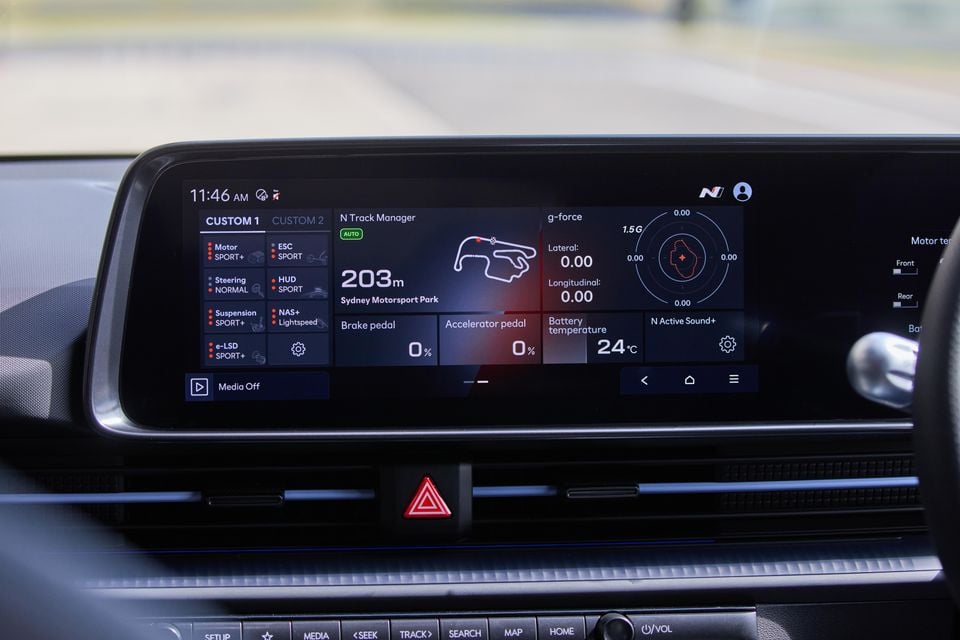
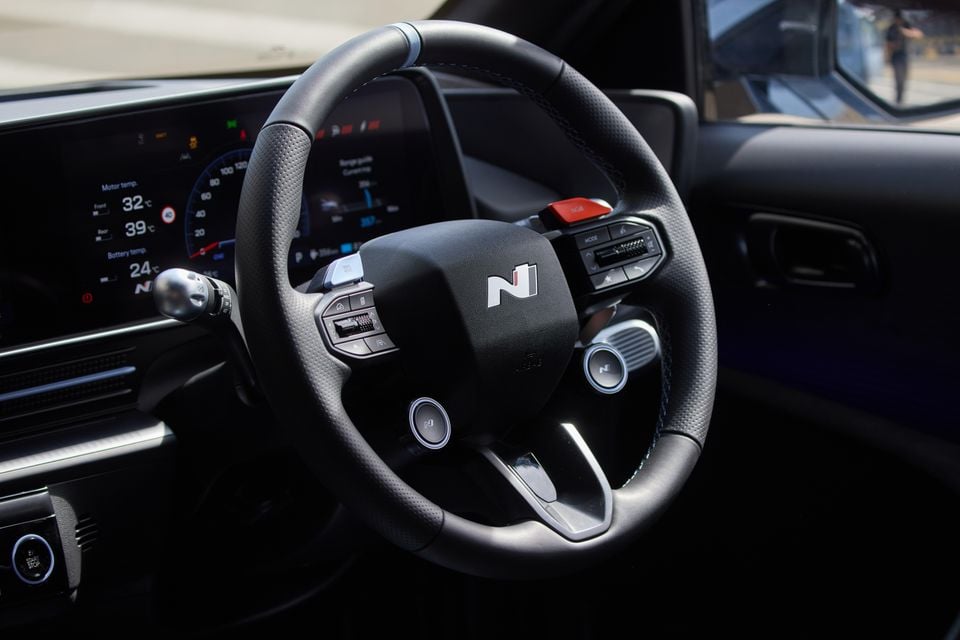
The technology available in the Ioniq 6 N is likewise relatively upmarket. Both screens are housed in a single straight panel that sits flush with the dash – a sign of intentional design – while the user interface is vibrant and responsive.
Treasured mod-cons such as wireless smartphone mirroring and connected services are a given, but it’s the native N mode app that steals the show. First featured in the i30 N, this newly expanded performance hub contains more drive mode settings than you can poke a stick at, plus visualisations of key vehicle data and even maps of Australian racetracks. For the first time, N owners can now create their own user-generated track maps.
Moving across, the digital instrument display has also received the N treatment. In the Eco and Normal drive modes, it’s nothing to write home about, but shifting into Sport or N mode unlocks motorsport-inspired elements not limited to a central tachometer and extensive telemetry.
Above, the head-up display also transforms, displaying a sequence of lights that help you to time the perfect ‘gear shift’, just like what you’d find in an F1 car. Hyundai has even gone to the effort of programming the interior ambient lighting to sync with the shift lights when the car is in attack mode – a neat touch.
As I briefly suggested earlier, some will scoff at these abundant technological toys. However, it took just a few hours for me to appreciate their ability to engage the driver. And they’re never forced upon you – the Ioniq 6 N will happily do boring if you want it to.
It’ll also try to do the practical sedan thing, at least up front. There’s useful storage space in the centre console bin, cupholders, lower tray and sliding glovebox drawer, but not in the comically narrow door bins, while wired and wireless device charging options are present.
It doesn’t do all the boring stuff as well as some other sedans, though. For example, the second row isn’t hugely inviting.
Wide-opening rear doors are a plus, as is the legroom afforded by the Ioniq 6 N’s long 2965mm wheelbase. However, its sloping roofline caps rear headroom, and there’s not much space left for feet under the front seats.
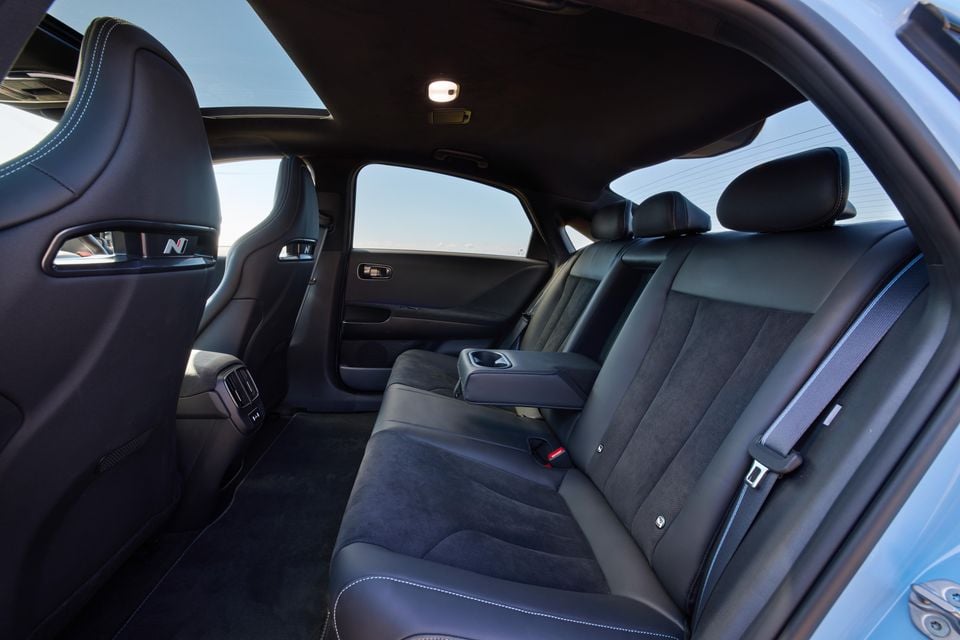
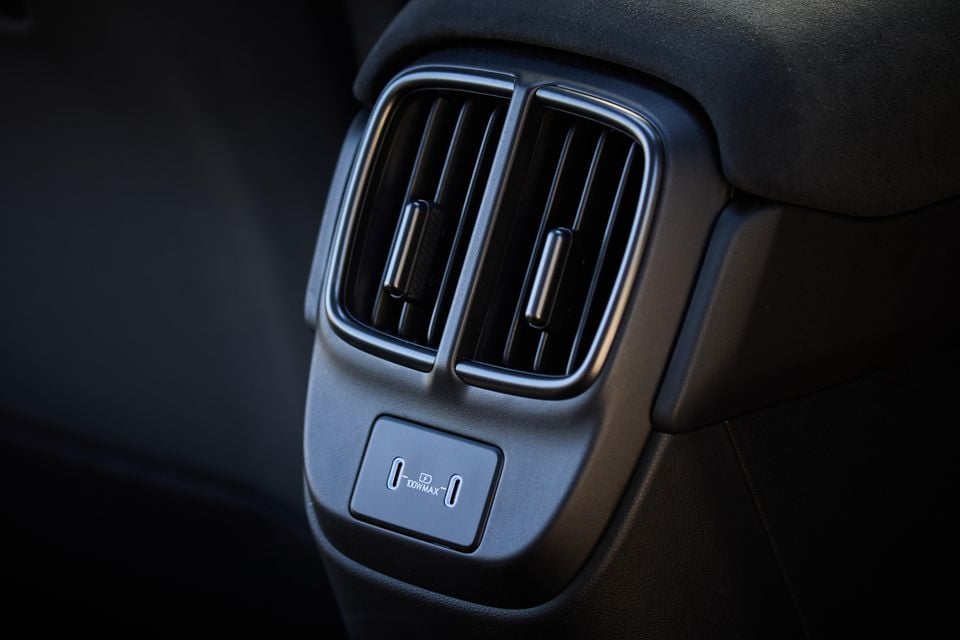
In a similar vein, the rear seating position itself is made more awkward by the upward tilt and fixed recline of the rear bench. As a result, I can’t imagine long journeys in the back of the Ioniq 6 N would be particularly pleasurable.
That said, rear passengers are still afforded access to seat heating (outboard only), air vents, powerful 100W USB-C outlets, a couple of storage nooks, and a fold-down centre armrest with integrated cupholders.
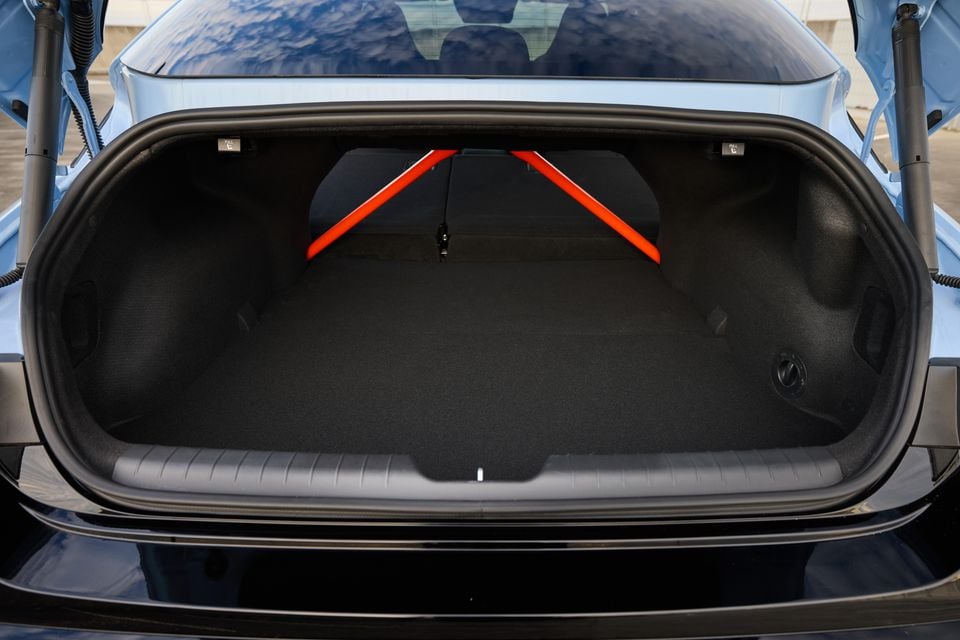
Further back, the boot is another point of weakness. As with the second row, access isn’t the problem, given the Ioniq 6 N features a hands-free power tailgate that opens plenty high enough. Rather, the issue here is again a lack of space. Hyundai quotes 371 litres of rear cargo capacity for the Ioniq 6 N – around half that of the equivalent Tesla – and, looking inside, there’s not much vertical space to work with.
If this was any other sedan I’d tell you to fold the rear bench for more acreage, but that’s not really practical here given the presence of bright red chassis bracing that serves as a permanent barrier between the boot and cabin.
“What about the ‘frunk’?” I hear you asking. The 6 N doesn’t have one. Nor does it have a physical spare tyre – an unsurprising omission in this day and age.
| Dimensions | Hyundai Ioniq 6 N |
|---|---|
| Length | 4935mm |
| Width | 1940mm |
| Height | 1495mm |
| Wheelbase | 2965mm |
| Cargo capacity | 371L |
To see how the Hyundai Ioniq 6 N lines up against the competition, check out our comparison tool
Like the Ioniq 5 N, the 6 N is powered by a dual-motor all-wheel drive electric powertrain comprising a 166kW front-axle motor and a 282kW rear-axle motor to produce standard combined outputs of 448kW/740Nm, or 478kW/770Nm with N Grin Boost enabled.
| Specifications | Hyundai Ioniq 6 N |
|---|---|
| Drivetrain | Dual-motor electric |
| Battery | 84kWh lithium-ion |
| Power | 448kW (478kW with N Grin Boost) |
| Torque | 740Nm (770Nm with N Grin Boost) |
| Drive type | All-wheel drive |
| Weight | 2166kg |
| 0-100km/h (claimed) | 3.4 seconds (3.2 seconds with N Grin Boost) |
| Energy consumption (claimed) | 18.7kWh/100km |
| Energy consumption (as tested) | 22.0kWh/100km |
| Claimed range | 487km |
| Max AC charge rate | 11kW |
| Max DC charge rate | 350kW |
To see how the Hyundai Ioniq 6 N lines up against the competition, check out our comparison tool
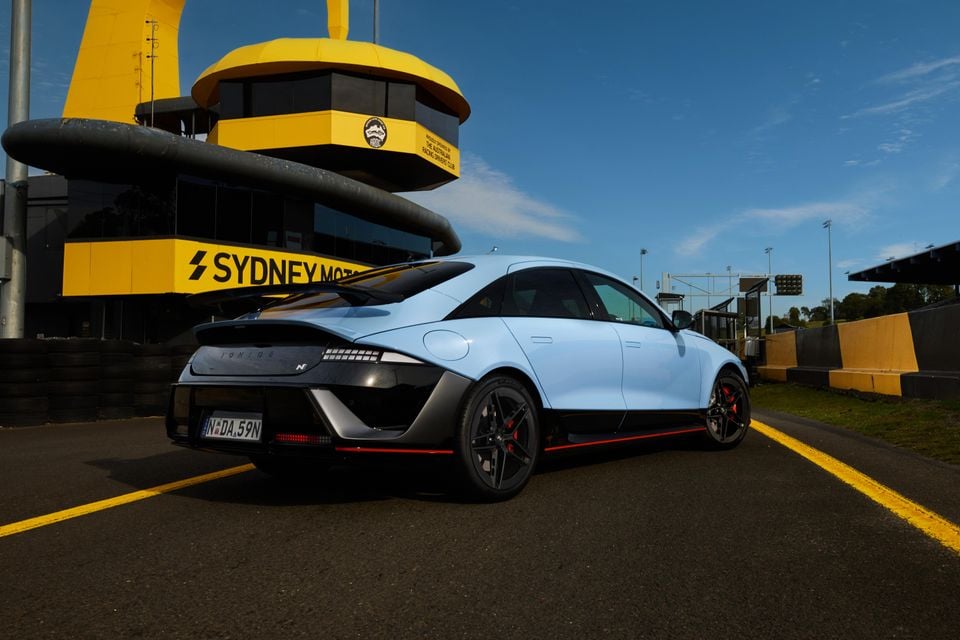
Hyundai split the launch event into two parts – an afternoon spent carving up country roads followed by a morning track session at Sydney Motorsport Park – so it’s only fair I do the same with these impressions.
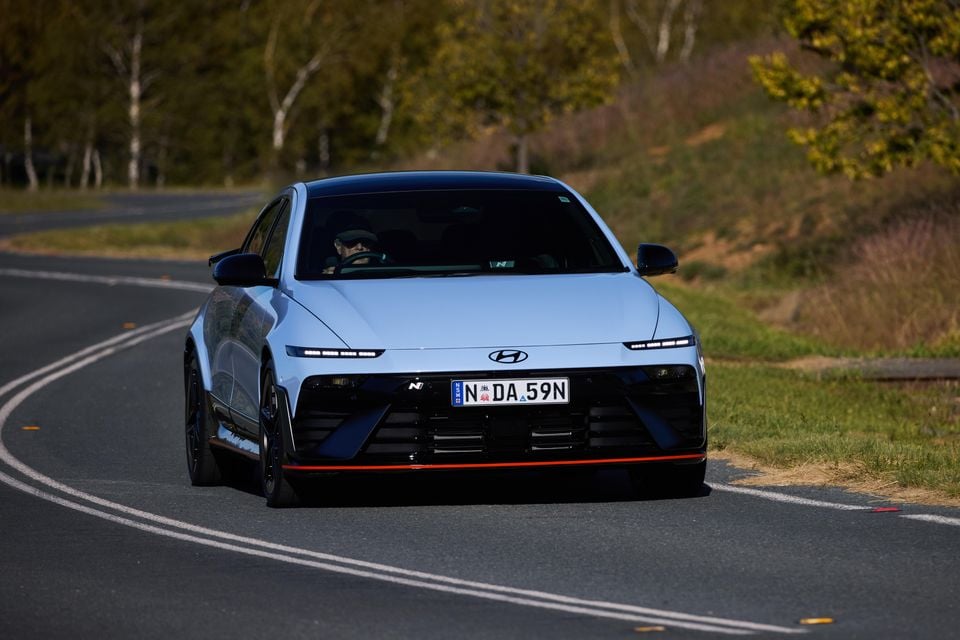
To reach decent roads we were first forced to exit greater Sydney, which meant driving the Ioniq 6 N in traffic.
Such conditions can be the Achilles heel of a performance car, given their overarching tendency to be stiff, spiky, and sometimes just plain uncomfortable. That’s not the case here.
Rather, the Ioniq 6 N behaves like any other EV when driven gently. It’s quiet – especially with N Active Sound+ switched off – and smooth under acceleration, while several regenerative braking modes allow for some flexibility in deceleration. Having said that, the transition between regen and friction braking can be jarring due to the sensitivity of the left pedal.
Ride comfort is also a bit of a mixed bag, as I’ll continue to explain later, but smooth urban roads definitely favour the Ioniq 6 N’s electronically controlled suspension (ECS).
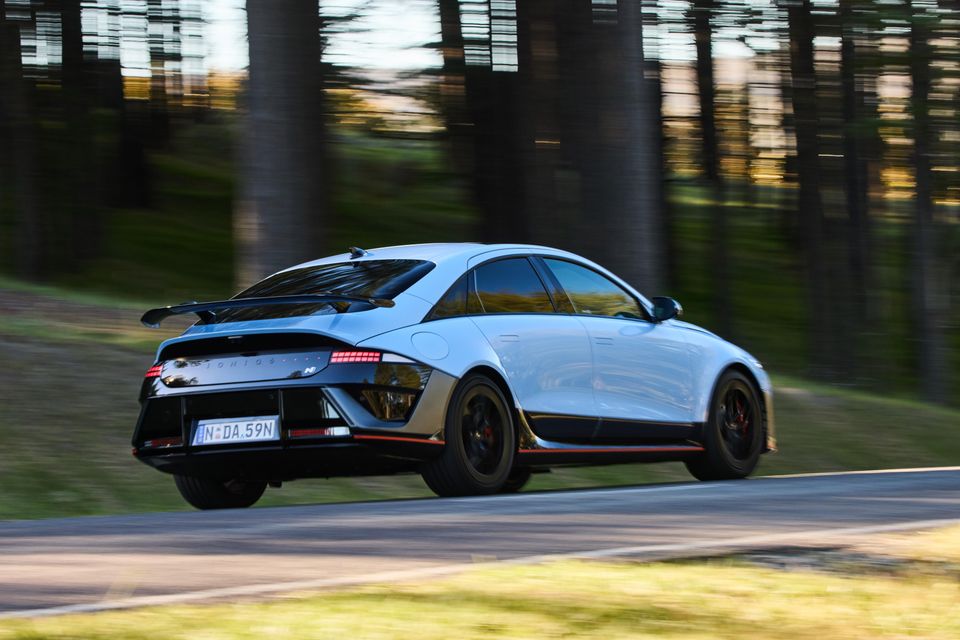
Still, the stroke-sensing adaptive dampers are best left in their softest setting. That’s the beauty of the Ioniq 6 N though; just about every facet of the driving experience is configurable.
Indeed, you can pair the softer suspension setup with light steering, true 50:50 all-wheel drive and a muted powertrain for a cushy, confidence-inspiring daily commute.
The news is similarly positive if you spend lots of time on the highway, as the Ioniq 6 N is equipped with the latest version of Hyundai’s Highway Driving Assist – a Level 2 semi-autonomous system that actually works in the real world. The overspeed warning system isn’t so thoughtfully calibrated, although it’s easily silenced, and road noise is quashed by special acoustically optimised window glass.
So, this large, expensive electric sedan can comfortably handle the demands of everyday life. Big whoop, I know.
The bigger question remains: when the traffic clears and the road begins to twist, can it put a smile on your face?
If this is the car for you, we’ll compare offers from trusted dealers, handle the back and forth and manage your purchase from enquiry to delivery.
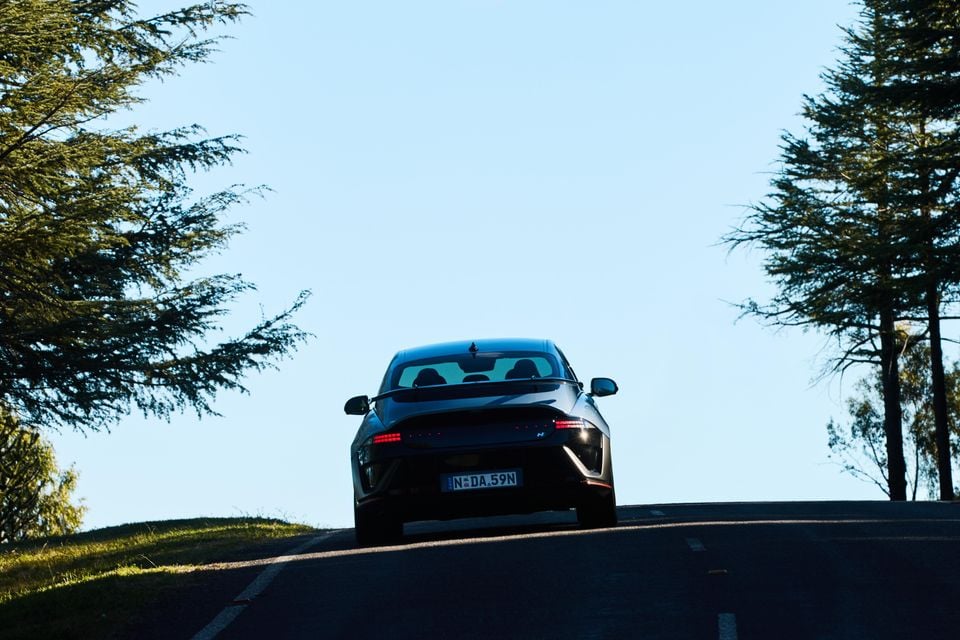
Upon breaching Sydney’s northern borders and winding our way towards Laguna, the answer quickly became clear, and it’s a resounding yes.
Clearer sections of tarmac allow each of the 448 kiloWatts and 740 Newton-metres to finally be unleashed in violent bursts of speed so intense they glue your back to the seat, simultaneously inducing a maniacal grin. Hit the big red N Grin Boost button and you’re all of a sudden wielding an extra 30kW and 30Nm for 10 seconds at a time.
And that’s before you add in the aural thrills of the ‘Ignition’ soundscape, which accurately mimics the tones of a high-pitched screaming V6. It’s great fun when utilised in isolation, yet there’s even more to be gained from pairing it with N e-shift.
First introduced with the Ioniq 5 N, N e-shift simulates a dual-clutch automatic gearbox through paddle-actuated ‘shifts’ and fluctuations in power delivery, as well as special sound effects.
Breaking it down further, torque is limited when you attempt a pull in the wrong gear, while aggressive upshifts trigger the same jolting sensation that you’d expect from a combustion car. Fake pops and crackles even emanate from the rear cabin speakers when you lift off the throttle.
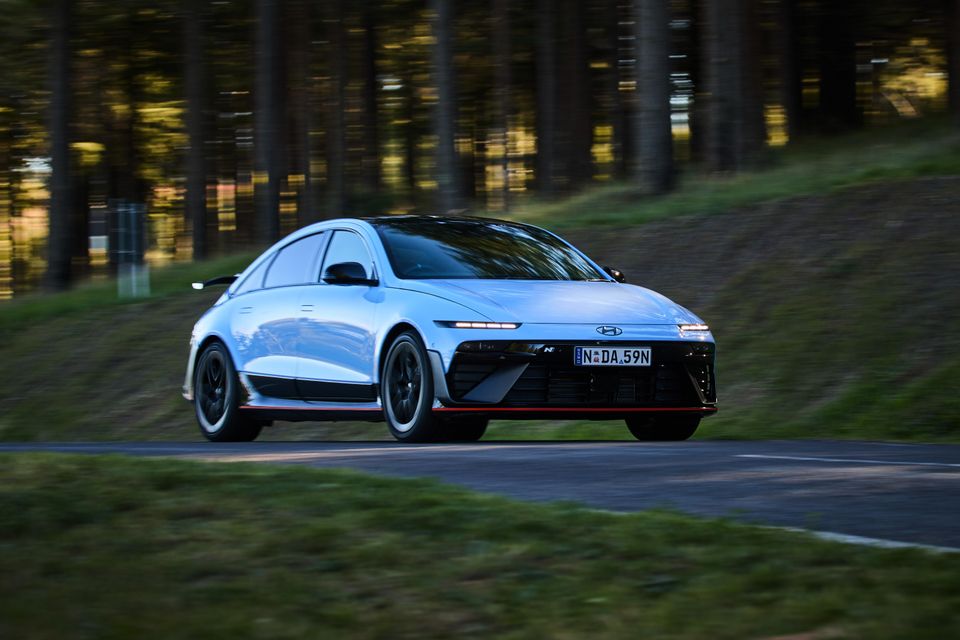
The system was convincing back then and it’s even more so today, courtesy of enhancements including shortened ‘gear’ ratios and a widened availability window that now includes just about all drive modes.
As such, the Ioniq 6 N can pull off truly epic impressions of petrol-powered performance icons, and it can do so more often than the Ioniq 5 N can.
Being a low, slippery sedan, the Ioniq 6 N also handles better than its SUV sister model, and most of its electric rivals.
It keenly tackles corners headfirst, responding quickly to steering inputs even if there’s little feel through the wheel. Once committed to turning, the wide Pirelli high-performance tyres and all-wheel drive system go to work, ensuring consistent grip and a neutral balance that also benefits from the electronic limited-slip differential (e-LSD).
You can, of course, shift this balance using the N Torque Distribution tool, which is able to send up to 95 per cent of the available torque to either axle for a front- or rear-wheel drive experience.
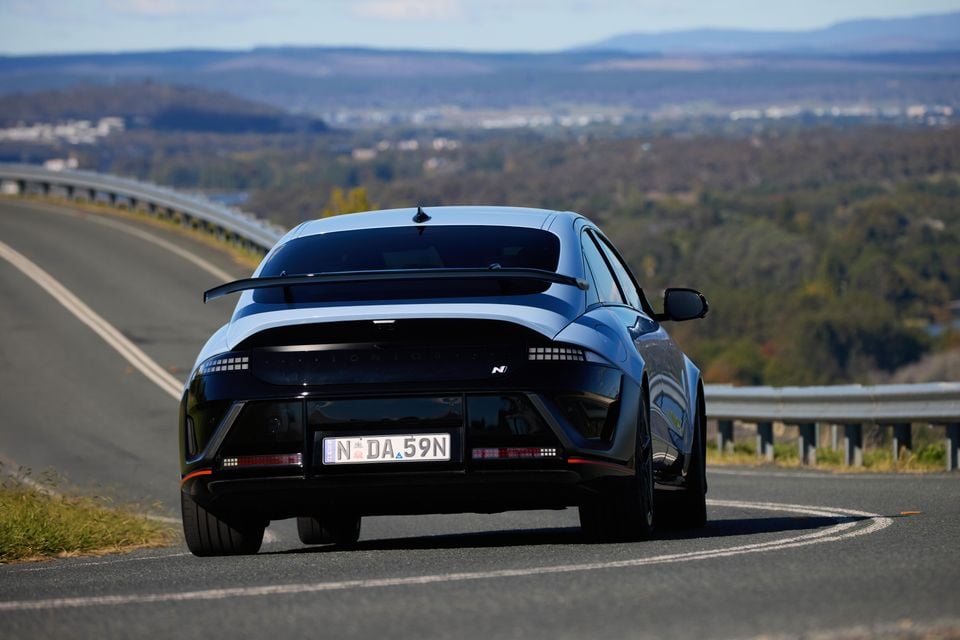
While it is possible to alter the dynamics of the Ioniq 6 N on the fly, there’s no way to address its sheer size. This car is long and wide, and you feel that when navigating narrow stretches of single-lane tarmac.
Australia’s patchy country roads also expose the limitations of the suspension. The Ioniq 6 N struggles to absorb the impact of sharp edges and potholes, transmitting some of their harshness into the cabin. This is the case regardless of the chosen setting, as there’s not a huge difference between the feel of ‘Normal’ and ‘Sport’, while the stiffest mode is quite obviously targeted at track driving.
Still, the Ioniq 6 N is a riot to steer in this environment. It absolutely thrives when driven at eight-tenths, which is all that’s really safe and legal on a public road.
But what about when you amp up the intensity closer to ten-tenths? We were sent to Sydney Motorsport Park the next morning to test exactly that.
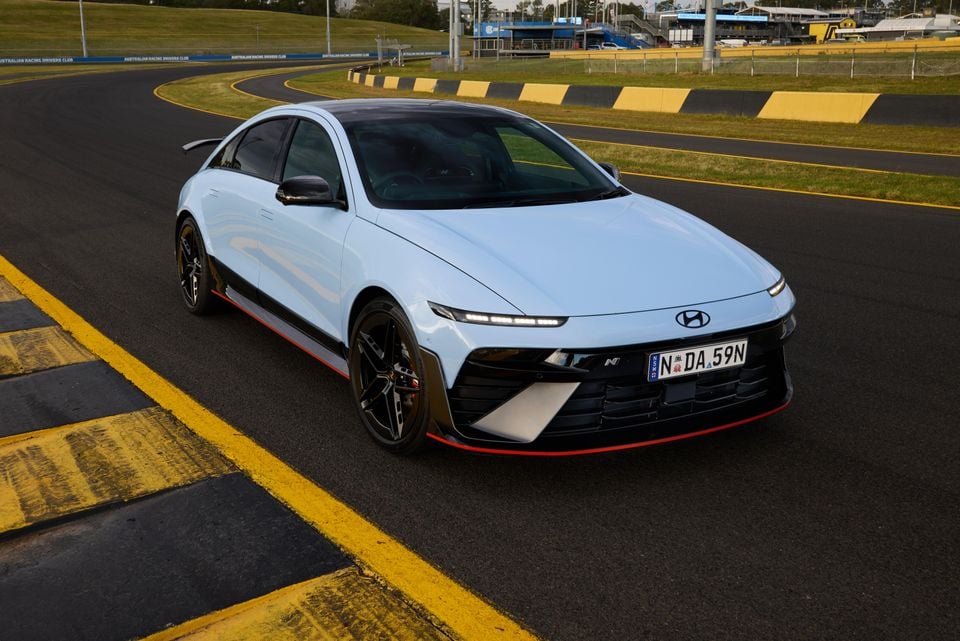
And it didn’t take long to figure out that the Ioniq 6 N is a very accomplished performance vehicle, albeit not the perfect track car.
Its straight-line potency is undeniable. Unlike some EVs, the Ioniq 6 N doesn’t let up once you hit triple-figure speeds. Rather, it continues to surge forward in an unrelentingly linear manner between 100-200km/h, and indeed beyond that towards its 257km/h top speed.
And because it’s electric, the thrust is delivered instantly – you’re never forced to wait for a turbo to spool or for revs to build. Well, unless you activate N e-shift, which I would highly recommend if you prioritise fun over lap times.
It really is epic rifling up through the cogs (only occasionally bouncing off the faux rev-limiter) without worrying about a speeding ticket, and the simulated gearing combines with N Active Sound+ to provide important points of reference when trying to manage speed on the track. Again, there’s no mechanical hesitancy or delay, so you can trust the N e-shift system to respond consistently.
The demands of track driving also draw attention to the immense stopping power of the Ioniq 6 N. It sheds velocity quickly and there’s lovely feel through the brake pedal – something that isn’t required nearly as much on the road. Repeated hard use doesn’t result in much brake fade, either.
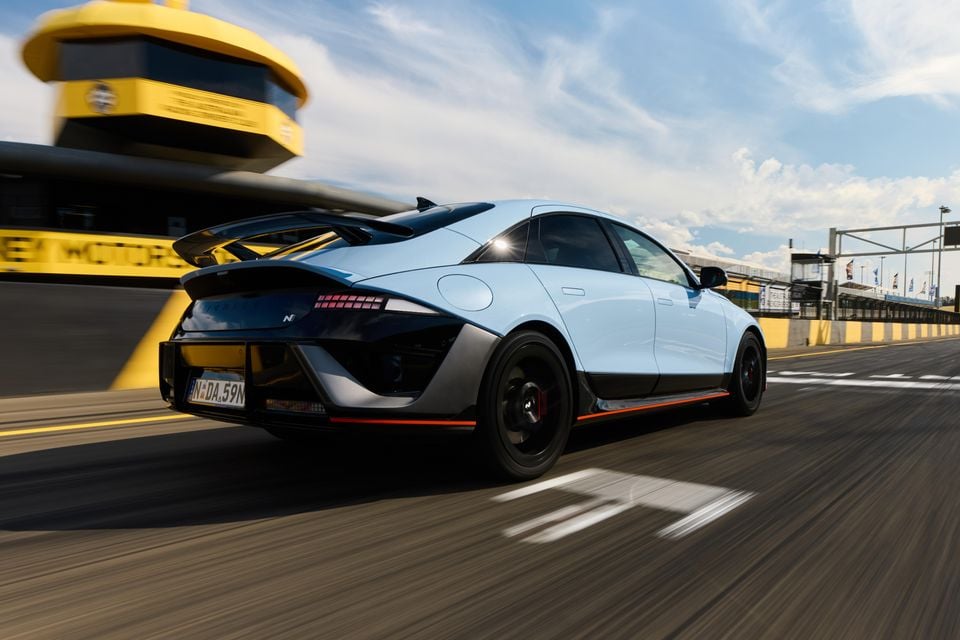
In a similar vein, the tyres stand up to hard abuse. We cut three hours' worth of flying laps and there was ample rubber remaining by the end, which came as somewhat of a surprise to those who attended the launch of the Ioniq 5 N.
The tyres also offer incredible levels of grip, helping the 6 N to remain relatively flat through turns when driven purposefully. The e-LSD also acts to send power exactly where it's needed on corner exit.
The Ioniq 6 N does, however, struggle with quick changes of direction, as there’s just so much weight (2166kg) to shift. There’s no escaping the fact this is a very heavy car, and while it hides that mass better than the taller Ioniq 5 N, you can still feel significant lateral forces going through the tyres and chassis all the time.
Understeer creeps in when you ask too much of the front-end, and there’s a real skill to managing the transfer of weight through successive bends. Light and accurate steering helps with this, but your arms still work hard simply because of the mass involved.
Engineers can’t defy physics, right? In this sense, the Ioniq 6 N doesn’t feel quite as agile or track-oriented as lighter, combustion-powered performance sedans.
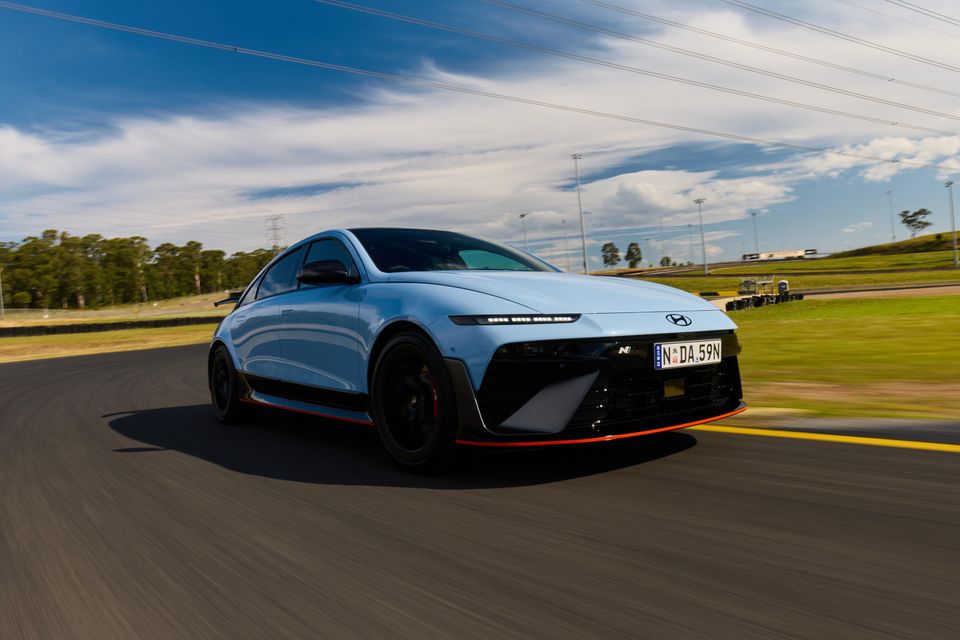
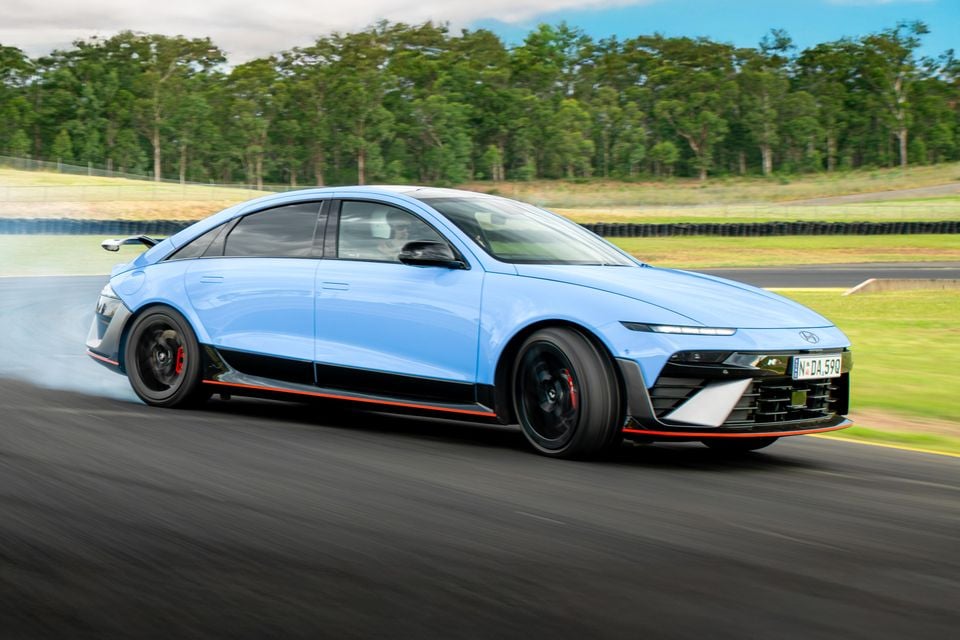
It’ll still drift like the best of them, though. Sure, the Ioniq 6 N is all-wheel drive by default, but it’s also quite tail-happy. It also boasts this thing called the N Drift Optimiser, which does exactly what the name suggests with a combination of custom torque distribution, traction control and wheelspin settings. Yep, even a complete novice can slide this thing around controllably.
Alternatively, you can set the torque distribution tool to send more shove to the front wheels for improved stability. It’s a case of choose your own adventure.
That’s also true of the configurable battery management system, which takes instructions from the driver to optimise battery cooling and performance for a broad set of applications ranging from drag racing to extended track sessions.
Realistically, you could commute in the Ioniq 6 N from Monday to Friday, take it drifting at a skid pan on a Friday night, track it on Saturday and finish with a coastal cruise on Sunday, and it likely wouldn’t miss a beat. You can’t say that about many other EVs.
To see how the Hyundai Ioniq 6 N lines up against the competition, check out our comparison tool
The Ioniq 6 N arrives in a single, fully loaded variant.
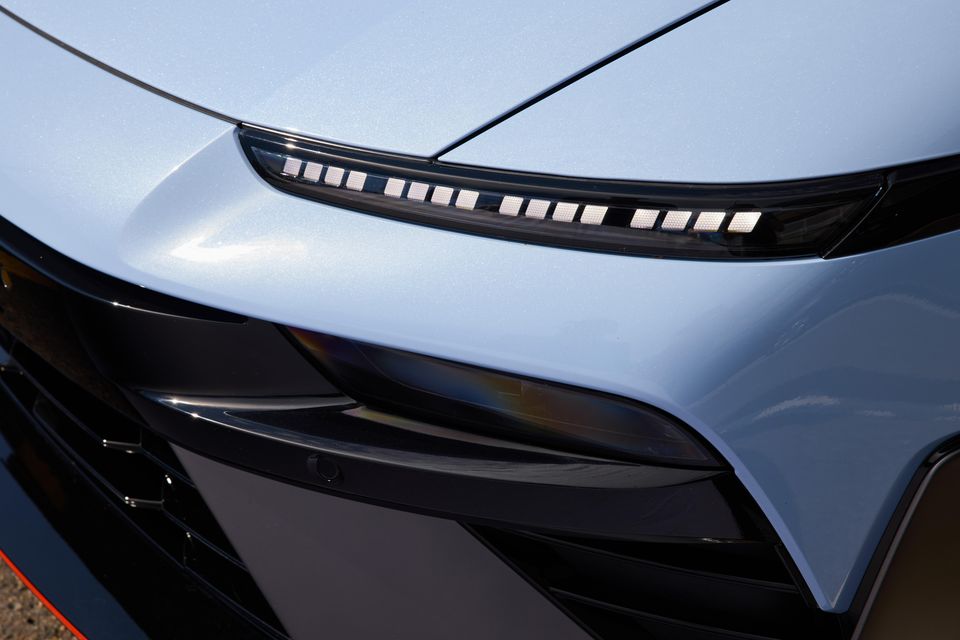
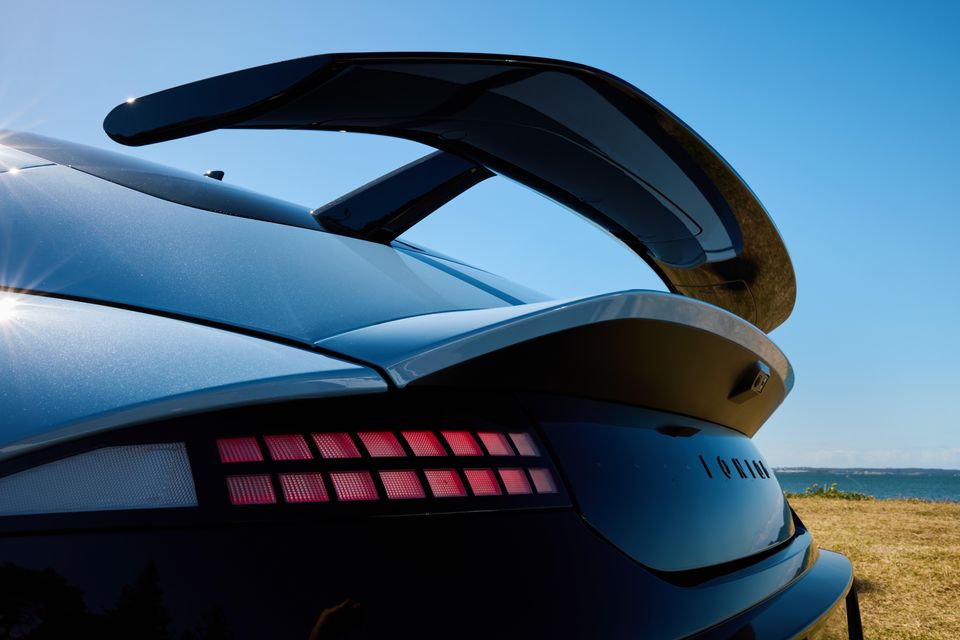
2026 Hyundai Ioniq 6 N equipment highlights:
To see how the Hyundai Ioniq 6 N lines up against the competition, check out our comparison tool
The single-pane sunroof can be deleted at no cost – a must for taller drivers who plan to take their Ioniq 6 N on track.
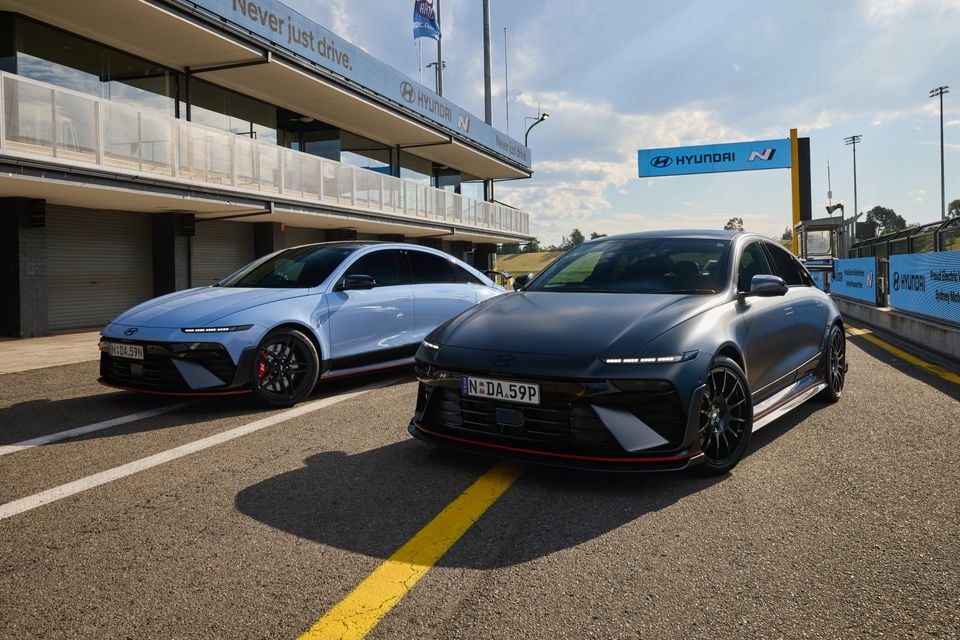
A range of N Performance accessories will be available for the Ioniq 6 N, as follows:
Ticking all the boxes adds over $24,000 to the cost of the base car, although each item can be purchased separately. The prices above exclude fitment, although Hyundai charges $600 to install the full set of accessories.
To see how the Hyundai Ioniq 6 N lines up against the competition, check out our comparison tool
The standard Hyundai Ioniq 6 has a five-star rating from ANCAP, which was awarded back in 2022. However, this rating is unlikely to apply to the N, given the Ioniq 5 N didn’t inherit the five-star rating of the standard Ioniq 5.
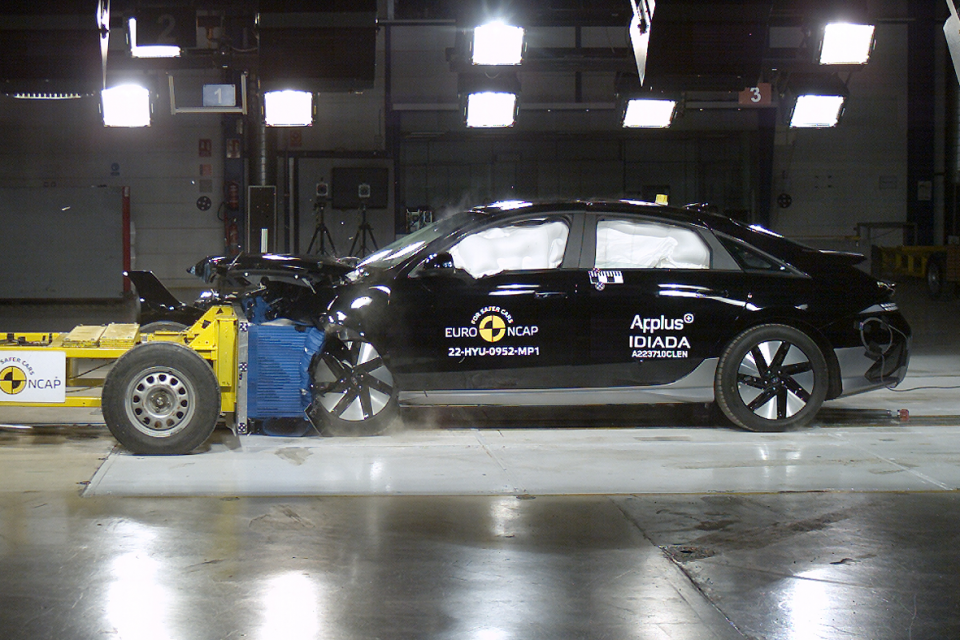
Standard safety equipment includes:
To see how the Hyundai Ioniq 6 N lines up against the competition, check out our comparison tool
Hyundai Australia backs its model range with a seven-year, unlimited-kilometre warranty (if you service on time at a Hyundai dealer, otherwise it's five years) which includes non-competitive, recreational driving on racetracks.
| Servicing and Warranty | Hyundai Ioniq 6 N |
|---|---|
| Warranty | 7 years, unlimited kilometres (conditional) |
| High-voltage battery warranty | 8 years, 160,000km |
| Roadside assistance | 12 months (then service-activated) |
| Service intervals | 24 months or 30,000km |
| Capped-price servicing | Lifetime (service-activated) |
| Average annual service cost(5 years) | $262.40 |
| Total capped-price service cost(5 years) | $1312 |
To see how the Hyundai Ioniq 6 N lines up against the competition, check out our comparison tool
Punters are quick to point out that $115,000 is a lot of cash for a Hyundai, but the car we’re talking about here is no base-model Venue.
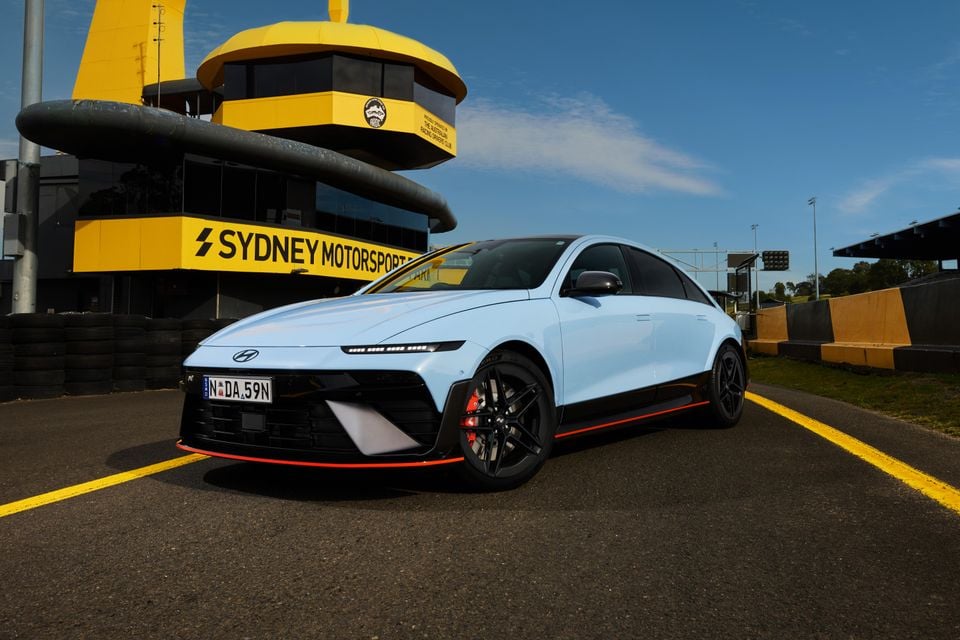
Putting the badge snobbery aside, the Ioniq 6 N is far more engaging to drive than the Tesla Model 3 Performance or BYD Seal Performance. It’s far more interesting, too, even if that works against it in some ways.
Is it as premium or accomplished as a petrol-powered BMW M3 or Audi RS5? No, but those two require a lot more cash.
What about the more closely comparable Taycan? Again, the Porsche is a more upmarket product, and costs almost four times as much in top-spec form, but even then it's probably not as whimsically fun to steer.
That leaves the Ioniq 6 N in a league of its own as an everyday electric sports sedan with a sense of humour and a relatively affordable price tag. A worthy sequel to the epic Ioniq 5 N, I’d say.
CarExpert can save you thousands on a new Hyundai Ioniq 6 N. Click here to get a great deal.
Click the images for the full gallery
If this is the car for you, we’ll compare offers from trusted dealers, handle the back and forth and manage your purchase from enquiry to delivery.
Quickly see how this car stacks up against its competition. Select any benchmark to see more details.
Hyundai IONIQ 6
Hyundai IONIQ 6 Sales rolling 12-months#
*Based on VFACTS and EVC data
Looking for complete Hyundai IONIQ 6 price history?
Our Hyundai IONIQ 6 Pricing Page shows exactly how prices have changed over time.
2025
$72,668
2025
$84,428
2025
$88,103
2025
$89,616
2026
$122,781
Josh Nevett is an automotive journalist covering news and reviews, with a background in motorsport journalism.
Add CarExpert as a Preferred Source on Google so your search results prioritise writing by actual experts, not AI.
William Stopford
16 Hours Ago

Damion Smy
10 Days Ago

Derek Fung
15 Days Ago
William Stopford
23 Days Ago
Damion Smy
1 Month Ago
Damion Smy
1 Month Ago
Add CarExpert as a Preferred Source on Google so your search results prioritise writing by actual experts, not AI.
# Based on VFACTS and EVC data
† Displayed prices are based on the drive-away price of the vehicle, which includes delivery charges, registration fees, number plates, and applicable road taxes, based on a Sydney location. However, prices may vary between states and territories, and additional costs such as compulsory third party (CTP) insurance, dealer delivery fees, and optional extras are not included. These prices are subject to change without notice and may not reflect current market pricing or dealer offers.
 Automotive Vehicle Spec Data & 4K images Powered by JATO Dynamics Ltd