




James Wong
Deepal parent confirms new Chinese brand for Australia – UPDATE
Changan will launch its Nevo brand in Spain next year, and it has plans to expand into other European markets and potentially Australia.
2 Hours Ago
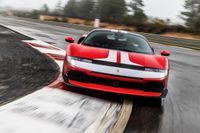
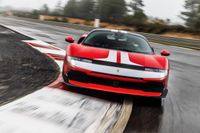
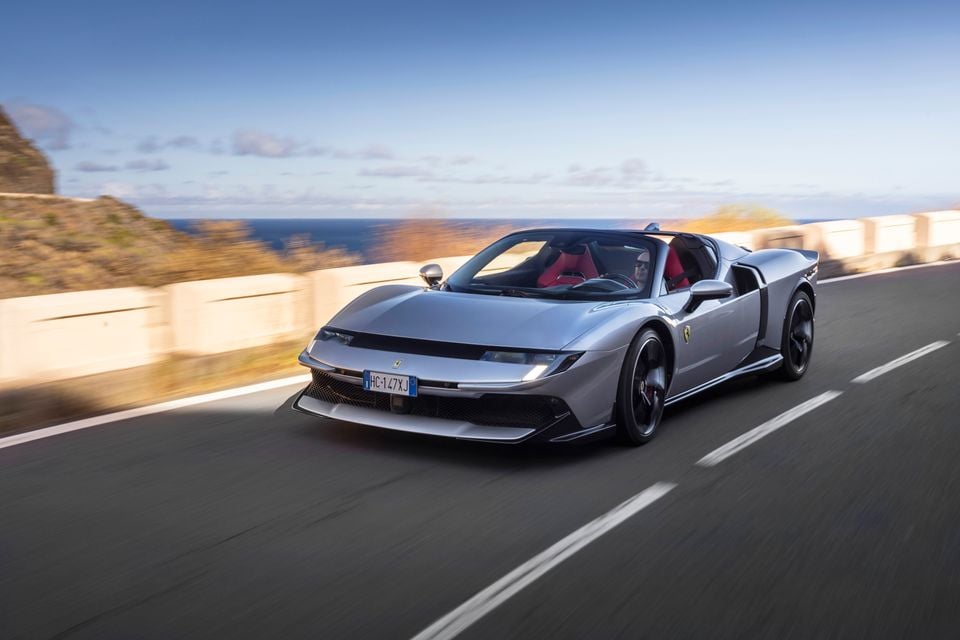
Ferrari's 849 coupe is already absurdly capable. Removing the roof gives it the theatre its numbers deserve, and sacrifices little of its ability.
If this is the car for you, we’ll compare offers from trusted dealers, handle the back and forth and manage your purchase from enquiry to delivery.
Ferrari has created a problem for itself. Once a road car can accelerate from 0-200km/h in 6.5 seconds (quicker than a Bugatti Veyron), adding more speed stops making it meaningfully more exciting on a public road. The numbers become something you recite to people, rather than something you can properly use.
The Ferrari 849 Testarossa Spider solves that problem in the simplest possible way, by removing the roof. Sure, you can argue the coupe is lighter and purer, but the Spider gives you something meaningful at 60km/h which makes it so much more special, and that is not only the sun and the air but a less obstructed connection to the twin-turbo V8 behind you.
At this level, theatre is worth more than another tenth of a second. There was a time when a car capable of reaching 100km/h in 6.5 seconds was considered properly quick. The 849 Testarossa Spider reaches double that speed in the same time, yet its defining quality isn’t how frighteningly fast it is.
It’s how completely unintimidating it can feel when you aren’t exploiting all 772kW.
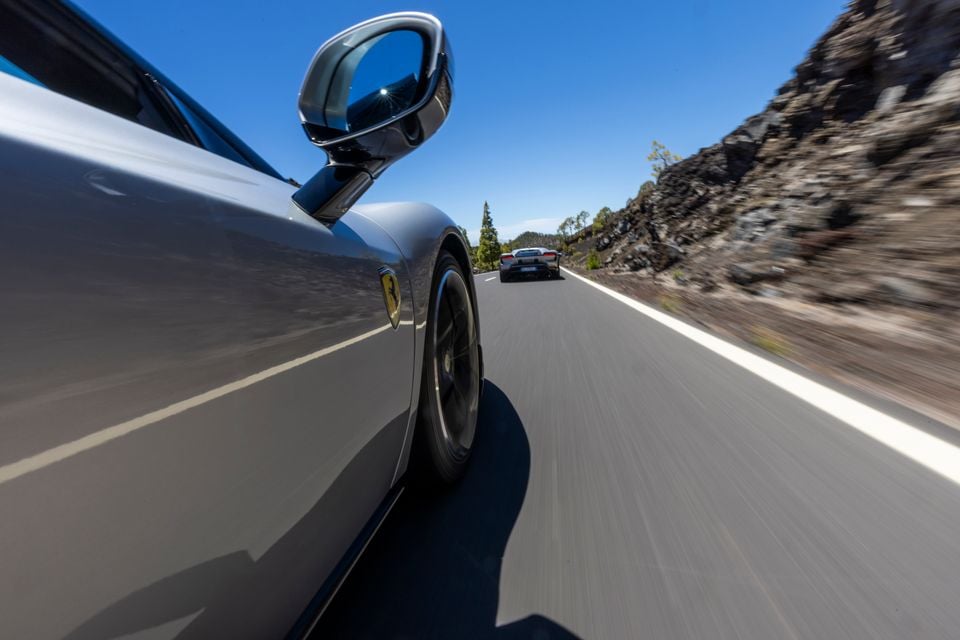
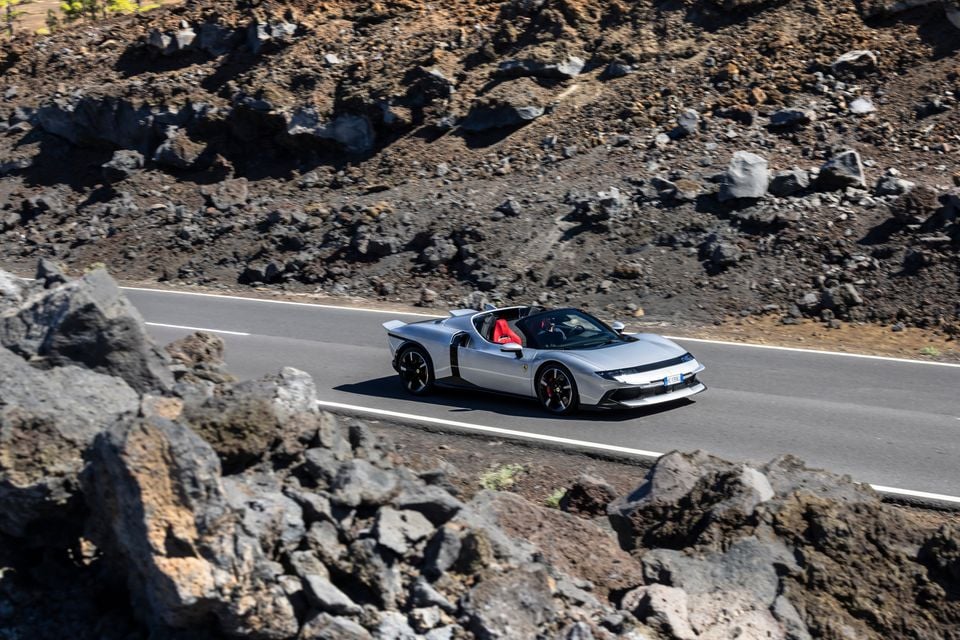
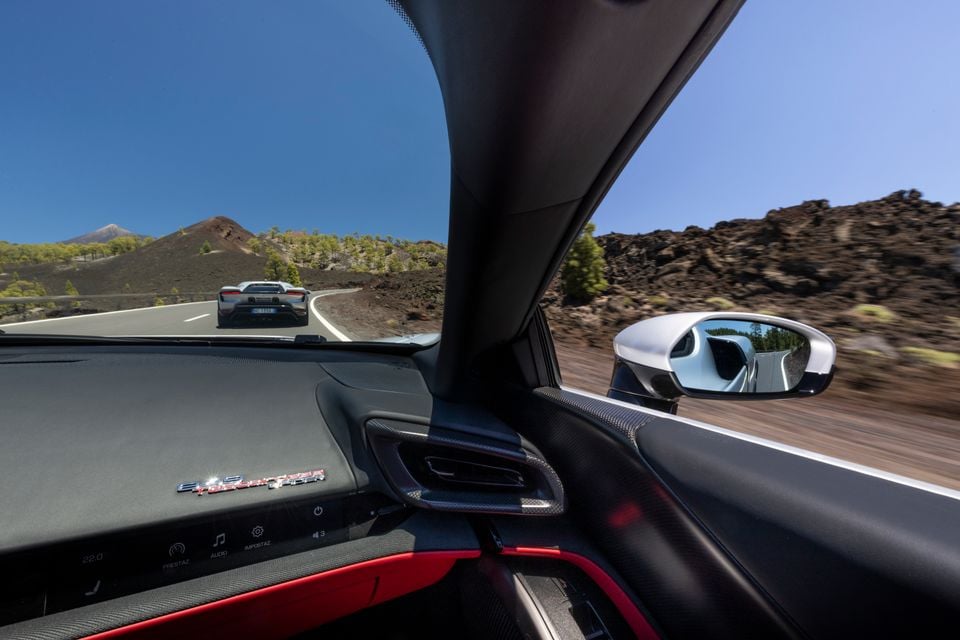
Our press launch route in Tenerife climbed away from the Canary island's coast and towards its volcanic interior, taking in tight corners, poor surfaces, open sweepers, and some demanding descents.
The 849 is more than 2.3 metres wide, weighs 1660kg dry in its lightest quoted configuration, and produces the sort of acceleration that can make passengers feel physically unwell. From behind the wheel, however, it feels far more approachable than its dimensions, power, or appearance suggest.
Our earlier drive of the 849 Testarossa coupe took place in torrential rain around Seville, which revealed just how effectively Ferrari’s electronics could deploy more than 1000 horsepower on a soaked racetrack.
Tenerife gave us the dry roads needed to understand the rest of the car. What separates the 849 from the SF90 it replaces isn’t simply another 50cv of power. It’s the way the powertrain, steering, suspension, brakes and electronic controls now behave as one system rather than a collection of extremely clever individual components.
The Spider also isn’t an afterthought created by cutting the roof off a finished coupe. Ferrari says the two body styles were conceived in parallel, with around 90 per cent of the open-roof version shared with the coupe and the remainder specific to the Spider.
The company positions the coupe as the track-focused choice for purists, while the Spider is intended for an owner who wants the same fundamental performance but places greater value on open-air driving, comfort, and sharing the experience with someone else.
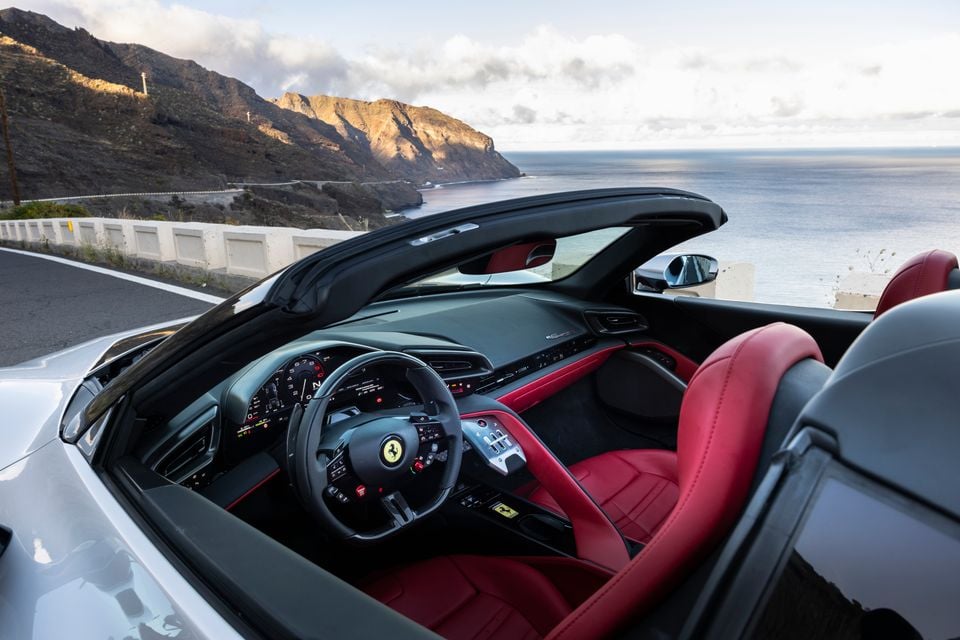
Ferrari Australia expects the Spider to account for the greater share of local 849 Testarossa sales. Having now driven both versions, that expectation makes perfect sense.
The 849 Testarossa Spider is priced from $1,015,589 before on-road costs, making it $82,941 more expensive than the coupe.
| Model | Price before on-road costs |
|---|---|
| Ferrari 849 Testarossa | $932,648 |
| Ferrari 849 Testarossa Spider | $1,015,589 |
| Spider premium | $82,941 |
Australian deliveries are expected to commence in the first quarter of 2027, approximately six months after the coupe begins arriving locally.
Of course, the price written on a Ferrari order form and the price paid when the car is eventually delivered are rarely the same thing.
We estimate a sensibly optioned 849 Testarossa Spider will cost around $1.2-$1.3 million on the road. That is an estimate, rather than a Ferrari-supplied drive-away figure, because local prices for the launch car’s options weren’t available and statutory charges vary between states.
Our Argento Nürburgring-coloured test car was far from a bare-bones specification.
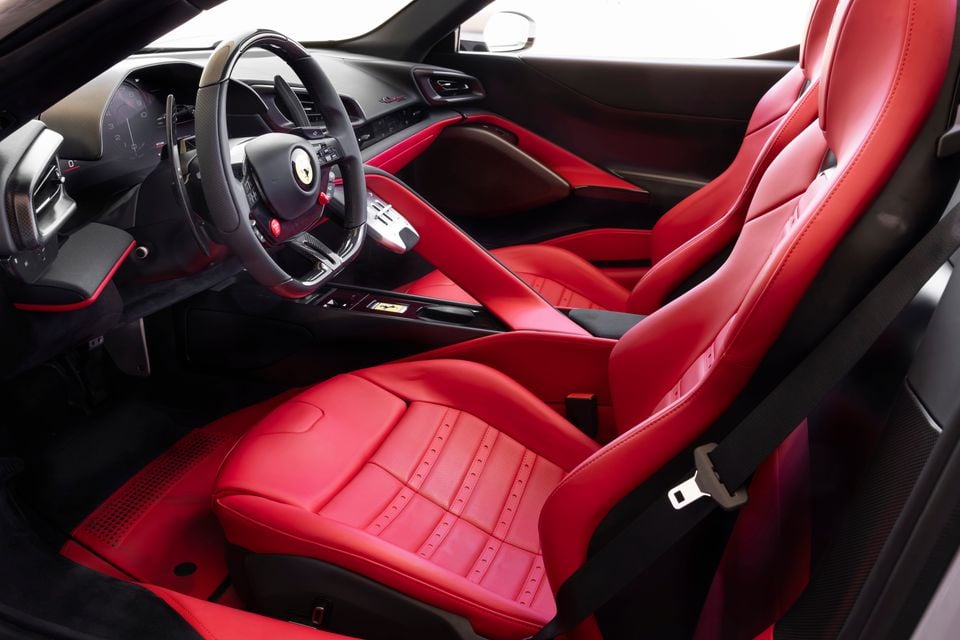
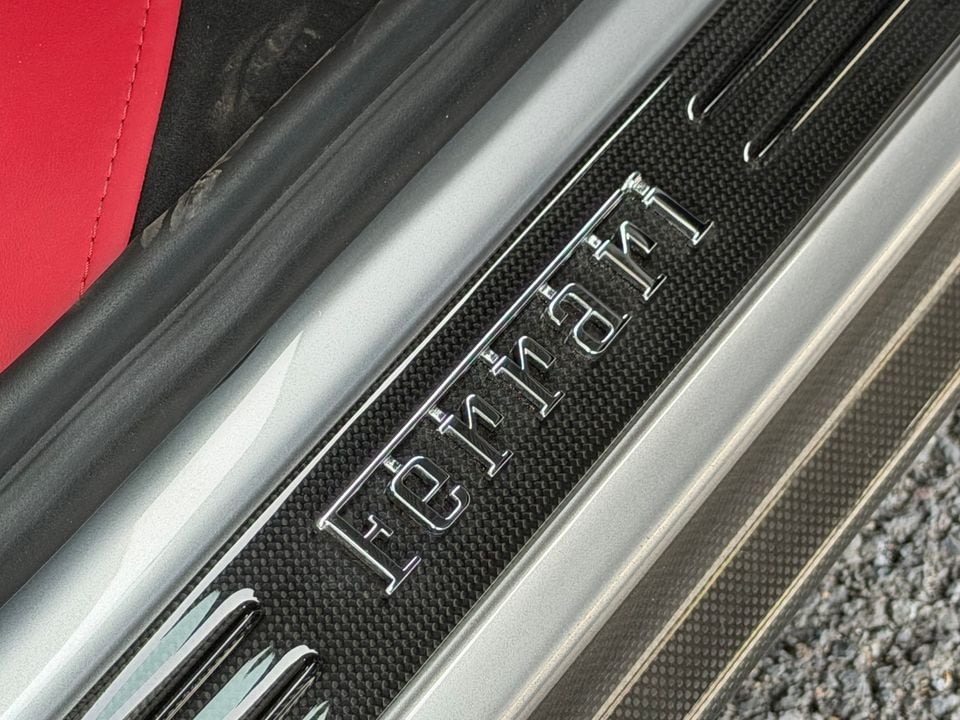
Its build plate listed a black two-tone body treatment, a Rosso Giudecca full-leather interior, full-electric ventilated Daytona-style seats, neck warmers, adaptive cruise control, a suspension lifter, forged diamond-finish wheels, black exhaust outlets, Scuderia shields, titanium wheel bolts, premium audio, and extensive carbon-fibre trim.
The latter extended to the engine bay, rear bonnet, wheel-arch trims, front spoiler, rear diffuser, doors, sills, dashboard, central tunnel, steering wheel, and driver's zone.
Without prices for those individual items, it would be misleading to quote an as-tested figure. It’s safe to say, however, that an 849 Spider configured like our car would sit well above its already formidable base price.
That raises the same residual-value question we had about the coupe. Ferrari’s hybrid technology is now well established, and the company has comprehensive long-term battery support programs, but buyers spending well beyond $1 million should still enter with their eyes open to the developing second-hand market for hybrid supercars.
The Testarossa name invites an obvious but incorrect interpretation of this car.
This isn’t a modern remake of the side-straked 1984 Testarossa, and it wasn’t designed by starting with that car and attempting to drag it into the 2020s.
The name itself has a much longer history. Ferrari first used the Testa Rossa name for the 500 TR in 1956, referring to the red cam covers fitted to some of its most important racing engines. The better-known road-going Testarossa didn’t arrive until 1984.
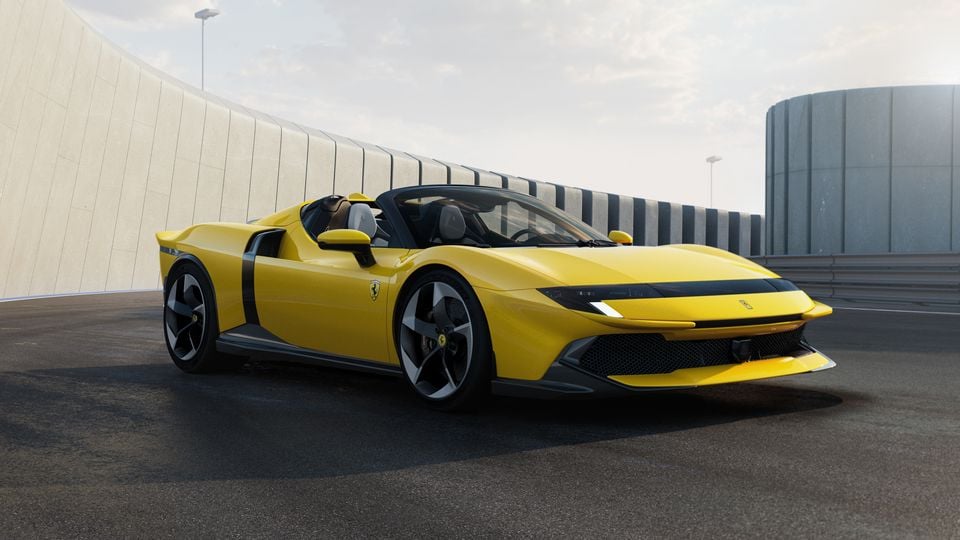
Jason Furtado, one of the 849 Testarossa’s lead designers, explained the design direction was established before the team knew the finished car would carry the Testarossa badge.
Its starting point was what he described as an aero-heavy brief, informed by Ferrari’s sports-prototype racers of the 1970s – particularly the 512 S and 512 M.
Those cars marked a transition from the curvaceous and voluptuous Ferraris of the 1960s to something more geometric, brutal, and functional. Cooling requirements grew, intakes became larger, and the bodywork began visibly responding to aerodynamics rather than merely enclosing the mechanical components.
That philosophy is written all over the 849.
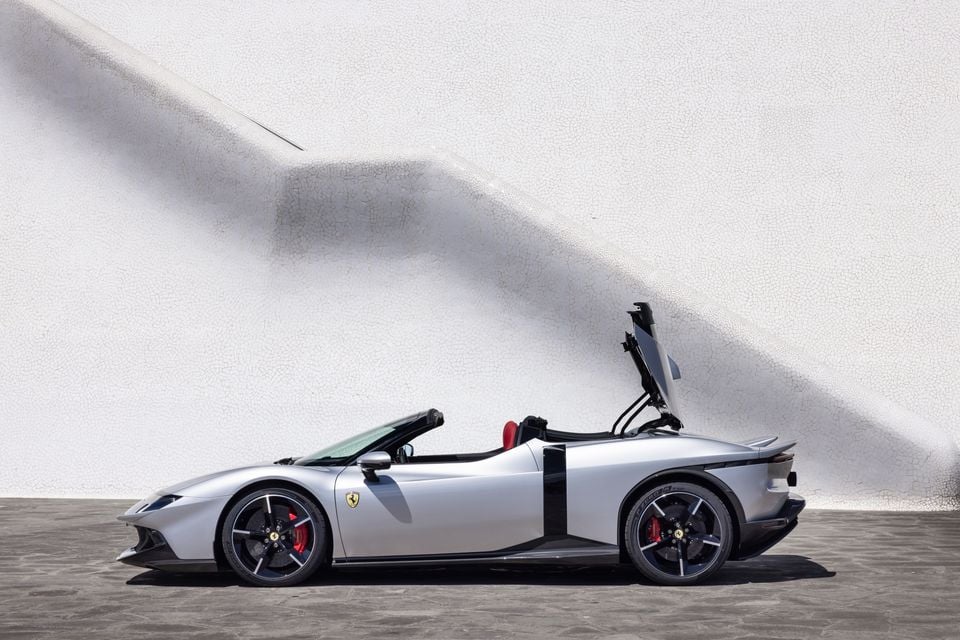
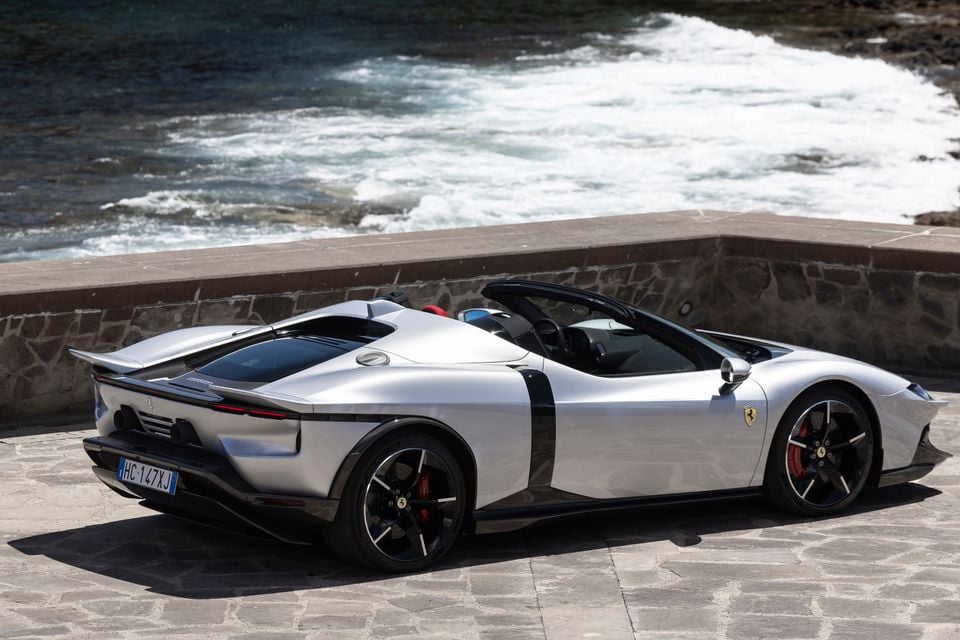
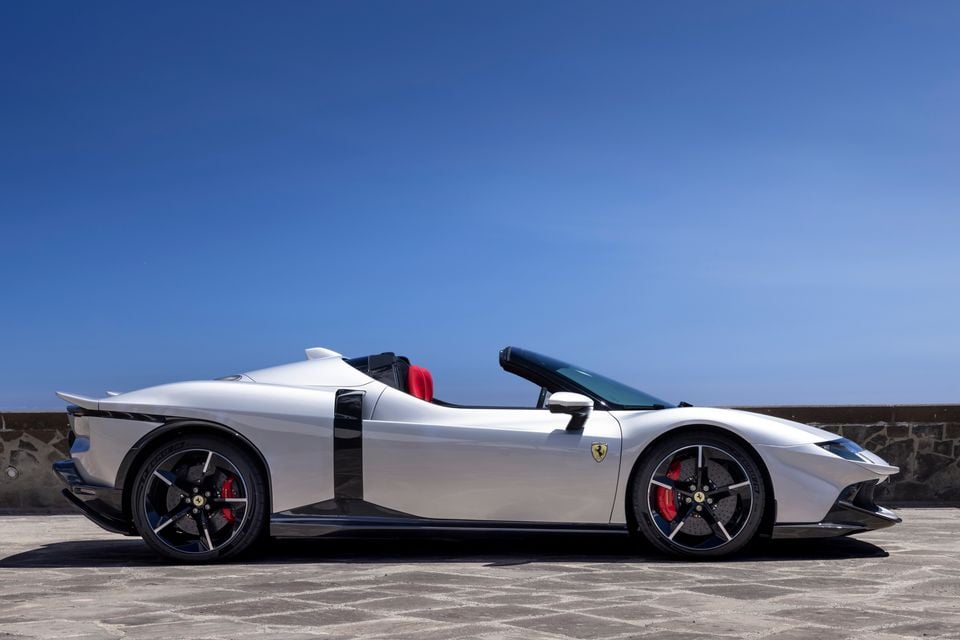
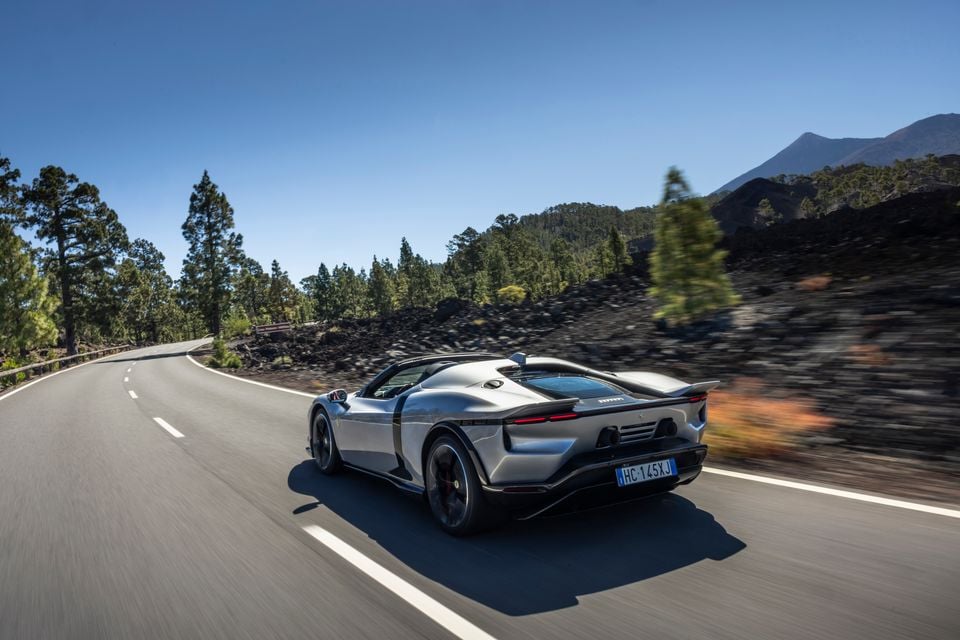
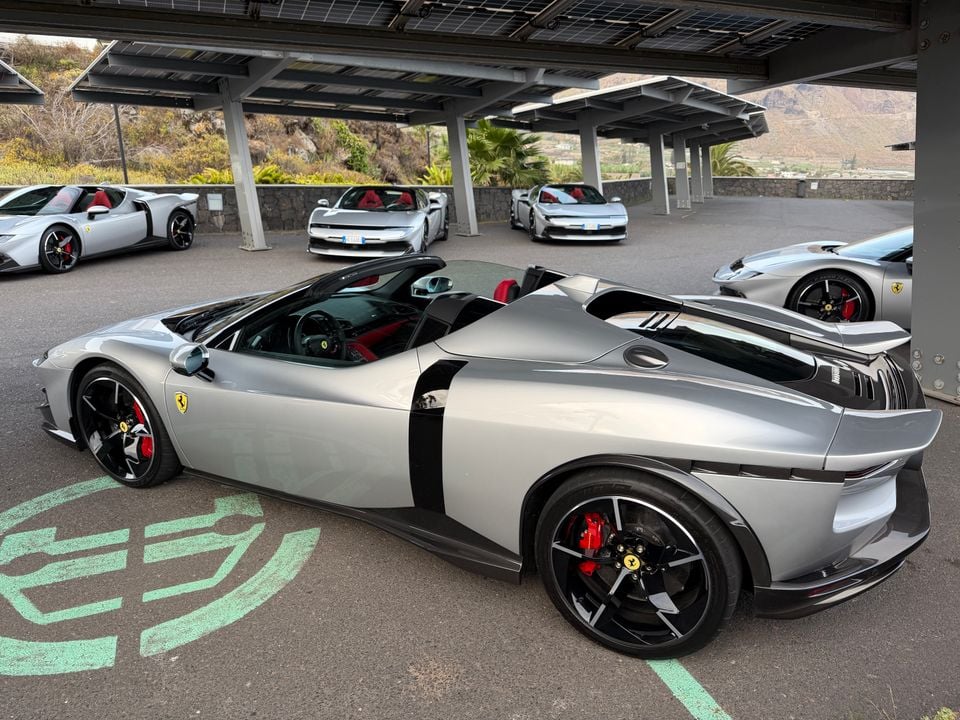
The door is perhaps its most technically impressive feature. Rather than having a relatively simple convex outer panel, its surface moves from positive to deeply negative and then back again, creating the huge channel that feeds air towards the rear of the car.
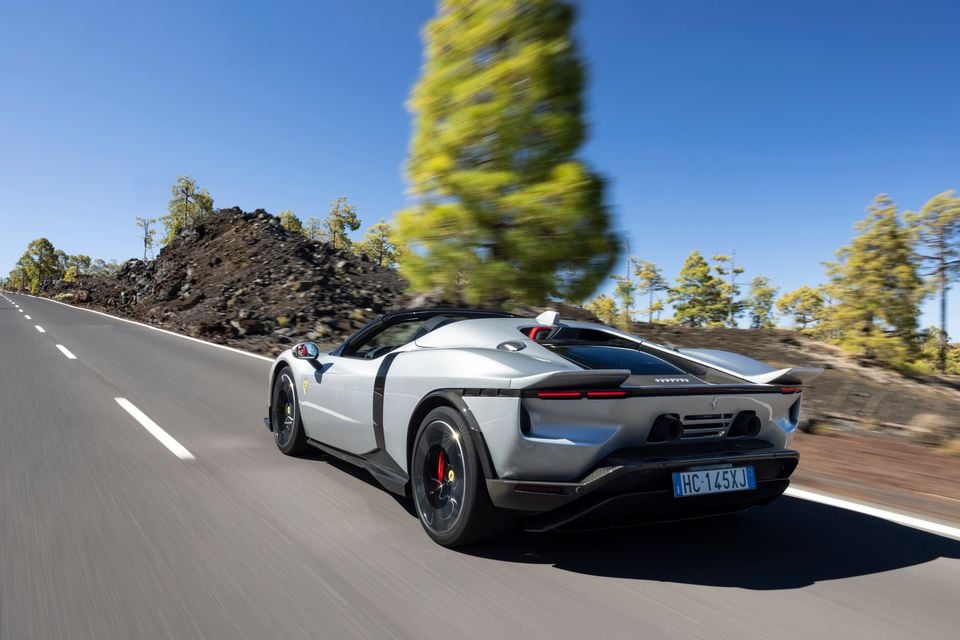
Ferrari says the entire door outer is formed from a single aluminium alloy pressing, despite its extraordinary depth and three-dimensional shape. It is part of an aero package that sends 30 per cent more air to the intercoolers than with the SF90 Spider.
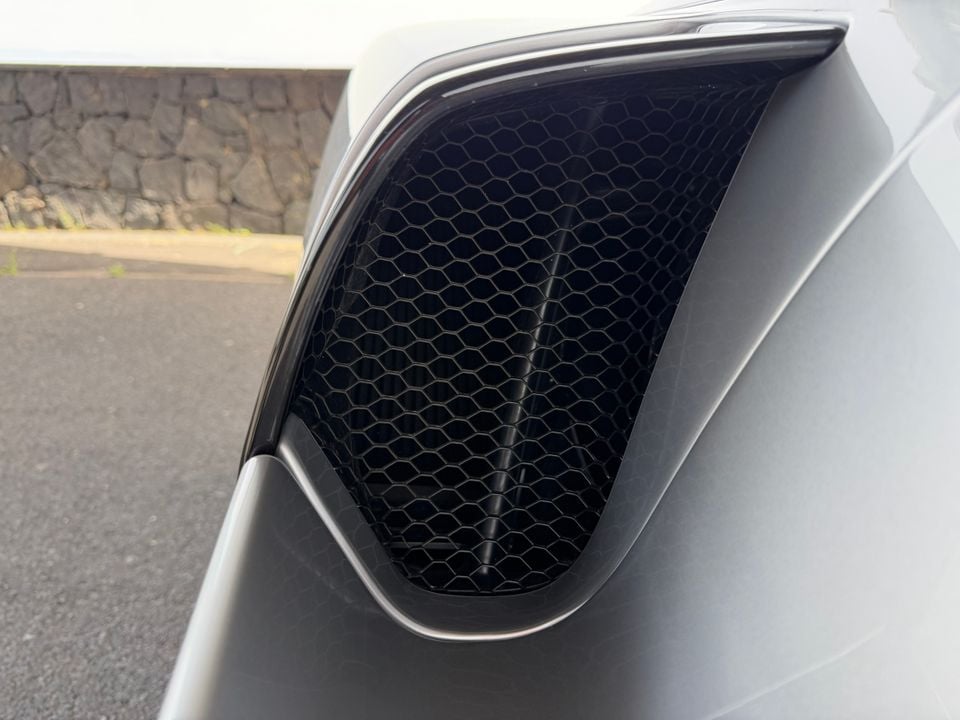
The vertical black element behind the door isn’t merely decorative. It incorporates an additional intake and provides a visual break in what would otherwise be an extremely long section of bodywork. Furtado described the effect as a corset, pinching the car in at its waist and making the doors and overall side profile appear shorter, tighter, and lighter.
The bodywork around it rises into broad rear shoulders, while the cabin appears to sit within the car rather than being perched on top of it. That is a significant part of why the 849 looks lower and more exotic than the SF90, even though the underlying concept is familiar.
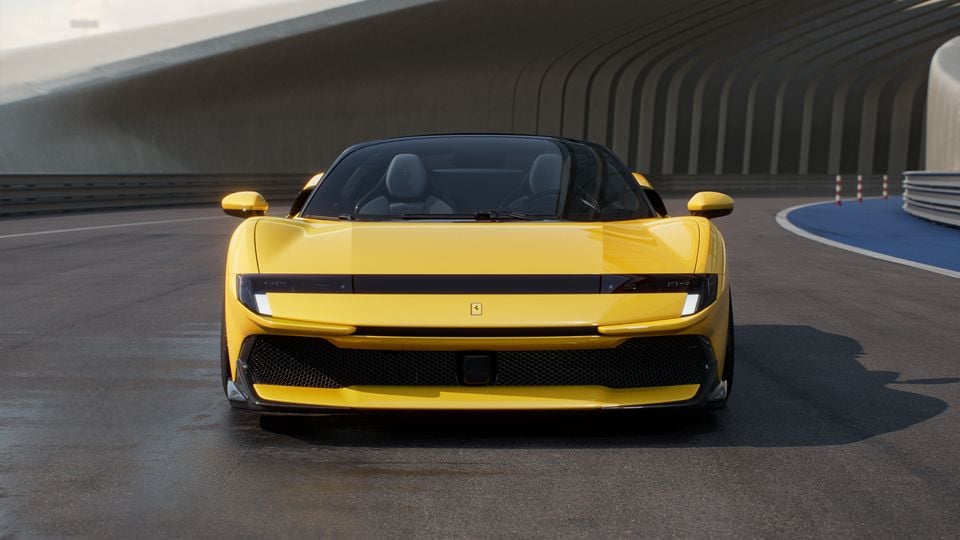
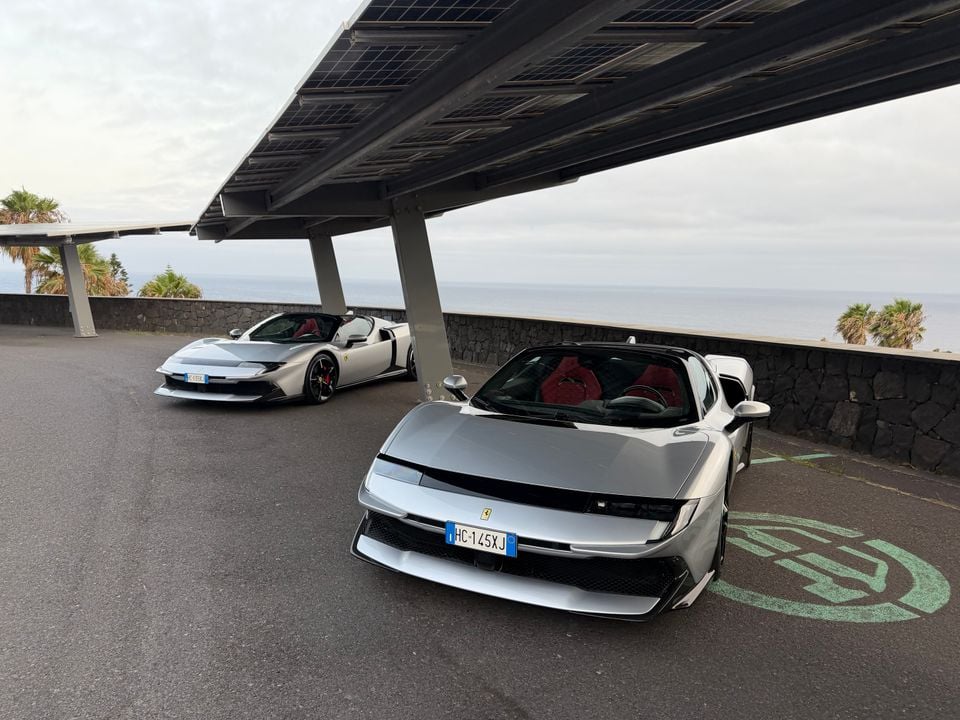
At the front, the thin lighting modules have been compressed into a full-width black fascia designed to evoke the effect of pop-up headlights without actually having them.
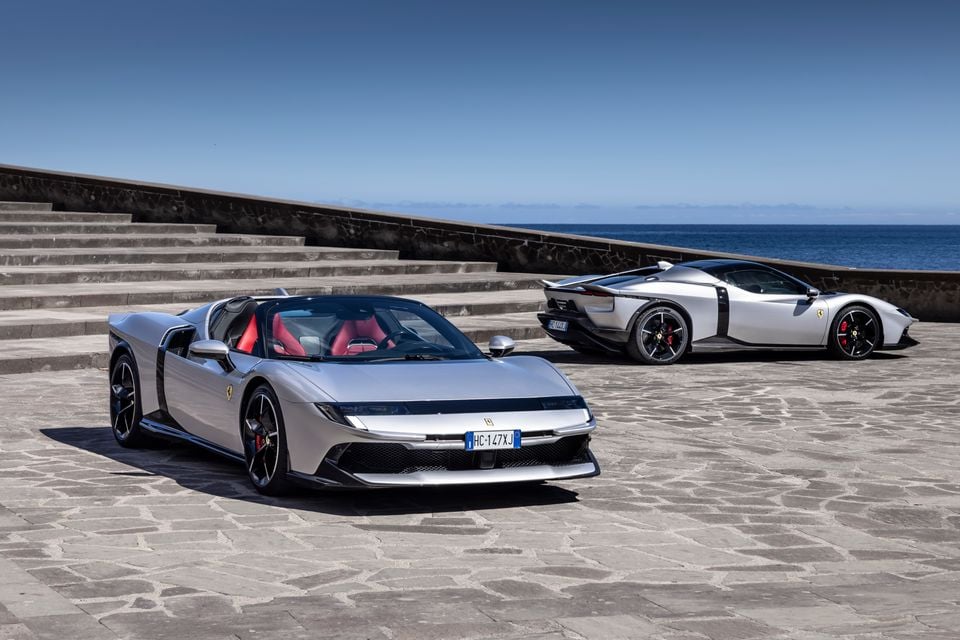
Modern pedestrian protection and lighting regulations make proper pop-up units unrealistic, so Ferrari has tried to recreate the visual impression of a closed headlight cover instead.
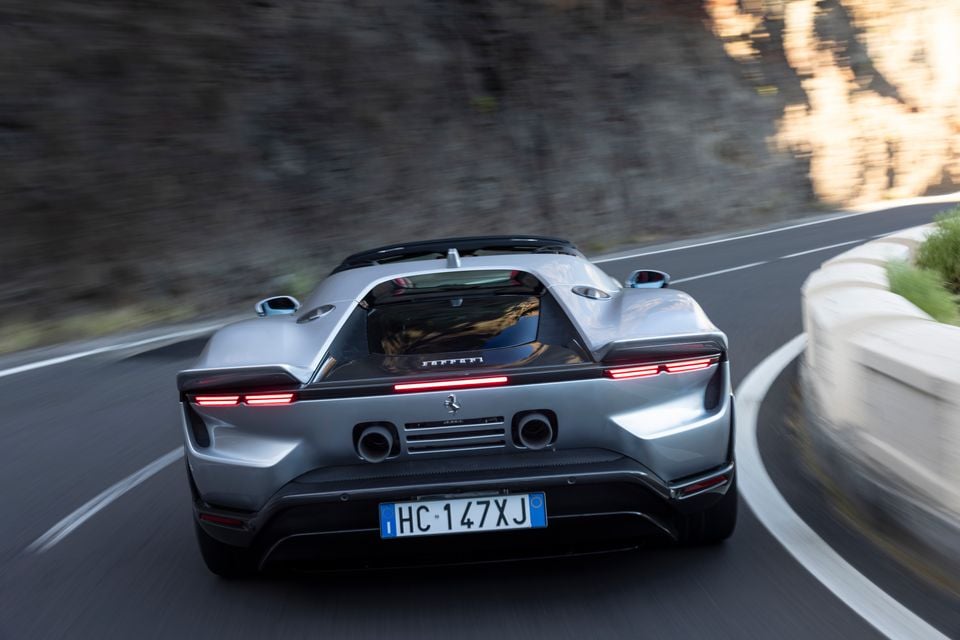
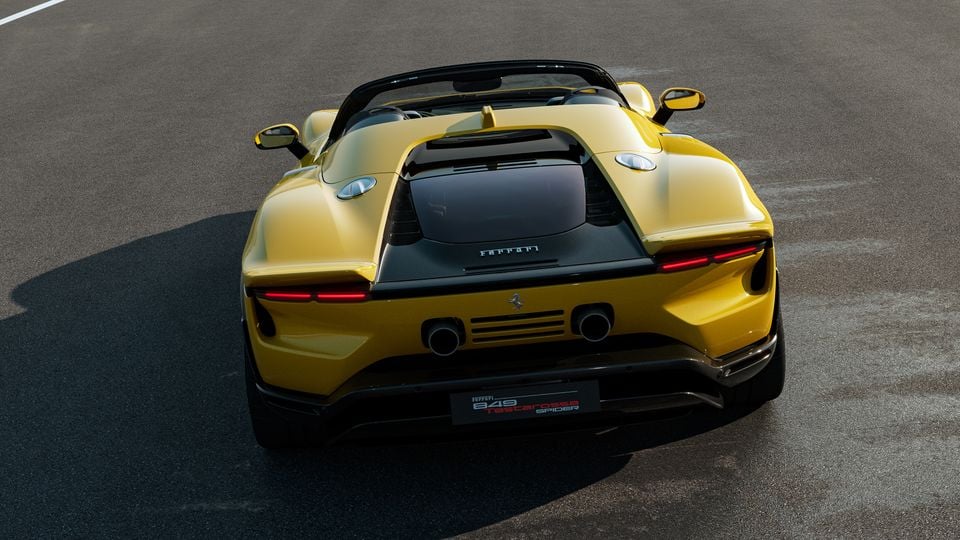
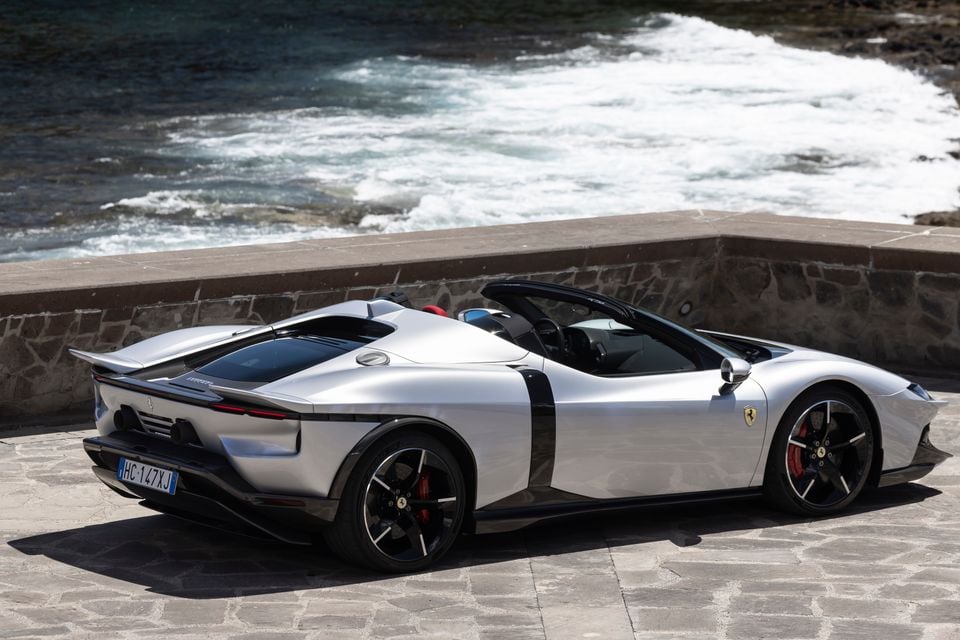
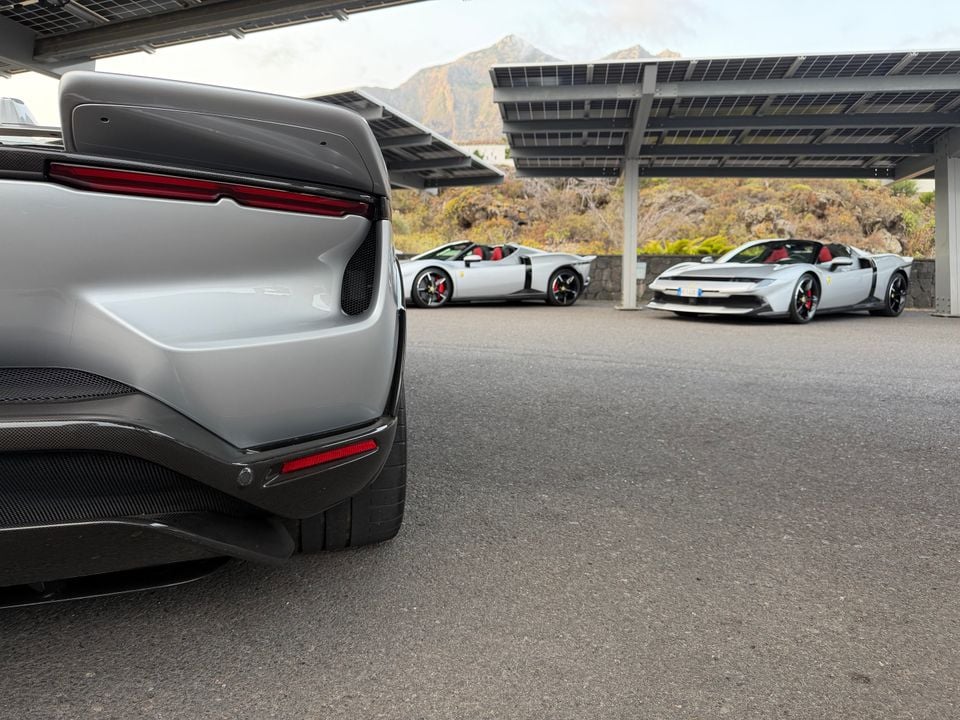
The rear is dominated by its twin tails, another functional reference to the 512 S. On the coupe they visually merge into the roof, but with the Spider’s hardtop stowed they become the defining elements of the car.
They aren’t ornamental, either. Ferrari says the twin tails generate 10 per cent of the rear downforce, working in conjunction with an active spoiler that can move between low-drag and high-downforce positions in less than one second.
In its high-downforce setting, the active element contributes up to 100kg of load at 250km/h. Total downforce is a claimed 415kg at the same speed, 25kg more than the SF90 Spider.
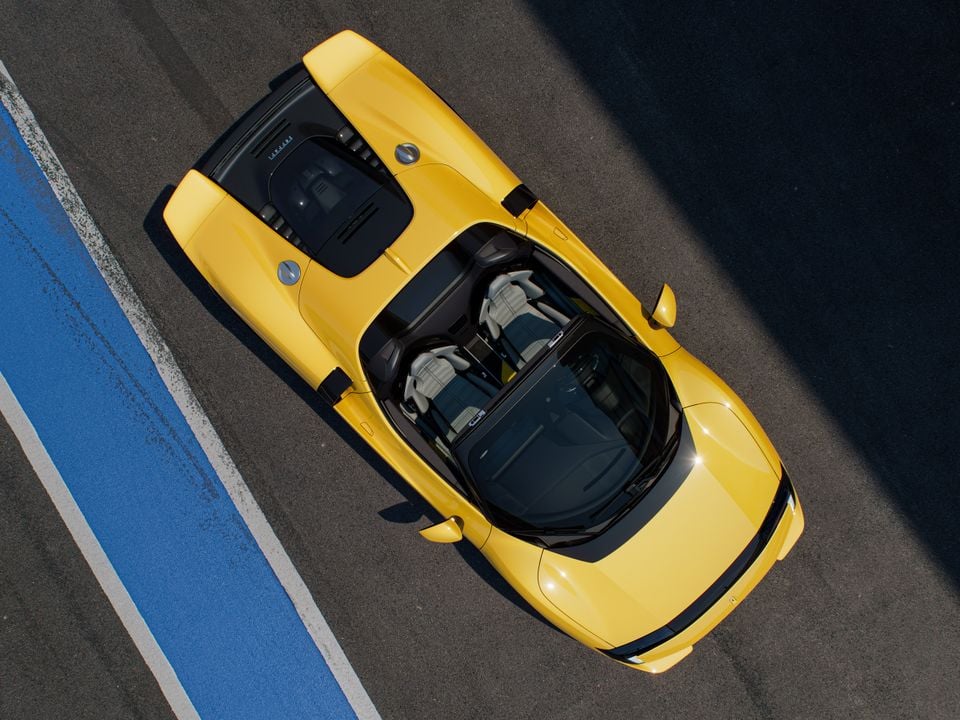
It’s a shape that benefits enormously from being seen in person. Some angles still appear challenging in photographs, but the size of the intakes, the depth of the door, and the relationship between the cabin and rear bodywork make far more sense in three dimensions.
“I think it’s more important to really set a new trend rather than playing it safe,” Furtado told CarExpert.
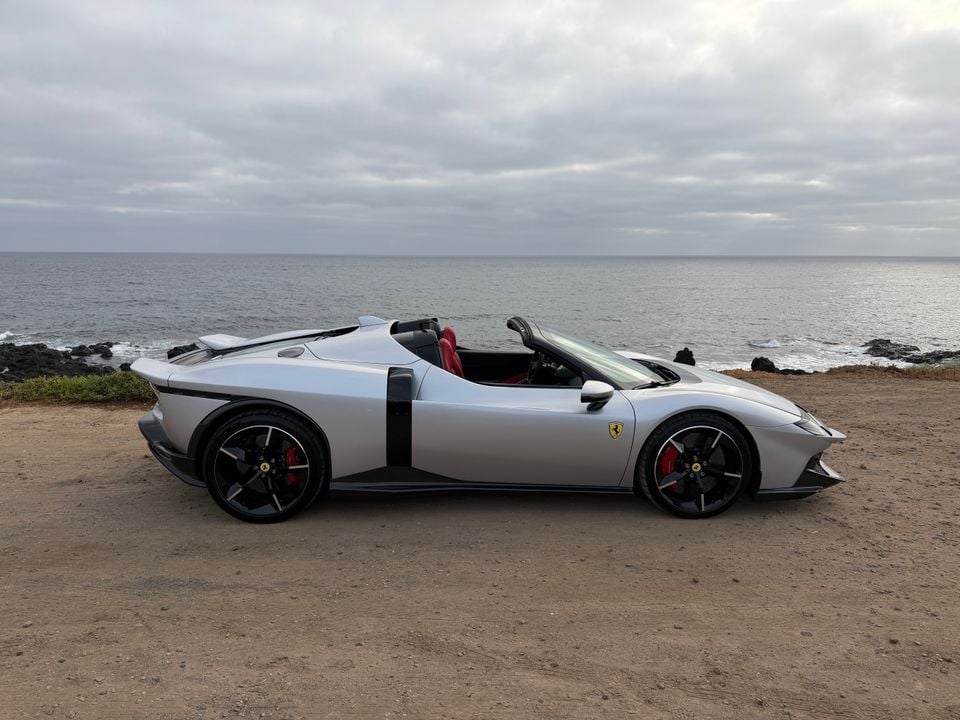
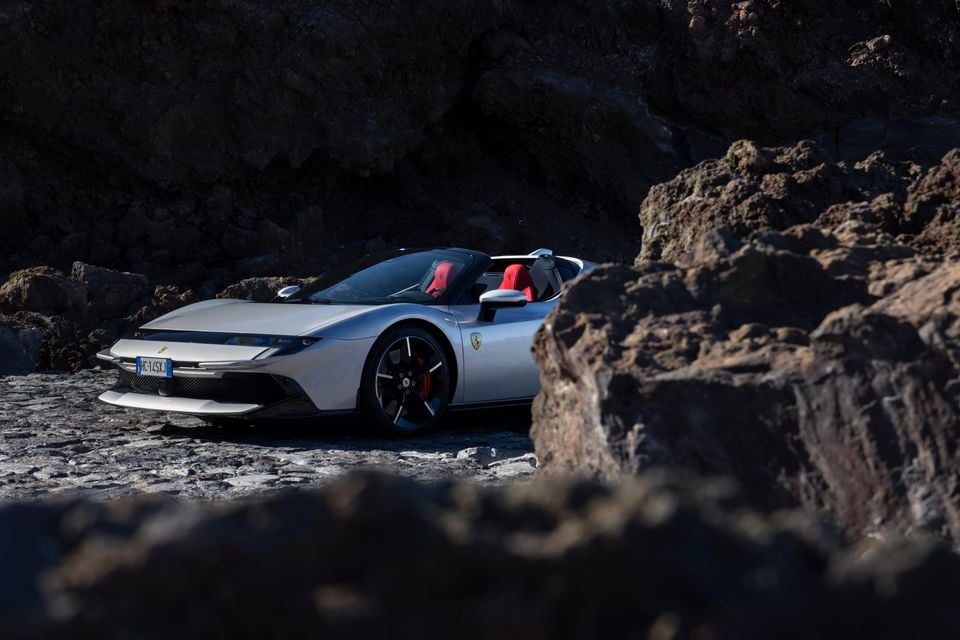
We agree, although our Argento Nürburgring car was arguably too discreet for the job.
The silver finish clearly shows the complexity of the surfacing, but this is a car that deserves a brighter colour – Rosso Fiammante, Giallo Ambra, a vivid blue, or something even more adventurous through Ferrari’s personalisation program.
A million-dollar Spider of this visual complexity shouldn’t be shy.
The two-piece retractable hardtop opens or closes in 14 seconds and can be operated at speeds of up to 45km/h.
It uses the same fundamental roof architecture and hydraulic concept as the SF90 Spider, but its geometry, external surfaces, interior trim, electronic control unit, and rear-glass position have been adapted specifically for the 849’s body and aerodynamics.
The glass rear screen can also be operated independently.
That is more useful than it sounds. On an especially hot day you can leave the roof closed, lower the rear glass, and bring more of the engine into the cabin without subjecting yourself to hours of direct sun.
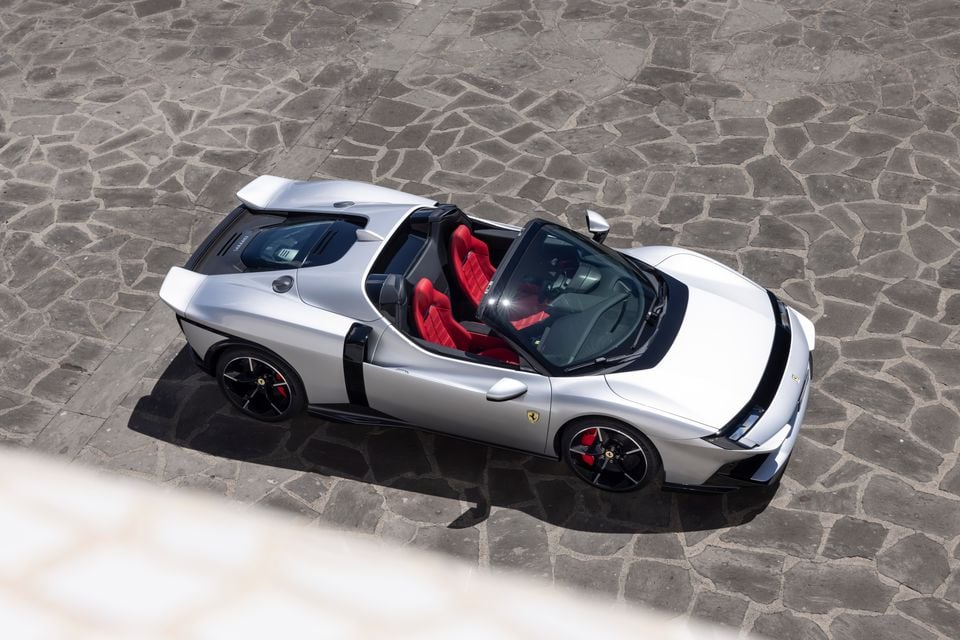
Ferrari has also developed a patented wind-management system for the Spider. Openings behind the seats capture high-energy airflow arriving above the side windows and release it through lower vents near the seat bases, reducing turbulence around the occupants and central tunnel.
It worked well enough for us to leave the roof down throughout the morning without the cabin becoming unpleasant or tiring.
With the roof closed, a bridge across the rear tonneau guides airflow towards the engine cover and active spoiler. Ferrari says this allows the Spider to maintain downforce in line with the coupe in that configuration.
The roof and structural reinforcement add around 90kg compared with the coupe.
That figure needs some context. The SF90’s on-paper coupe-to-Spider gap was around 100kg, but Ferrari says the apparent 10kg improvement for the 849 is largely because its newer adjustable lightweight carbon-fibre seat can now be ordered in the Spider.
In other words, the roof mechanism itself hasn’t suddenly lost 10kg. Ferrari is simply able to quote the Spider in a lighter possible seating configuration than before. Our test car’s full-electric ventilated comfort seats weren’t the lightest available.
Ferrari’s brief flirtation with touch-sensitive steering wheel controls is coming to an end, and good riddance.
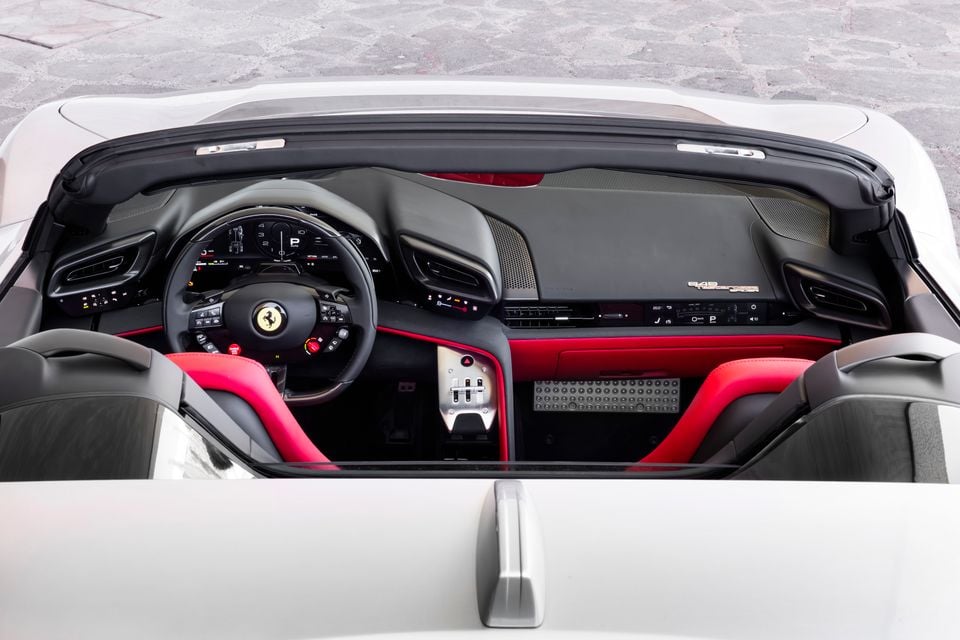
The 849 returns most of the important functions to proper mechanical buttons, including the engine start button. The indicators, lights, wipers, Manettino, and frequently used driving controls are all positioned where you can operate them without looking away from the road.
The digital eManettino remains in the centre of the wheel, providing access to the four hybrid modes: eDrive, Hybrid, Performance, and Qualify.
That arrangement makes sense. The conventional driving functions are physical, while the electrified powertrain modes remain part of the digital interface.
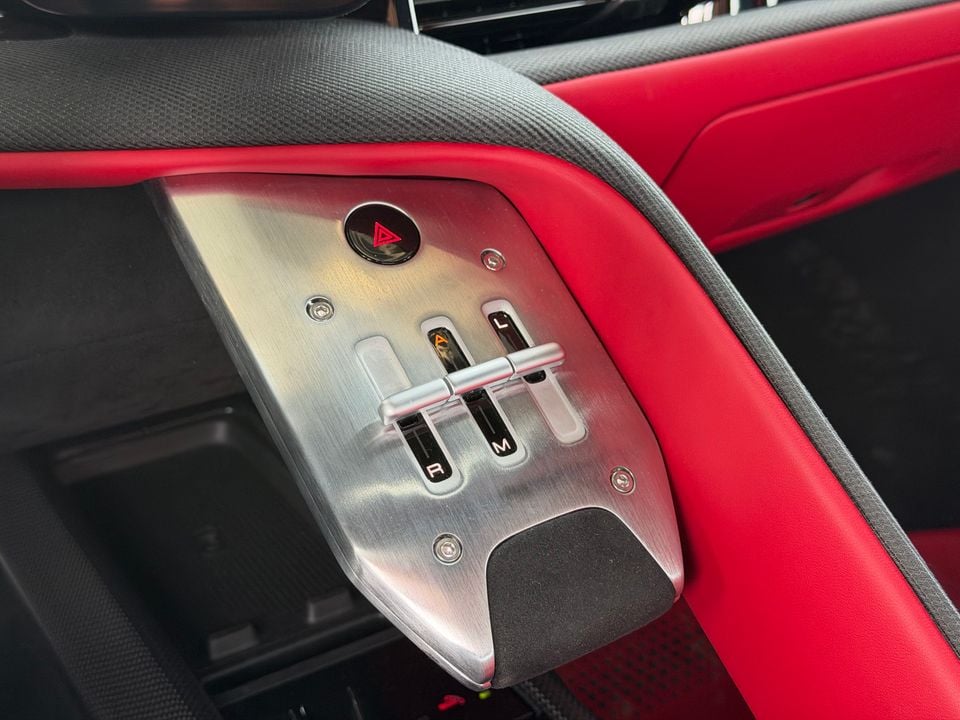
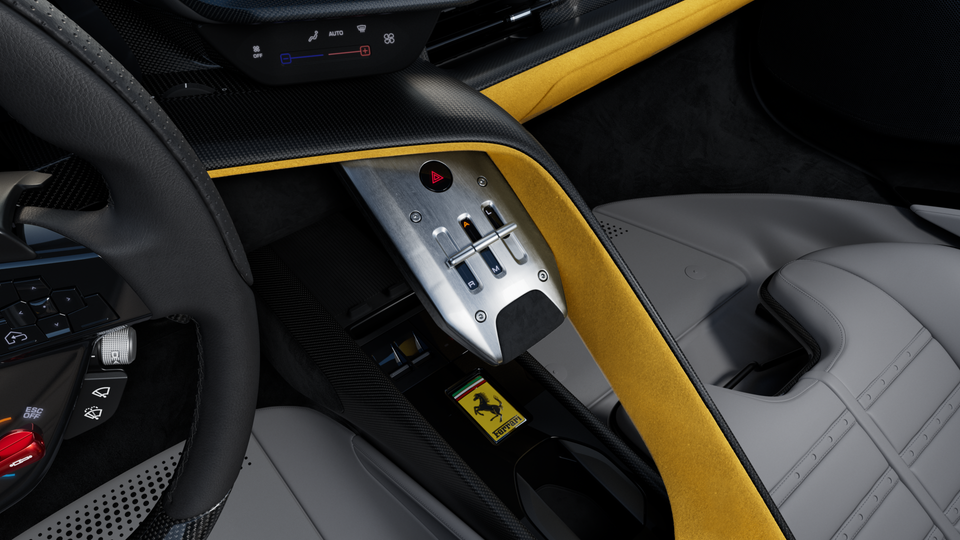
The drive selector is another highlight. Inspired by the F80, it sits high on a sculptural aluminium ‘sail’ extending from the centre console, and gives the cabin something resembling the open gear gate of an old manual Ferrari.
It doesn’t change how the eight-speed dual-clutch transmission operates, but it does provide a level of ceremony that was missing from some of Ferrari’s more clinical recent interiors.
The cabin architecture mixes a broad, horizontal dashboard with more enclosed, single-seater-like elements around the driver. The upper dash appears to float above a contrasting horizontal band, while aluminium-framed C-shaped air vents sit at either end.
Not everything has become physical. The climate controls still use a touch-sensitive interface, but they are close to hand and the digital instrument cluster briefly displays the selected temperature and fan setting before returning to its previous screen.
If this is the car for you, we’ll compare offers from trusted dealers, handle the back and forth and manage your purchase from enquiry to delivery.
It’s a far better execution than forcing the driver to navigate through layers of a central touchscreen.
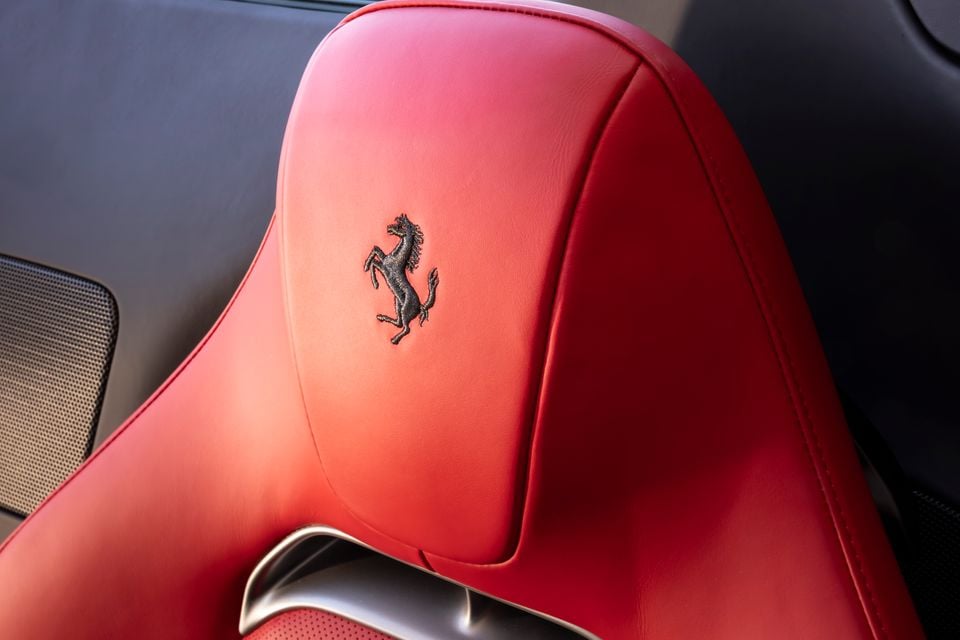
Our car’s Daytona-style seats were exceptionally comfortable and well suited to the Spider’s mission. They were electrically adjustable, ventilated, and paired with optional neck warmers.
Ferrari also offers a carbon-fibre racing seat, including a newer, lighter design, but the comfort seat is the better fit for a road-focused Spider unless reducing every possible kilogram is your overriding concern.
The driving position is excellent. The pedals, steering wheel, and seats line up naturally, every important control is within easy reach, and outward visibility is unexpectedly good.
Even with the roof closed, the rear glass and mirrors provide a clear view behind. Looking forward, there’s none of the letterbox-view sensation associated with some older supercars. Remove the badges from your field of view and the basic sightlines could belong to a far more conventional sports car. That matters because the 849 is enormous.
| Dimension | Ferrari 849 Testarossa Spider |
|---|---|
| Length | 4718mm |
| Width | 2304mm |
| Height | 1186mm |
| Wheelbase | 2650mm |
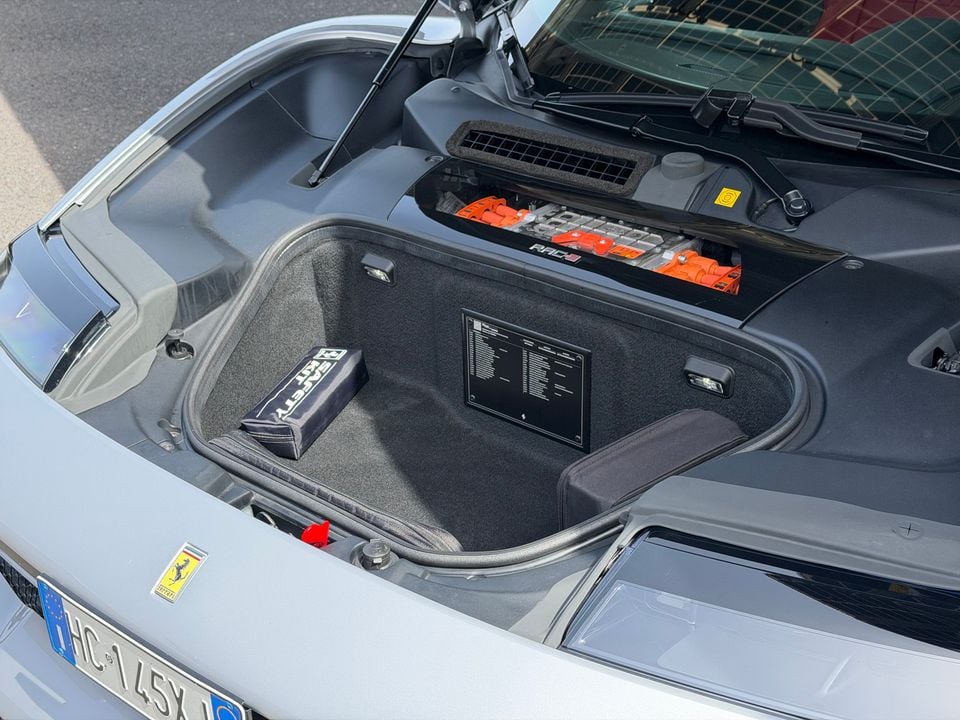
| Front luggage capacity | 74L |
Ferrari’s official figures are shown above.
Practicality is less impressive. There’s a cupholder, a pair of USB-C connections, modest door storage, and a few small places for personal items, but this is not a spacious cabin despite the huge exterior footprint.
The 74-litre front luggage compartment will accommodate a couple of carefully selected soft bags, but you’ll need to pack lightly for a weekend away.
The basic powertrain concept carries over from the SF90 Spider: a mid-mounted twin-turbo V8, an eight-speed dual-clutch transmission, one electric motor at the rear, and two electric motors operating independently across the front axle.
Almost every important detail has been revised.
| Specification | Ferrari 849 Testarossa Spider |
|---|---|
| Engine | 3990cc twin-turbo petrol V8 |
| Engine outputs | 610kW at 7500rpm, 842Nm at 6500rpm |
| Maximum engine speed | 8300rpm |
| Electric motors | Three, 162kW combined |
| Maximum eDrive output | 120kW |
| Total system output | 772kW |
| Battery | 7.45kWh lithium-ion |
| Transmission | 8-speed dual-clutch automatic |
| Drive type | On-demand all-wheel drive with torque vectoring |
| Dry weight | 1660kg with optional content |
| Weight distribution | 45 per cent front, 55 per cent rear |
| Electric range | Up to 25km |
| 0-100km/h | Under 2.3 seconds |
| 0-200km/h | 6.5 seconds |
| Top speed | More than 330km/h |
| 100-0km/h | 28.5m |
| Fuel tank | 68L |
| Fuel consumption | Under homologation |
The internal-combustion engine’s output has risen by 50cv to 830cv, or 610kW, while the three electric motors continue to contribute a combined 220cv, or 162kW. Total output is 1050cv, equivalent to 772kW.
Ferrari doesn’t quote a combined system torque figure, so we won’t invent one by adding unrelated engine and motor outputs.
The V8 itself has been heavily re-engineered. Ferrari has fitted the largest turbochargers it has ever used on a production car, incorporating low-friction bearings derived from the F80 and turbine heat shielding inspired by the 296 GT3.
The cylinder-heads, engine block, exhaust manifolds, intake plenums, valvetrain, fuel rail, and intercooling have also been revised. The challenge was not merely finding another 50cv, but doing it without adding obvious lag or sacrificing response at lower engine speeds.
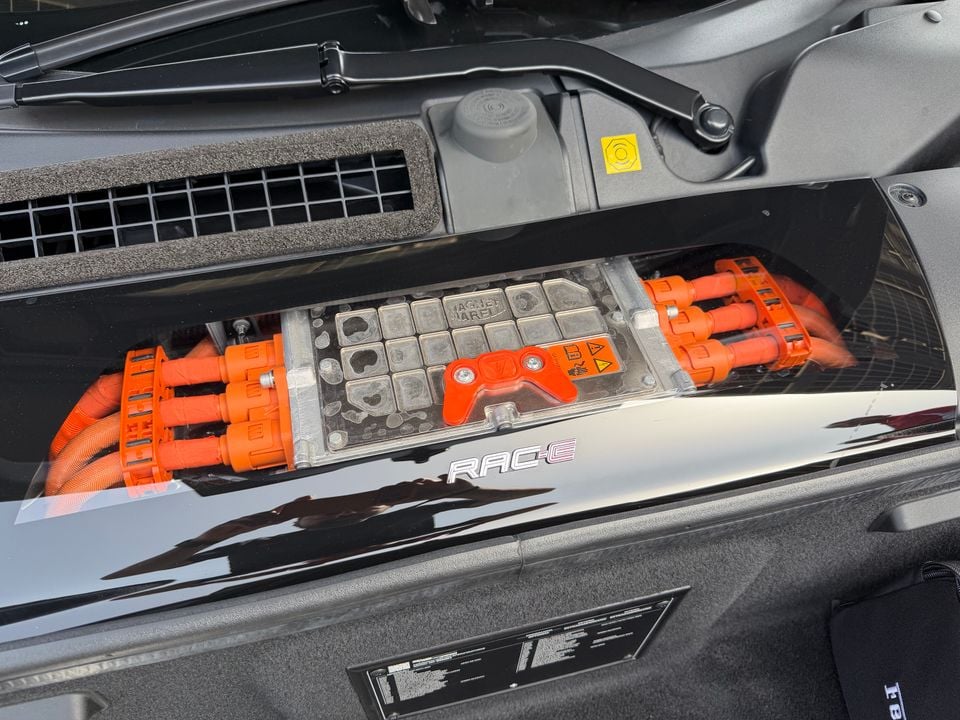
The front motors provide on-demand all-wheel drive and individual-wheel torque vectoring. The rear motor sits between the engine and transmission, filling gaps in the V8’s delivery, recovering energy under braking, and helping manage transitions between electric and combustion power.
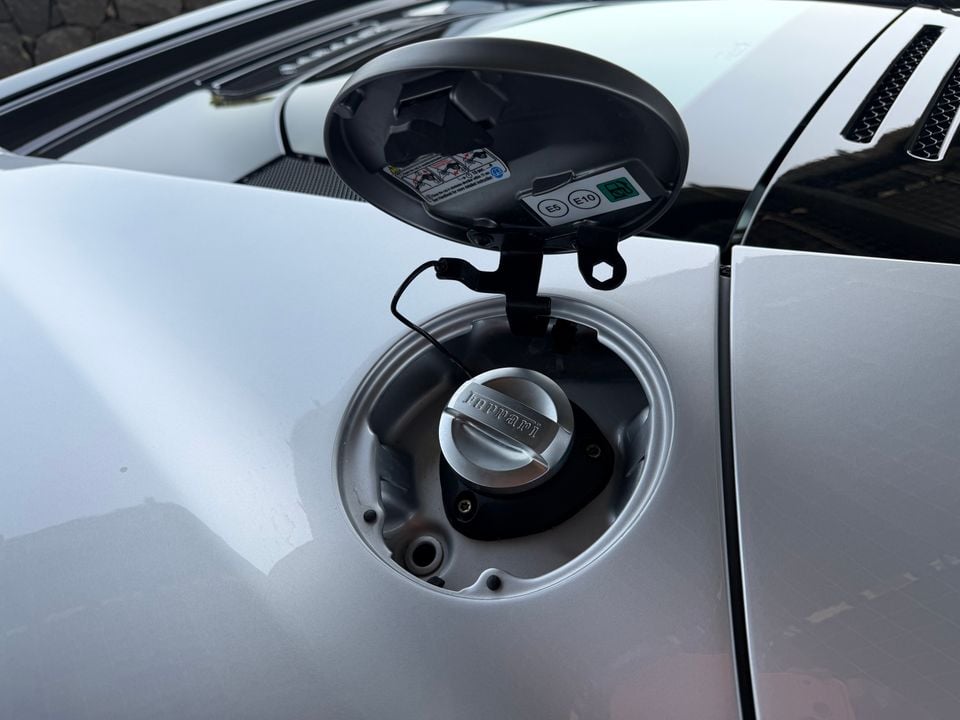
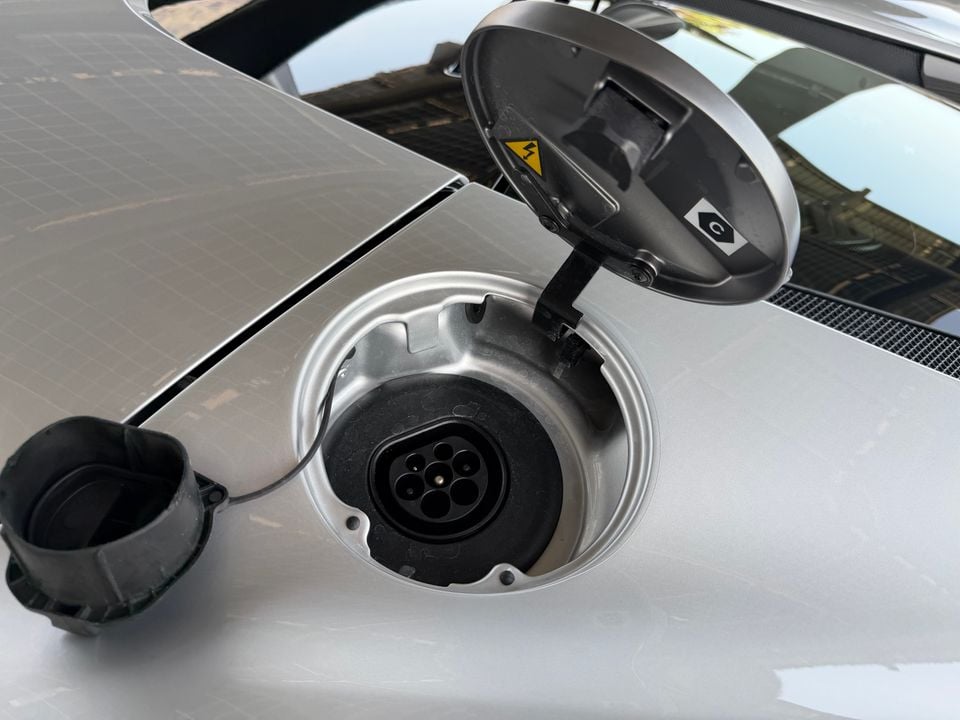
The 7.45kWh battery permits up to 25km of electric-only driving, with up to 120kW available in eDrive mode.
The 1660kg weight figure is dry and requires optional lightweight content. It should not be confused with the mass of a fully fuelled car carrying two people, nor should it be taken as the exact weight of our heavily optioned test vehicle.
Even so, Ferrari claims this is the best power-to-weight ratio it has achieved in a regular range model.
We covered the coupe’s extensive engine, hybrid, aerodynamic, and chassis changes in greater technical detail in our earlier 849 Testarossa review.
The word that best describes the 849’s power delivery is linear.
That may seem an odd description for a 772kW car with the largest turbochargers ever fitted to a production Ferrari, but there is no dramatic wait followed by an uncontrolled wall of boost.
There’s no weak section of the rev range, no obvious gap as the electric assistance changes its contribution, and no point at which the car feels as though it is gathering itself before delivering everything it has.
The accelerator simply provides more speed in proportion to how far you press it – right up to the point where the acceleration becomes genuinely difficult to comprehend.
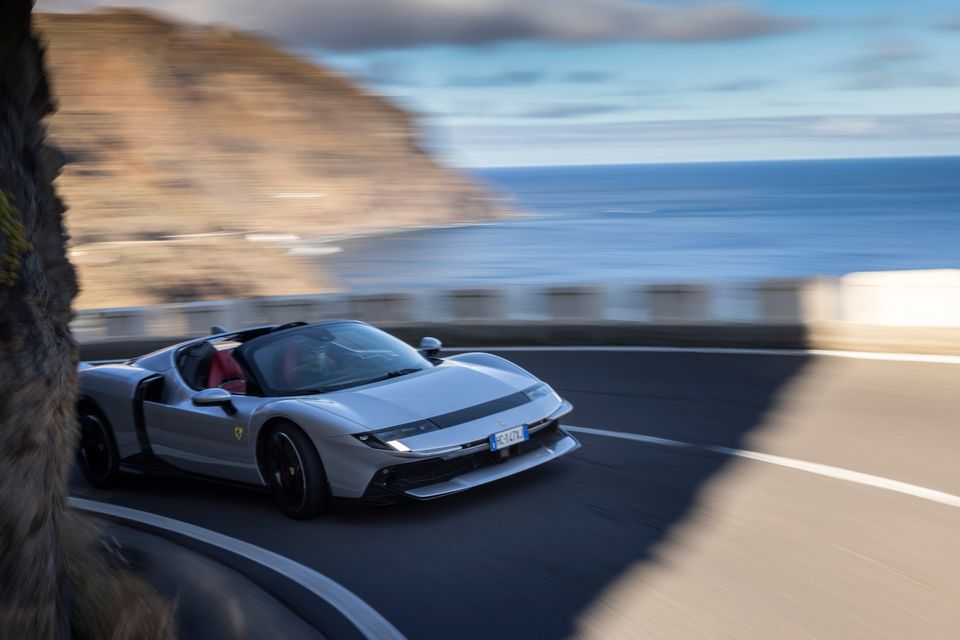
Full throttle while joining a highway is enough to make the world appear to move backwards. The initial hit is fierce, but what distinguishes the 849 is how relentlessly it continues accelerating after the first impact.
Many extremely fast electric vehicles deliver their greatest shock immediately and then begin to taper. The Ferrari seems to become more serious as the speed rises.
A claimed 0-100km/h time of under 2.3 seconds is extraordinary. Reaching 200km/h in 6.5 seconds is the figure that properly explains what you’re dealing with here.
Yet the powertrain’s refinement is arguably more impressive than its peak performance.
Compared with the SF90, the combustion engine, electric motors, and transmission feel more convincingly integrated. The SF90 could feel wild and slightly abrupt, as though several enormously powerful systems had agreed to cooperate but retained their individual personalities.
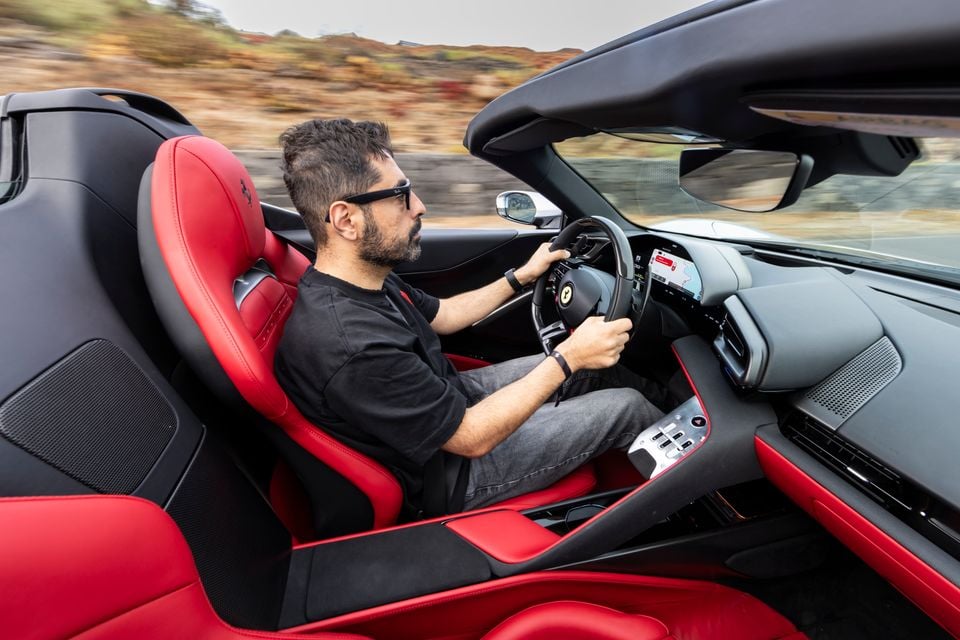
The 849 behaves like it has one power source. That makes it easier to drive smoothly, easier to meter out of a corner, and less likely to surprise its driver. It is more polished and less unruly than the SF90, which some owners may regard as a loss of character.
However, at the speeds this car can generate, we would rather have the greater consistency.
Accessibility should not be confused with softness. The 849 will still overwhelm an inexperienced driver who treats its accelerator casually, but it doesn’t make routine driving feel like punishment for not being a professional racing driver.
The steering response is immediate without making the car nervous, and the front electric motors do more than help deploy the power. By varying torque independently from side to side, they assist the car into a corner and help pull it through the exit.
It creates the sensation of a vehicle much lighter than the number on the specification sheet.
Ferrari’s new Ferrari Integrated Vehicle Estimator, or FIVE, is central to this behaviour.
The system constructs a simplified real-time digital twin of the car using its physical sensors. Ferrari says it can estimate road speed with an error of less than 1km/h and vehicle yaw angle with an error of less than one degree.
Those estimates are then shared with the traction control, electronic differential, all-wheel drive, torque-vectoring system, and ABS Evo.
None of this is apparent from the driver’s seat. There’s no obvious moment where you feel a computer correcting a mistake. You simply turn the wheel, apply the accelerator, and experience a car placing itself with remarkable accuracy.
That invisibility is the mark of good electronic engineering. The technology isn’t there to distract you with what it can do; it’s there to make the car’s responses more predictable.
Through Tenerife’s faster bends, the 849 felt exceptionally balanced. It remained settled under braking, turned without hesitation, and accepted huge amounts of power on corner exit without feeling like the front and rear axles were negotiating separate plans.
The ride is equally impressive. Ferrari’s ‘bumpy road’ damper setting allows the softer suspension calibration to be selected independently of the Manettino’s more aggressive drivetrain and stability settings.
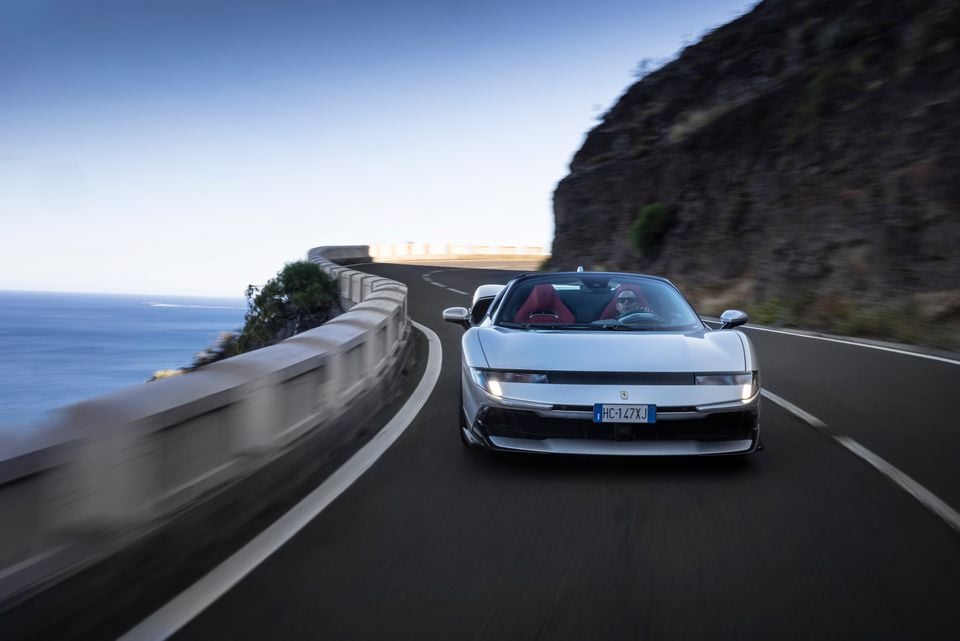
With the car in Sport or Race and the dampers softened, it dealt with broken and patched surfaces far better than a 772kW flagship supercar has any right to.
It never becomes plush, but it breathes with the road rather than skipping across it. The compliance keeps the tyres connected to imperfect surfaces and gives the driver greater confidence, particularly when the road becomes narrow or unpredictable.
That is another reason we would be cautious about ordering the Assetto Fiorano specification for a road-driven Spider.
Assetto Fiorano removes around 30kg through lightweight seats, carbon-fibre wheels, titanium, and other composite components. It also adds more aggressive aerodynamics and can substitute the adaptive dampers for stiffer, single-rate Multimatic units.
For regular circuit use, that will be the specification to have. For roof-down road driving, the standard suspension and comfort seats are a better expression of what makes the Spider special.
Initially, the brakes are mighty. Ferrari has enlarged the discs and pads, fitted new rear calipers, revised the brake-by-wire calibration, and added ABS Evo. Cooling airflow towards the front brakes is claimed to have increased by 15 per cent, while airflow to the rear calipers has risen by 70 per cent.
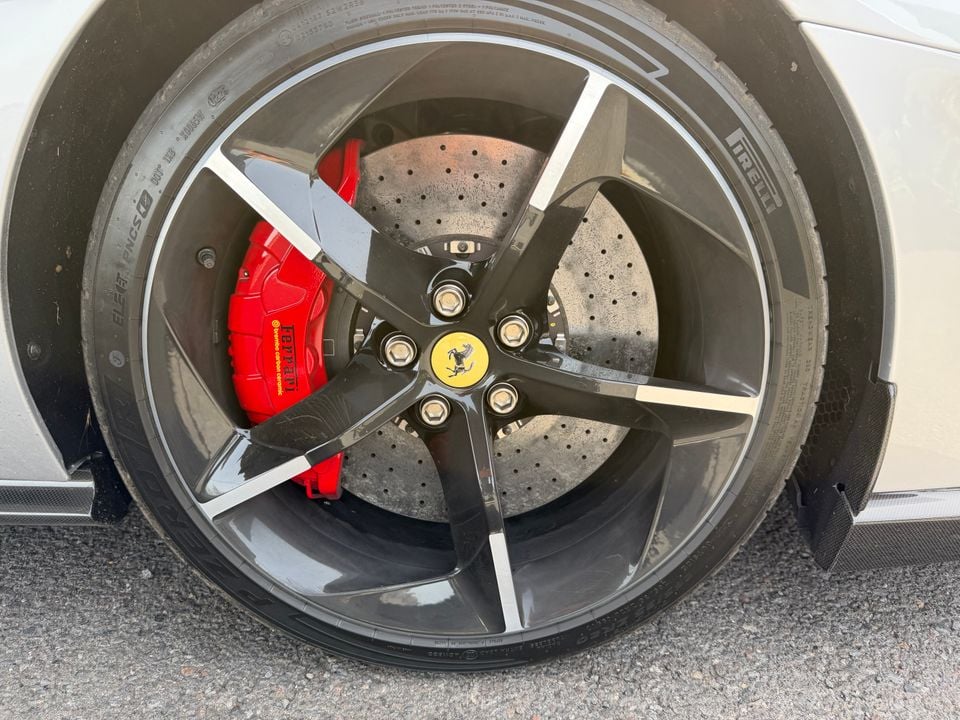
The 100-0km/h stopping distance is a claimed 28.5 metres. However, after repeated and unusually hard use on Tenerife’s mountain roads, we could smell the smoke coming from the brakes and felt the pedal become softer.
They didn’t stop working, and this wasn’t even remotely close to a braking issue. The car continued to decelerate strongly, but more pedal pressure was required and the change in feel was clear enough that we chose to back off rather than continue testing their limits.
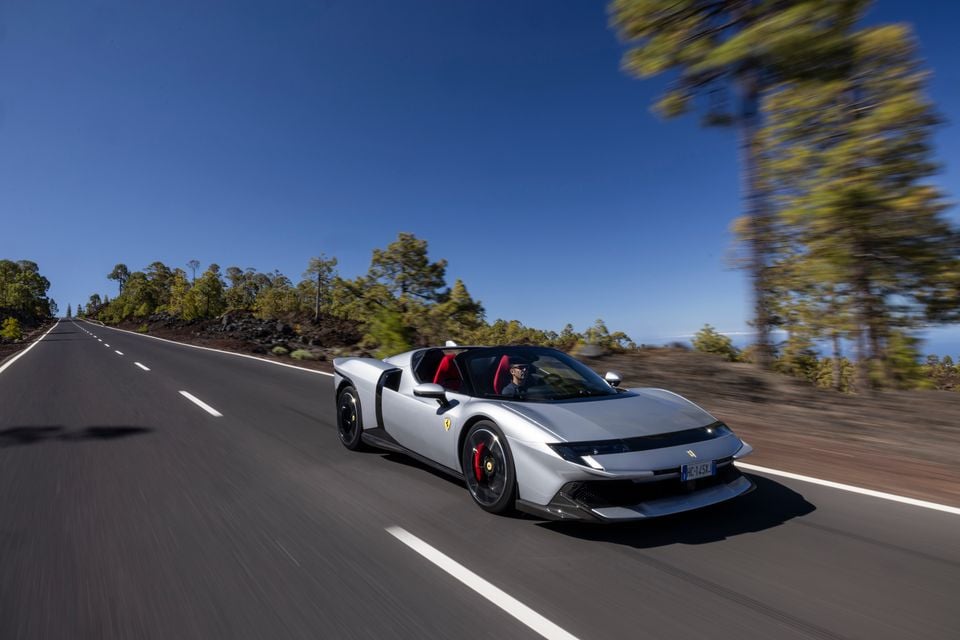
This was severe use, involving repeated acceleration and braking on a demanding road. It is not representative of how most owners will drive, however, a car with this level of performance can build speed so rapidly that very serious braking hardware is required to repeatedly manage a huge amount of energy, and the 849’s mass cannot be completely hidden from physics.
Noise is the 849 Testarossa Spider’s clearest emotional shortfall.
Ferrari says the V8’s sound level has been increased across the rev range. The exhaust manifolds have been reworked, a new shift strategy derived from the SF90 XX Stradale introduces a more pronounced character during hard upshifts, and the engine now revs to 8300rpm.
A tuned physical duct – described by Ferrari as a ‘hot tube’ – carries genuine exhaust frequencies into the cabin. Because the packaging behind the occupants differs between the coupe and Spider, the duct and its tuning are specific to each body style.
This isn’t merely a synthesised engine note being played through the speakers. The sound originates from the car.
There simply isn’t enough of it. Lowering the roof improves matters, as does dropping the rear glass with the hardtop in place, but the V8 remains too distant and restrained relative to the drama of the styling and performance.
It still sounds good though and at higher revs it develops a harder edge, and there is a clear mechanical authenticity to what reaches the driver.
But a Ferrari costing more than $1 million before options, with a flat-plane-crank V8 spinning to 8300rpm behind its occupants, should produce a sound that raises the hairs on your arms. The 849 rarely does.
It’s particularly noticeable because every other part of the car feels so extreme. The acceleration is shocking, the bodywork looks like it has escaped from a sports-prototype paddock, and the view over your shoulder is dominated by huge air intakes and twin tails.
The soundtrack should complete that experience. Instead, it remains its least convincing element. Thankfully, you can fix it by simply ordering an exhaust from one of the many third-party manufacturers that will allow your Ferrari to breathe and be free of European emission regulations.
More than you might expect. The 849 starts silently and can travel for up to 25km using electric power alone. Selecting eDrive turns a 772kW Ferrari into an almost silent front-wheel-drive electric car with up to 120kW available.
Nobody is buying an 849 Testarossa Spider to reduce their fuel bill, but the ability to leave home early or return late without waking the neighbourhood is genuinely useful.
It also makes crawling through towns or slow traffic less tiring, and you can manually start the V8 when you want it.
Hybrid mode allows the car to decide when to use the engine. Performance keeps the combustion engine running and manages the battery to provide consistent output over a longer period. Qualify releases the maximum available performance for a shorter window.
The driver-assistance systems are also relatively easy to disable when they become intrusive. A steering-wheel shortcut opens the relevant menu, from which the systems can be switched off with a handful of inputs.
You need to repeat the process after restarting the car, but it is less frustrating than digging through several touchscreen menus.
Ferrari includes scheduled maintenance for the first seven years of the car’s life.
| Servicing and warranty | Ferrari 849 Testarossa Spider |
|---|---|
| Vehicle warranty | 3 years, unlimited kilometres |
| Hybrid component warranty | 5 years |
| Service intervals | 12 months |
| Scheduled maintenance | Included for the first 7 years |
The vehicle warranty and servicing details mirror those previously published for the 849 Testarossa coupe. Ferrari’s official Spider material confirms its seven-year maintenance program and five-year hybrid-component coverage.
Ferrari also offers two longer-term hybrid support programs.
Warranty Extension Hybrid can extend comprehensive coverage through to the eighth year and includes replacement of the high-voltage battery at no additional cost when extended to that point.
Power Hybrid then allows owners to cover major powertrain and hybrid components from years eight to 16, with another high-voltage battery replacement available from year 16.
Those programs are important. They don’t guarantee future values or eliminate the potential depreciation associated with any million-dollar supercar, but they address one of the most rational concerns surrounding long-term hybrid ownership: the eventual cost and availability of a replacement battery.
Ferrari had not completed homologation for the Spider’s fuel consumption or CO2 emissions at the time its technical information was issued.
Our drive was dominated by hard acceleration, mountain roads, and repeated use of the V8, so any consumption figure recorded during the launch would have been useless as an indication of normal ownership.
The rational choice here is the coupe. It’s 90kg lighter, structurally purer, and better suited to an owner who intends to spend meaningful time on a circuit. Add the Assetto Fiorano specification and it becomes an even more specialised instrument.
The emotional choice is the Spider – and at this end of the market, the emotional choice is usually the right one.
The difference between these cars isn’t really about what happens at 200km/h. Very few owners will ever explore their performance closely enough for the coupe’s weight and structural advantages to become decisive.
The Spider’s advantage is available every time the weather cooperates.
At 80km/h, an open roof changes the entire experience. You hear more of the powertrain, feel the air moving around the cockpit, and become part of the environment rather than watching it through glass.
It turns the 849 from an astonishingly effective piece of engineering into something more memorable.
We would skip Assetto Fiorano unless regular track use is genuinely planned. Spend the money on the front lifter, the comfortable ventilated seats, the neck warmers, and a colour with enough personality to suit the car.
Yes, the engine should be louder, the cabin needs more useful storage, and our experience of the brake pedal softening under extreme use must be acknowledged. The price is also enormous, even before Ferrari’s options catalogue begins doing its work.
But none of those issues fundamentally changes our verdict. The 849 Testarossa Spider is smoother and more approachable than the SF90 Spider, much easier to live with than its performance suggests, and almost impossibly fast when unleashed.
More importantly, it gives away remarkably little of the coupe’s capability, while adding an experience you can enjoy without risking your licence.
This isn’t the compromised 849 Testarossa. It’s the version that remembers a flagship Ferrari must do more than demolish performance benchmarks – it has to make every drive feel like an event.
MORE: Explore the Ferrari showroom
If this is the car for you, we’ll compare offers from trusted dealers, handle the back and forth and manage your purchase from enquiry to delivery.
Alborz Fallah is a CarExpert co-founder and industry leader shaping digital automotive media with a unique mix of tech and car expertise.
Add CarExpert as a Preferred Source on Google so your search results prioritise writing by actual experts, not AI.
James Wong
2 Hours Ago

Max Davies
3 Hours Ago

Damion Smy
15 Hours Ago

William Stopford
16 Hours Ago

Dave Kavermann
16 Hours Ago

Matthew Hansen
16 Hours Ago
Add CarExpert as a Preferred Source on Google so your search results prioritise writing by actual experts, not AI.
# Based on VFACTS and EVC data
† Displayed prices exclude on-road costs such as delivery charges, registration fees, number plates, insurance and applicable road taxes. These prices are subject to change without notice and may not reflect current market pricing or dealer offers.
 Automotive Vehicle Spec Data & 4K images Powered by JATO Dynamics Ltd