


2027 Mercedes-AMG GT 4-Door Coupé review: Quick drive
We expected to dislike AMG’s electric GT. Several hours on Spanish roads and at Ascari changed that, but pricing and resale value remain questions.

- Model tested
- 2027 Mercedes-AMG GT
- Drive-away from
- $267,376†Better deals with CarExpert
CarExpert's take on the GT
Very Good
What we love
- Excellent steering, ride comfort, and track stability
- Spacious, beautifully finished cabin with superb displays
- Simulated V8 experience is surprisingly convincing
Worth a thought
- Some plasticky controls in an otherwise lovely cabin
- Full handling adjustment requires ESP to be switched off
- Resale value remains the big ownership question
Are there other rating labels?
- Excellent
- An outstanding car in almost every way. A joy to drive, packed with great features, and highly recommended.
- Very Good
- A well-rounded car that's enjoyable to drive, offers great value or features, and is easy to recommend.
- Good
- A solid choice that does most things well. Comfortable, capable, and worth considering in this segment.
- Average
- Meets the standard for this segment. May not stand out, but still a dependable and reasonable option.
- Below Average
- Falls a bit behind others in the segment, but still passes safety checks and may suit specific needs or budgets.
Introduction
We really wanted to dislike the new Mercedes-AMG GT 4-Door Coupé.
An electric replacement for a V8 AMG, complete with pretend engine noise and gear changes, was always going to be a difficult sell. Then there were the photographs. In particular, that rear-end looked... well, frankly awful.
Nonetheless, after three to four hours of driving in Spain, including winding roads and laps of the Ascari circuit, we have to admit we got quite a lot of that wrong.
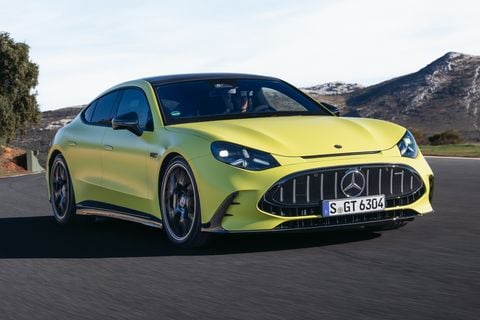
Lets start with the design. The rear-end of this big electric sedan has a depth and shape that photographs struggle to capture. Those six circular tail-lights, the broad shoulders, the black detailing, and the diffuser work together far better when you walk around the car. In a darker colour, or the bright yellow-green of the launch cars, it looks special on the road.
If anything, the front-end now looks a little too generic compared with the rear. It could do with some of the same aggression. But this is a good-looking car in the metal, and that is something we certainly didn’t expect to write.
We spend enough time complaining that new cars all look the same. AMG has done something different here, and it deserves to be seen before being dismissed. Ironically, by the end of our three days with the car, we'd go so far as to say it actually looks great! Whoever was in charge of photographing this car at Mercedes-Benz (and Ferrari with the Luce) needs to find a new job.
The bigger surprise is how it drives. The steering, suspension, and overall balance are excellent. There’s a properly luxurious cabin, room for four adults, and enough grunt to make the old argument about whether an electric performance car is fast enough rather pointless. This is a missile.
This new electric GT 4-Door Coupé is built on AMG’s dedicated AMG.EA architecture and likely conceived at a time when the Porsche Taycan was seen as a huge hit. It succeeds the previous four-door model, which was sold here in GT 63 S E Performance form with a 4.0-litre twin-turbo V8 plug-in hybrid powertrain. The two-door Mercedes-AMG GT Coupé is a separate car.
How much does the Mercedes-AMG GT 4-Door Coupé cost?
The electric GT 4-Door Coupé is coming to Australia, but local pricing, timing, and the final model lineup remain unconfirmed.
Our expectation is that the flagship 860kW version will land somewhere in the $300,000s. For context, the outgoing four-door GT 63 S E Performance was listed at $409,600 before on-road costs in its final 2025 guise, so it might even land in the 4s.
The obvious alternatives are the Porsche Taycan and Audi e-tron GT – two models that have well and truly passed their use-by date and AMG is no doubt hoping it can reinject some life into this segment.
The international GT 4-Door Coupé range comprises 53, 55, and 63 versions. The 55 looks particularly interesting because it shares the 63’s three-motor layout and 106kWh usable battery, but produces 600kW of power and 1800Nm of torque instead of 860kW and 2000Nm.
Asked whether there were hardware differences between the motors in the 55 and 63 versions, AMG engineer René Szczepek told CarExpert: “In the motors, no”. That doesn’t make them identical cars because the suspension, brakes, equipment, and calibration are in the 63s favour, but it does beg the question as to whether some tuner can unlock the full power of the 63 in a 55 package in the future?
Still, if you feel 600kW is inadequate for a daily driver you may need to consult your local therapist.
If the 55 comes here at a meaningful saving with the right equipment, it could be the one to buy.
What is the Mercedes-AMG GT 4-Door Coupé like on the inside?
This finally feels like the sort of interior we want from an expensive Mercedes. For what feels like a generation, we have had Mercedes-Benz interiors feel a little plasticky and cheap, but if this is a sign of what's to come, we love it.
The seats are comfortable, the doors feel substantial, and the carbon-fibre trim, headlining, and overall fit and finish in our test car were lovely. It’s a cabin we would happily spend a long day in and this car loves to eat up long drives.
The displays are particularly good. There’s a 10.2-inch digital instrument cluster and an integrated 14.0-inch central infotainment touchscreen, with the latter angled towards the driver. An additional 14.0-inch passenger display is available and was fitted to our test cars.
The picture quality is up there with a high-end tablet. Even in strong Spanish sunshine, glare was limited, the graphics stayed clear, and the touchscreen responded quickly. The clarity and responsiveness reminded us of a latest-generation OLED iPad Pro.
The latest MBUX interface runs on Mercedes-Benz’s MB.OS operating system. More useful than another list of software features is the fact that it feels fast and straightforward to use. The passenger can also operate entertainment functions from their own screen without taking over the driver’s display.
We loved being able to say 'Hey Mercedes, turn off the driving alerts' so the bloody thing would stop beeping at us for going 2km/h over the speed limit. Again, this is European regulations having an overreach across all markets, so at least now you don't have to scroll through a bunch of menus.
We would still like proper climate control buttons. Temperature settings remain along the bottom of the central screen, so the basics aren’t buried, but other adjustments require opening a menu.
There are physical controls beside the two wireless phone charging trays, for functions including drive mode selection, parking assistance, hazard lights, and audio volume. We would happily trade some of that space for air-conditioning controls we can find by touch.
The other disappointment is with how some of the hardware feels. The big outboard air vents have a metallic appearance, but feel plasticky, as do the three driving dynamics dials on the centre console. More substantial metal controls would suit the rest of the cabin better. Those dials adjust accelerator response, cornering behaviour, and traction. We’ll get to what they actually do shortly, because their usefulness depends on how you’re driving.
Rear-seat space is better than the low roofline suggests. There’s generous legroom and headroom, and we'd have no problem putting four large adults in this car. Recesses in the battery floor provide space for rear passenger feet, helping avoid the knees-up position found in some electric performance cars.
The international specification has two individual rear seats as standard, with a three-seat bench available as an option. It remains to be seen what we get in Australia but, either way, we'd treat it primarily as a comfortable four-seater.
The Sky Control panoramic roof is another highlight. It’s a single glass panel with nine individually switchable sections. You can make those sections transparent or opaque, changing how much light enters different parts of the cabin. It looks great and makes the rear feel more open.
Boot capacity is 415 litres using the VDA measurement method, with a further 41 litres available in the front compartment. The rear seatbacks also fold.
| Dimensions | GT63 4-Door Coupé |
|---|---|
| Length | 5094mm |
| Width | 1959mm |
| Height | 1411mm |
| Wheelbase | 3040mm |
| Kerb weight (DIN) | 2460kg |
| Cargo capacity (VDA) | 415L – rear seats up 41L – under-bonnet storage |
What’s under the bonnet?
The 860kW GT63 4-Door Coupé has three axial-flux electric motors, one at the front and two at the rear.
| Specifications | GT55 4-Door Coupé | GT63 4-Door Coupé |
|---|---|---|
| Drivetrain | Tri-motor electric (axial-flux) | Tri-motor electric (axial-flux) |
| Battery (usable) | 106kWh | 106kWh |
| Power | 600kW – peak 375kW – continuous | 860kW – peak 530kW – continuous |
| Torque | 1800Nm | 2000Nm |
| Drive type | All-wheel drive | All-wheel drive |
| Kerb weight | 2460kg | 2535kg |
| 0-100km/h (claimed) | 2.8 seconds | 2.4 seconds |
| 0-200km/h (claimed) | 9.0 seconds | 6.8 seconds |
| Energy consumption (claimed, WLTP) | 17.8-21.0kWh/100km | 17.9-21.0kWh/100km |
| Claimed range (WLTP) | 597-700km | 596-696km |
*The GT63's 860kW peak is quoted for Launch Control at 80 per cent battery charge.
Each rear motor drives its own wheel. They share a housing, but there is no mechanical connection between the two rear motors or a conventional rear differential linking them.
That gives AMG direct control over how much drive goes to each rear wheel. The front motor can also be disconnected during low-load driving to reduce drag.
The motors use technology developed by British specialist YASA, which Mercedes-Benz owns, and are manufactured in Berlin. The car itself is built in Sindelfingen.
Axial-flux motors arrange their main working parts as thin discs, with a stator between two rotors. The layout packs substantial torque into a compact space. It’s a very technical thing that we're not going to pretend we fully understand, but it certainly makes this AMG different to simply saying it has three electric motors.
The Germans insist that the main difference between what they do and what the Chinese do in their high-end motors is that this car can sustain power for much longer.
The battery is equally important. It has 106kWh of usable capacity, operates at 800 volts, and contains 2660 cylindrical cells in 18 modules. Electrically non-conductive oil flows around the cells to remove heat directly.
Developed by AMG in Affalterbach with input from Mercedes-AMG High Performance Powertrains in Brixworth (think Formula 1), the battery uses tall, narrow cells measuring 105mm by 26mm. Their shape helps heat escape from the centre of each cell.
Mr Szczepek, who is responsible for AMG driving dynamics simulation and integration, explained the point during our chassis walkaround in Spain.
“If you are able to cool down the centre of your cell, you have a very good ability of continuous power output,” he said.
Mercedes-AMG quotes 530kW of continuous output for the flagship, separate from its 860kW peak. Keeping the battery cool is essential to making performance available repeatedly, including when it is taking energy back in under braking.
Even the centre tunnel has a job in that cooling system, housing pumps and a heat exchanger. There’s quite a lot more going on here than a large battery and an AMG badge.
The entry-level GT53 takes a different approach, with two electric motors, 400kW, and 800Nm. It also uses a physical two-speed rear transmission.
How does the Mercedes-AMG GT 4-Door Coupé drive?
On the road, it is remarkably easy to live with. Put it in Comfort mode and it settles into being a quiet, comfortable four-door sedan. We drove over some substantial bumps, and the suspension dealt with them without making the cabin feel unsettled.
Given most owners will spend far more time driving to work or heading away for the weekend than doing laps, regardless of what AMG puts in its launch presentation this is where the car will be most useful.
The steering is superb. There is proper feel through the wheel, the front-end is precise without being nervous, and the car responds naturally as you build up the pace. Despite its 2460kg kerb weight and more than five metres of bodywork, it doesn’t feel cumbersome.
It would be silly to suggest the mass has disappeared. But from behind the wheel, we weren’t constantly thinking about its weight, width, or length. It feels much more manageable than the numbers suggest.
Our test car had three-chamber air springs and hydraulically interconnected dampers in place of conventional anti-roll bars. The system can control body roll while allowing more freedom of movement over bumps. Rear-wheel steering helps it turn at lower speeds and adds stability at higher speeds.
The result is a very broad range of chassis behaviour. Comfort mode really is comfortable, while the firmer settings give the body the control it needs on a circuit. We didn’t come away wishing AMG had sacrificed one for the other.
Our test car had seven drive modes: Comfort, Sport, AMGFORCE Sport+, Race, Slippery, Individual, and Eco. We spent most of our time exploring the first four, with the road and track portions of the day showing how differently the car can behave.
Sport+ is where it becomes particularly interesting. The 55 and 63 versions reproduce the V8 sound of the petrol V8-powered AMG GT R, using more than 1600 recorded audio files. They also simulate a nine-speed transmission, with paddle-operated shifts, interruptions in drive, and physical feedback through the seats.
We expected to hate this. Fake engine noise is an easy thing to dismiss, especially when you already know how good a real AMG V8 sounds.
Yet it works surprisingly well. Accelerate hard and the sound builds with the car, the shifts have a convincing jolt, and the seat vibrations help make the whole thing feel connected. It’s far more persuasive than simply playing an exhaust note through a speaker. Is it better than the real thing? No, but did we hate it enough to turn it off? Also no.
You can even select Sport+ while stationary, hear it come to life, and rev it in Park. It sounds like a V8 from outside as well. Yes, that's slightly ridiculous. It's also quite entertaining.
Put someone in the passenger seat without telling them what powers the car, and we suspect plenty would be fooled. The combination of sound, acceleration, and physical feedback is that convincing.
Yes, we'd still prefer the real V8. But we didn’t resent the imitation in this car, and that was a surprise. The 53 version instead recreates the sound of the previous E53 Coupé’s inline turbo-six (to remind you that you bought the 'poor' man's version). Having to move up the range for the V8 soundtrack feels a little odd when neither car has the engine it’s pretending to have.
You can also turn the sound down or off. Quiet running suits Comfort mode nicely, while on track we were happy to concentrate on the car itself without the Sport+ gearshift routine.
At Ascari, the dominant impression was stability. After the briefing about almost 1200 metric horsepower, we expected something considerably more intimidating.
There is huge grip, and the way the motors deliver their power is very coherent. You don’t feel the car arguing with itself as it works out which wheel should receive the torque. It turns in accurately, stays composed, and puts its power down cleanly.
We were carrying a decent pace, although there was clearly more available. Mercedes-AMG driving instructors gave us long and hard speeches about how the car will bite and how we need to be extremely careful, almost to the point of trying to make us feel super-nervous about going flat out in the car (a very unusual thing at AMG events), which made us initially think the car couldn't handle it.
Nonetheless, we managed to get some hard laps in toward the end and, frankly, this thing is absolutely rock-solid. Even with the stability control switched off and the agility and traction dials set to five, it remained remarkably settled.
Those controls are part of AMG Race Engineer. Response adjusts the relationship between your right foot and the motors. Agility changes how readily the car rotates into a corner by altering torque distribution, while the nine-stage Traction control adjusts how much wheel slip it allows.
A conservative agility setting encourages a more understeer-led balance. Turn it up and the car becomes more willing to rotate, allowing oversteer. AMG’s description of making it feel as though the wheelbase has become shorter or longer is a useful way of understanding it.
The limitation is that individual Agility and Traction adjustment requires ESP to be switched off, and only works in Sport, Sport+, or Race. Response remains available across the drive modes.
That makes two of those prominent dials much more useful on a circuit than during normal road driving. We would prefer some ability to adjust the balance while keeping the stability-control safety net. As it stands, there’s a bit more theatre in their everyday usefulness than their position on the console suggests.
AMG’s demonstration driver could just get the rear-end moving, so it wasn’t the effortless, smoke-filled sideways display that people might associate with an old V8 AMG. The car we experienced was much more interested in finding grip.
It also has plenty of acceleration left to deploy. In Comfort, Sport, and Sport+, pulling both paddles activates up to 110kW of additional boost for as long as 63 seconds (yes, you get 55 seconds in that version). That brings the flagship to its quoted 860kW peak.
The aerodynamic work goes well beyond a spoiler. Depending on configuration, AMG offers active underbody Venturi elements, an extending rear diffuser, an active rear spoiler, and cooling shutters.
The front underbody element deploys from 120km/h and the central one from 140km/h. They accelerate the air beneath the car to create a low-pressure area and increase downforce. The rear spoiler changes angle from 80km/h, while the diffuser and cooling shutters manage airflow for efficiency and stability.
There’s also a Predictive Performance Manager with Hotlap and Endurance settings. AMG says it manages energy around a circuit, reducing power where it isn’t useful, such as downhill sections or tight corner combinations, and preserving it for places where it can make more difference.
The software and active aero are interesting, but the important part from the driver’s seat is that the GT feels consistent. We could move from a bumpy road to Ascari without it suddenly feeling out of its depth.
What do you get?
Australian specifications for the new Mercedes-AMG GT 4-Door Coupé have yet to be confirmed, although the German performance brand has detailed an extensive range of standard and optional equipment for overseas models.
2027 Mercedes-AMG GT 4-Door Coupé equipment highlights:
- 19- to 21-inch alloy wheels
- LED headlights with star-shaped daytime running lights
- LED tail-lights with star graphics
- Active aerodynamics package
- Active underbody Venturi elements
- Active rear diffuser
- Adaptive rear spoiler
- Active front air intakes
- Adaptive air suspension
- Active rear-wheel steering
- Carbon-ceramic front brakes
- Panoramic glass roof
- Switchable transparency
- Heat-insulating glass
- Front sports seats
- AMG Performance steering wheel
- Integrated OLED drive-mode controllers
- 10.2-inch digital instrument cluster
- 14.0-inch touchscreen infotainment system
- MBUX infotainment with MB.OS operating system
- AI-powered MBUX Virtual Assistant
- Live traffic information
- Customisable display themes
- AMG Performance Menu
- Real-time vehicle telemetry
- Active aerodynamics monitoring
- Ambient interior lighting
- Illuminated air vents
- Wireless smartphone chargers x 2
- Illuminate front cupholders
- Four-seat configuration with individual rear seats
- Split/folding rear seats
Optional equipment includes:
- AMG Performance charging
- 600kW DC fast-charging capability
- Additional powertrain cooling
- Carbon-design roof (market-dependent)
- Automatic parking system with Remote Parking function
- AMG Performance front seats with integrated head restraints
- Three-seat rear bench
- 14.0-inch front passenger touchscreen
- Burmester High End 4D sound system
- 'Sky control' panoramic roof illumination
- Illuminated AMG crests
- Illuminated racing stripes
- Leather, microfibre or carbon-fibre steering-wheel trim
- Manufaktur exterior and interior finishes
- Driver's Package
- Integrated dashcam (market-dependent)
Is the Mercedes-AMG GT 4-Door Coupé safe?
Australian safety specifications and any applicable ANCAP rating have yet to be confirmed for this new electric sedan.
During our chassis walkaround, Mr Szczepek showed us how the front suspension geometry is designed to direct a wheel outwards in a small-overlap impact, with shorter front battery modules leaving space in the relevant impact area.
The battery housing is also integrated into the car’s structural protection.
How much does the Mercedes-AMG GT 4-Door Coupé cost to run?
Mercedes-AMG claims 596-696km of WLTP range for the 860kW GT63 4-Door Coupé, depending on specification. Combined energy consumption is rated at 17.9-21.0kWh per 100km. Our mixed road-and-track launch drive wasn’t a representative test of everyday efficiency.
The headline charging figure is up to 600kW on DC power, with a claimed 10-80 per cent charge taking 11 minutes. AMG also quotes 460km of WLTP range being able to be added in 10 minutes. Those results need a suitable charger and the right battery temperature.
The 600kW capability forms part of the optional Performance Charging Package in Germany. Mr Szczepek explained that the higher-capacity cooling setup adds two radiators ahead of the front wheels. We still need to know how Mercedes-Benz will package it for Australia given you can barely find a working 50kW EV charger in Brisbane.
AC charging is rated at 11kW (which is disappointing in a world where most decent Chinese cars offer 22kW). That's the more relevant figure for owners plugging in at home overnight, although achieving it requires a suitable three-phase power supply and charger.
Mercedes-Benz currently provides a five-year, unlimited-kilometre new-car warranty for private Australian buyers. The GT’s specific battery warranty, local service schedule, and service prices remain to be confirmed.
The bigger ownership question for us is depreciation. At this sort of money, we'd want to think carefully about what the car might be worth in three or four years.
If you’ve already lost heavily on an expensive electric car, another presentation about battery technology won’t necessarily make you comfortable buying another one. You’ll want clear warranty terms and confidence that somebody will want it when you’re finished with it.
We hope the engineering in this AMG helps build that confidence over time. But an impressive cooling system doesn’t guarantee strong resale value.
CarExpert’s Take on the Mercedes-AMG GT 4-Door Coupé
Judged on how it looks in the real world, how it feels inside, and how it drives, the electric Mercedes-AMG GT 4-Door Coupé is a very, very good car.
The steering is excellent, the suspension deals with real bumps, and the cabin has the comfort and quality we expect at this level. There’s proper room for four adults, and on track it feels much less intimidating than its power and weight suggest.
Even the simulated V8 sound won us over more than we expected. We would still choose the real thing if all else were equal (and even if the real V8 was noticeably slower), but this is a convincing and enjoyable alternative.
We’d improve the feel of the vents and centre-console dials, add physical climate controls, and make more of the handling adjustability available without switching ESP off. The speed warnings could also be less persistent.
Australian pricing and equipment will determine how persuasive the package is, particularly if a well-equipped 600kW version sits meaningfully below the 860kW flagship.
And resale value remains a question that this launch couldn’t answer.
But we went to Spain ready to tell you the new electric AMG looked wrong and had lost too much of what made the old car appealing. After driving it, that's a very difficult argument to make.





 Automotive Vehicle Spec Data & 4K images Powered by JATO Dynamics Ltd