
Alborz Fallah
2027 Mercedes-AMG GT 4-Door Coupé review: Quick drive
We expected to dislike AMG’s electric GT. Several hours on Spanish roads and at Ascari changed that, but pricing and resale value remain questions.
2 Hours Ago
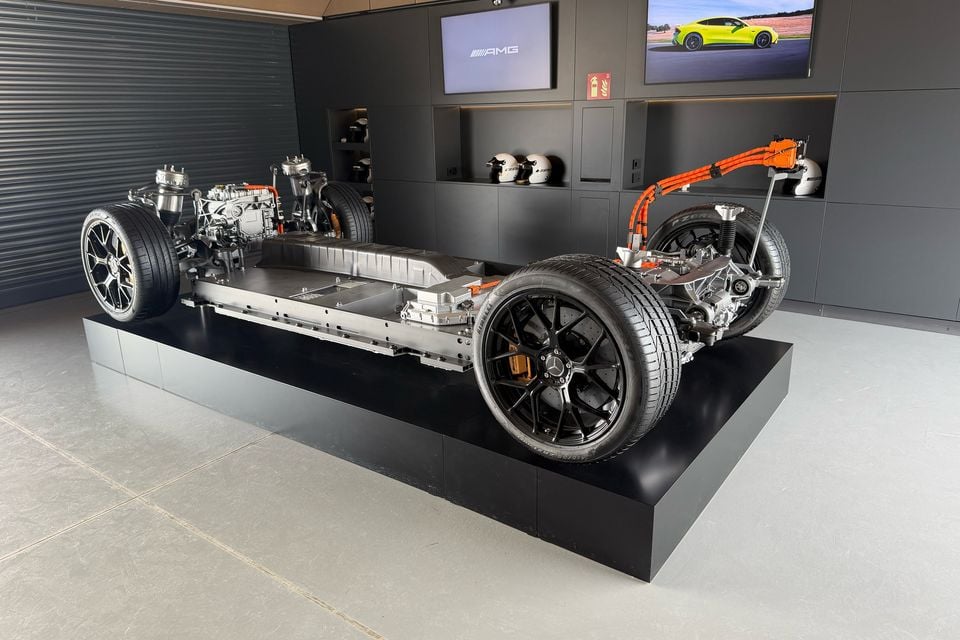
A chassis walkaround with one of AMG’s engineers reveals the compact motors, specially developed battery cells and elaborate cooling behind its new electric GT.
Publisher
Publisher
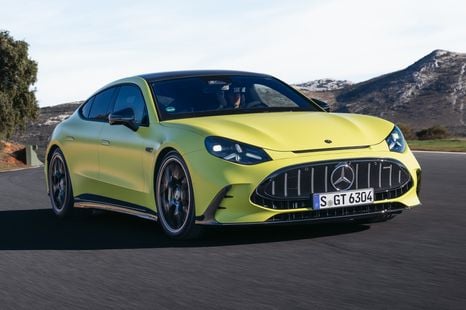
AMG's new electric vehicle (EV) promises an insane amount of power, but it's not just the top-level power that makes this German-engineered EV different to the rest.
Two electric motors sit side by side at the rear of the new Mercedes-AMG GT63 4-Door Coupe. They share a housing, but each drives its own wheel.
At the car’s launch in Spain, René Szczepek walked CarExpert around the exposed chassis and through the engineering behind its electric drivetrain. Mr Szczepek is responsible for driving dynamics simulation and integration at Mercedes-AMG.
We wanted to understand what an AMG buyer should look for in an electric motor. Cylinder counts and engine layouts have long given enthusiasts a useful starting point. A power figure tells us rather less about the machinery producing it.
The GT55 and GT63 have three axial-flux motors, including one at the front. Their design comes from British specialist YASA, which Mercedes-Benz acquired in July 2021.
“Mercedes-Benz is now producing them in a factory plant in Berlin,” Mr Szczepek said.
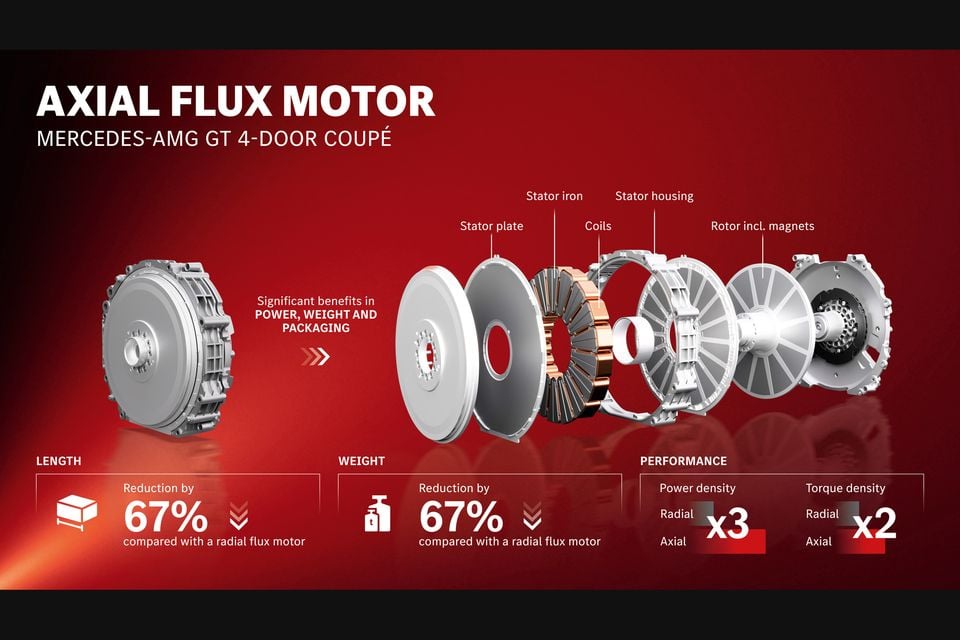
An electric motor has a stationary part, the stator, and a rotating part, the rotor. In an axial-flux motor, the magnetic flux runs parallel to its axis of rotation. In a conventional radial-flux motor, it runs perpendicular to that axis.
YASA’s arrangement places the stator between two disc-shaped rotors. The layout gives engineers more freedom to position the motor within the car, where it must share space with suspension, brakes, and crash structures.
AMG puts the front rotor-and-stator arrangement’s width at about 90mm, with each rear motor around 80mm wide. The complete drive units also contain gearing, inverters, and cooling equipment.
YASA says its shorter windings and direct oil cooling help maintain output under sustained use. Cooling an electric motor is critical because the windings heat up as it works. Thermal limits influence how much power the motor can keep delivering and for how long.
Building the motors in Berlin has required changes to the manufacturing process. Mercedes says production involves around 100 processes, approximately 65 of which are new to the company. It says the innovations have led to more than 30 patent applications.
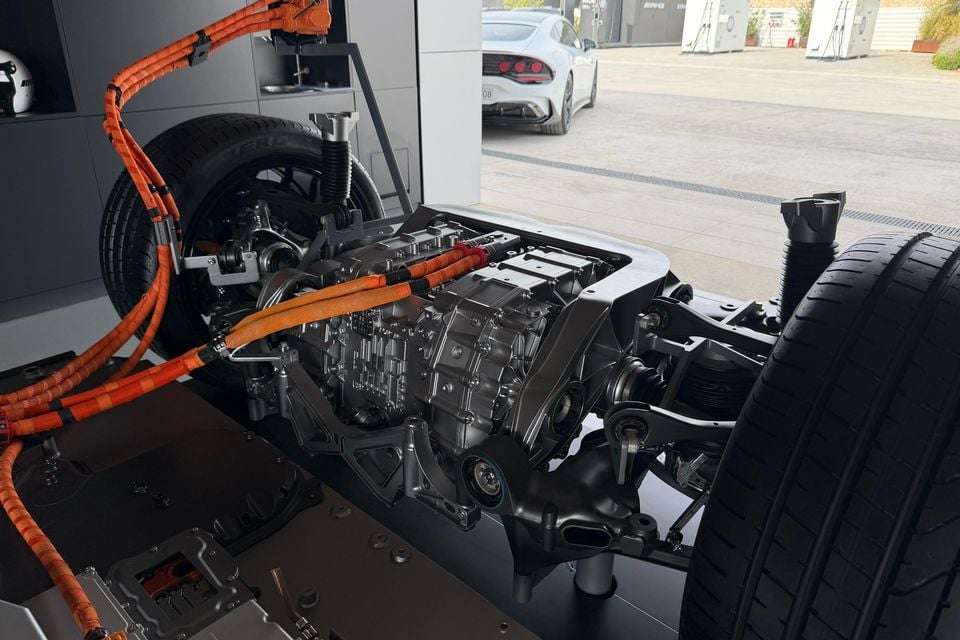
At the rear, putting two motors in one housing simplifies handling the assembly, Mr Szczepek explained. They remain mechanically independent, allowing their outputs to be controlled separately.
That's the basis of rear torque vectoring, as varying the drive at each wheel helps influence how the car turns. The motor installation and its control software therefore have a direct role in the handling.
The front motor also has a disconnect mechanism. It disengages during light-load driving or coasting to reduce drag losses, then reconnects for acceleration or regenerative braking.
The motors themselves are common to the GT55 and GT63. So essentially if you can hack the car, you can turn your GT55 into a GT63 by removing the software restriction.
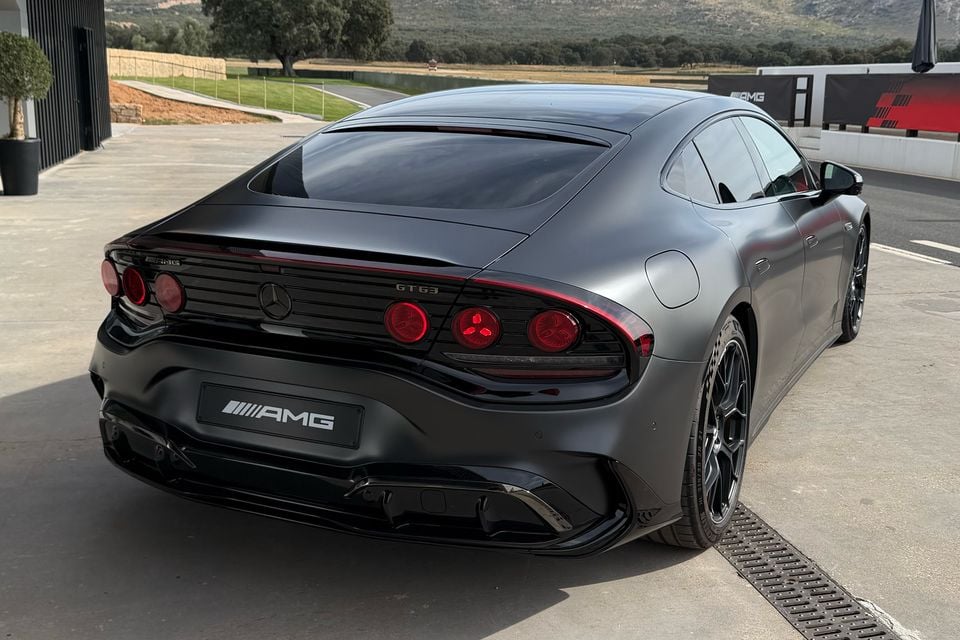
The GT63’s claimed peak output is 860kW of power, against 600kW for the GT55. Mercedes lists their continuous outputs separately, at 530kW and 375kW respectively.
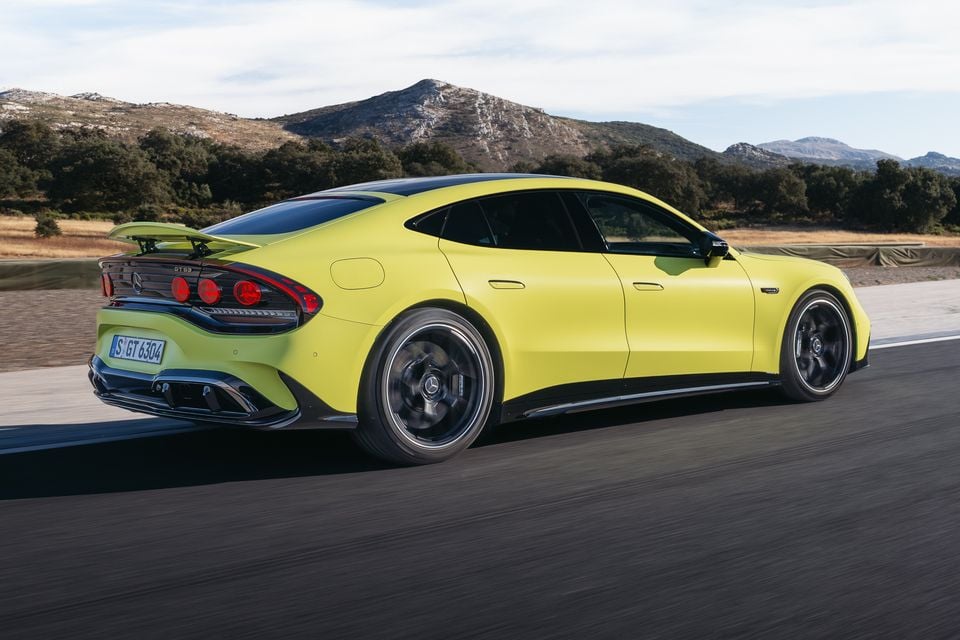
Both use an 800V electrical system and a battery with 106kWh of usable capacity. Delivering the energy quickly and repeatedly places its own demands on the cells and cooling system.
The pack contains 2660 cylindrical cells grouped into 18 modules. Mr Szczepek explained that the cell dimensions were chosen specifically for this application.
“So the diameter is specifically made. It’s not by accident or package-wise.”
Each cell measures 105mm tall and 26mm in diameter. AMG says the slender shape shortens the distance heat must travel from the core to the surface. Aluminium housings also help transfer heat.
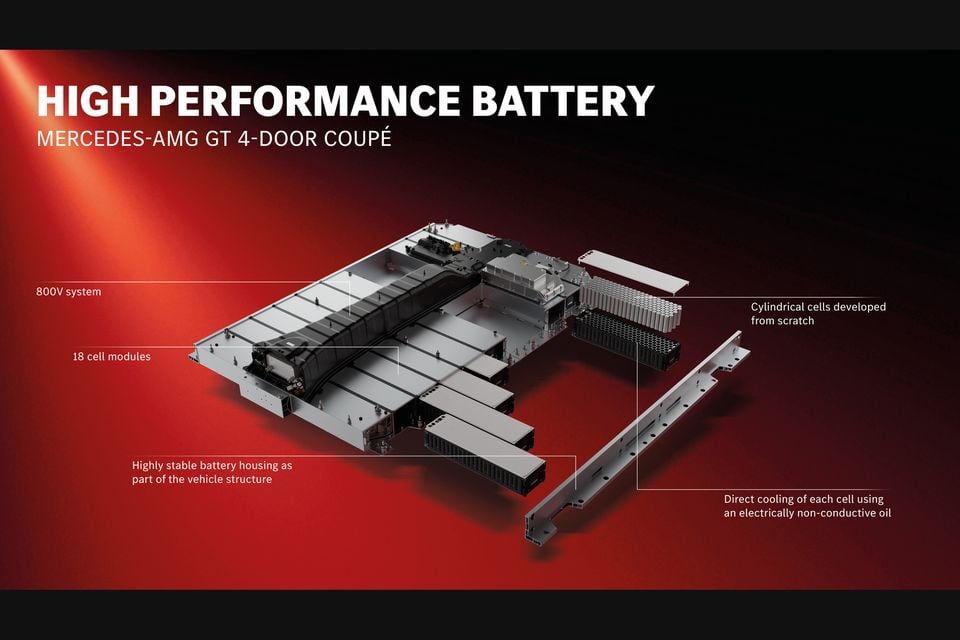
The cells use full-tab connections, joining their windings across the surface of the poles. AMG says reducing internal resistance helps them accept and deliver high power.
Electrically non-conductive oil flows around the cells, carrying heat away. Mr Szczepek described directing it to the electrical connections, then cooling around the central section of the cell bodies.
The channels change shape along the module to help maintain an even cooling effect. The objective is to control temperatures across the pack as energy is drawn out under acceleration and put back through regenerative braking or charging.
“Which means like if you are able to cool down the centre of your cell, you have a very good ability of continuous power output,” Mr Szczepek said.
AMG claims at least 20kW of battery cooling capacity, compared with the 5-8kW it quotes for conventional systems.
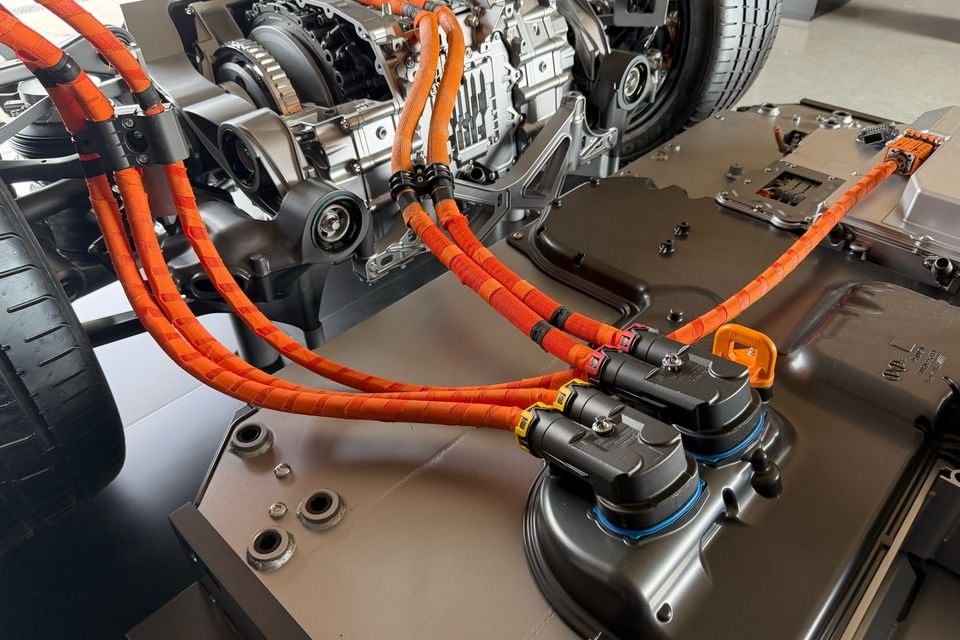
The cooling equipment also explains an apparently familiar internal combustion-powered (ICE) vehicle feature inside this EV: its centre tunnel. Mr Szczepek said retaining that space allowed AMG to accommodate the pumps needed for the battery’s oil circulation and other cooling functions.
“It’s like a usual thing happening in a [ICE] car, and we like integrated all the climate cooling pumps, all the cooling pumps we need for the battery oil flow and integrate that into that tunnel section and put it all in there.”
Beneath the tunnel, a pump module and oil-to-water heat exchanger connect the battery’s oil circuit to the vehicle’s cooling system.
“So that means package-wise, the car was a challenge,” Mr Szczepek said of fitting the car’s hardware together.
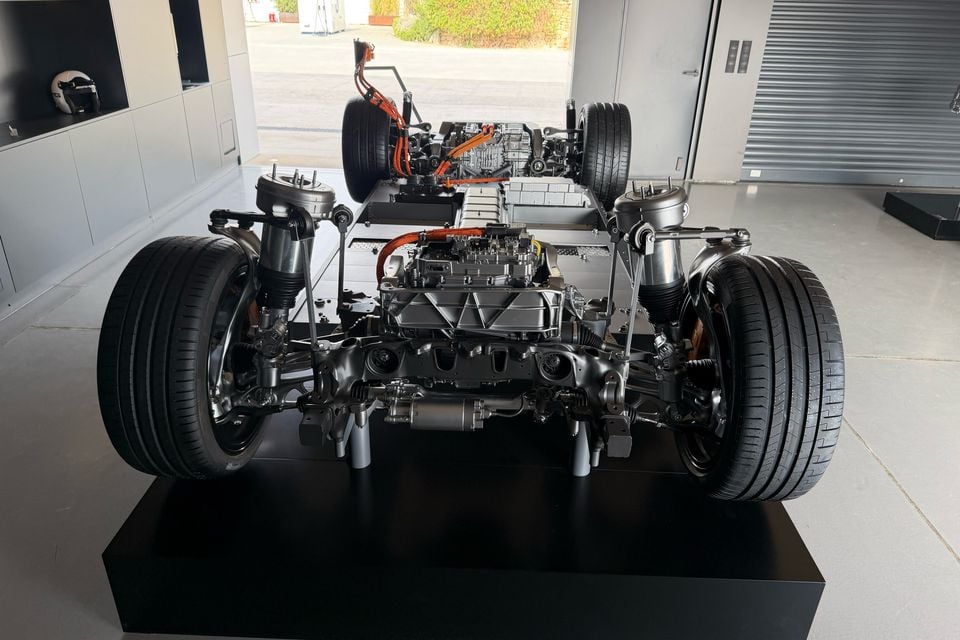
Packaging also affects crash protection. Mr Szczepek described how the front suspension geometry is intended to direct a wheel outwards in a small-overlap frontal impact. The battery’s front modules are shorter to leave space around that impact path.
“So those modules in the front are shorter than that one to just be preparing, just in case to be safe all the time.”
Cooling continues during rapid charging. The ability to take energy back into the pack is part of the same engineering problem as getting it out to the motors.
Mercedes claims a maximum DC charging rate of 600kW and a 10-80 per cent charge in 11 minutes under its specified test conditions. However, you'll need the optional AMG Performance Charging Package for that to work, something you won't have to worry about in Australia given we can barely get a 50kW charger working.
Mr Szczepek described two additional coolers ahead of the front wheels for the higher charging capability.
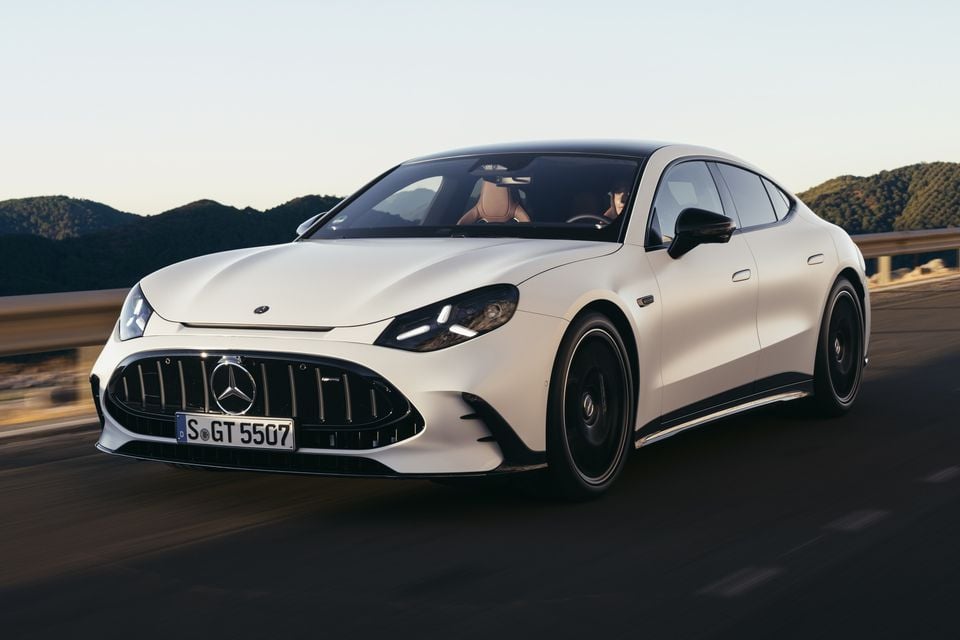
The development program has already subjected the technology to a much longer exercise than a launch-control demonstration. The AMG GT XX concept that previewed this drivetrain covered 40,075km at Italy’s Nardò circuit in 7 days, 13 hours, 24 minutes, and 7 seconds in August 2025, according to Mercedes-AMG.
Mercedes says the test combined 300km/h running with repeated charging stops, putting the prototype’s motors and battery through successive periods of high demand.
Back at the exposed chassis, Mr Szczepek also explained why fitting the rear motors involves two stages of rubber isolation. One separates the motors from their subframe, while another separates that assembly from the chassis.
He said the arrangement helps isolate noise while allowing engineers to control the effect of the motors’ mass as the car changes direction. The compact motor layout still has to be mounted so it works with the rest of the car.
“It always has to be in a phase, so that means if you steer in, the car just should rotate very naturally, very linear, and you could feel if there would be a mistake and we did something wrong.”
Research cars in our Showroom, compare your options or let our New Car Specialists do the running around to find you a great deal.
Alborz Fallah is a CarExpert co-founder and industry leader shaping digital automotive media with a unique mix of tech and car expertise.
Alborz Fallah
2 Hours Ago
Alborz Fallah
2 Hours Ago

Ben Zachariah
5 Hours Ago


Damion Smy
7 Hours Ago
Damion Smy
7 Hours Ago


William Stopford
8 Hours Ago
Add CarExpert as a Preferred Source on Google so your search results prioritise writing by actual experts, not AI.