





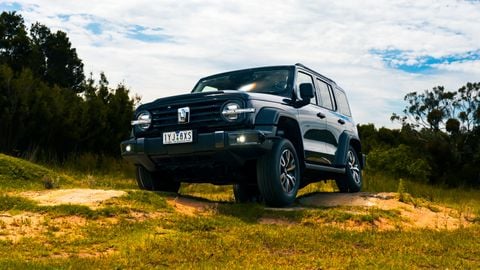
2024 GWM Tank 300 Hybrid review
GWM has electrified its Tank 300 off-roader with a hybrid drivetrain. Does it boost the retro-inspired Chinese 4x4 to new heights?

- Model tested
- 2023 GWM Tank 300
- Variant
- Ultra
- Drive-away from
- $46,990†Better deals with CarExpert
CarExpert's verdict on the Tank 300
Good
What we love
- Tough looks, plush cabin
- Boosted performance
- Capable 4x4 underpinnings
Worth a thought
- Unbearable lane-keep assistant
- $10,000 premium over petrol version
- Thirsty in real-world conditions
Are there other rating labels?
- Excellent
- An outstanding car in almost every way. A joy to drive, packed with great features, and highly recommended.
- Very Good
- A well-rounded car that's enjoyable to drive, offers great value or features, and is easy to recommend.
- Good
- A solid choice that does most things well. Comfortable, capable, and worth considering in this segment.
- Average
- Meets the standard for this segment. May not stand out, but still a dependable and reasonable option.
- Below Average
- Falls a bit behind others in the segment, but still passes safety checks and may suit specific needs or budgets.
Introduction
If the petrol-powered GWM Tank 300 hadn’t shaken up the off-road world enough, the brand has now introduced a segment-first hybrid option.
The 2024 GWM Tank 300 Hybrid has finally touched down after lengthy delays due to shipping issues, which forced the brand to launch with the turbocharged petrol-only versions.
It’s the first vehicle in its segment to offer a hybrid drivetrain, and quotes beefy power and torque outputs that translate to strong straight-line performance.
While it carries a hefty $10,000 premium over its petrol equivalent, the Tank 300 Ultra Hybrid on test is still a lot of metal for your money at $60,000 drive-away.
It’s decked out with features and even combines design elements from iconic off-roaders like the Jeep Wrangler and Mercedes-Benz G-Wagen throughout.
GWM has already delivered more than 1500 Tank 300s to Australian customers to the end of November, which is pretty impressive for a new brand competing in a segment dominated by established nameplates.
Now more than ever, local customers are willing to take a chance on challenger brands. Does the Tank 300 HEV better an already solid offering? Read on to find out.
Note: The images in the review show a mixture of Tank 300 Ultra and Tank 300 HEV vehicles.
How much does the GWM Tank 300 Hybrid cost?
2024 GWM Tank 300:
- GWM Tank 300 Lux: $46,990
- GWM Tank 300 Ultra: $50,990
- GWM Tank 300 Lux HEV: $55,990
- GWM Tank 300 Ultra HEV: $60,990
Prices are drive-away
Want to see how the Tank 300 shapes up against its rivals? Put it side-by-side using our comparison tool.
What is the GWM Tank 300 Hybrid like on the inside?
Just like the Tank 300 Ultra we tested earlier this year – so my thoughts are mostly the same.
From the bluff, upright dashboard to the conjoined 12.3-inch displays and circular air vents, it’s clear GWM has drawn inspiration from Mercedes-Benz’s iconic retro-modern off-roader.
The cabin of the Ultra we tested is mighty impressive, from the ‘faux’ leather-accented seats to the quilted leatherette door inserts and clear resolution of the digital screens. It does have quite a bit of ‘wow’ factor. Perceived build quality is solid, especially for the segment. The (cheaper) Jimny and (more expensive) Wrangler are utilitarian by comparison.
Storage is decent too, with a good amount of cubbies and shelves to leave your odds and ends, though I wish the front door pockets were a little more substantial.
In the Ultra, the driver is treated to an electrically-adjustable seat which is neat, with both front seats also featuring heating and cooling. The Ultra HEV adds memory presets for both the driver’s seat and mirrors.
The faux leather steering wheel also offers reach and rake adjustment, but as in most vehicles in the 4×4 segment you often find yourself sitting quite high in the cabin, and sort of looking down into the instrument binnacle.
The GWM Tank 300’s digital driver’s display gets top marks for colour and clarity, but a ‘needs improvement’ for layout and configurability. The menus and layout ape what we’ve seen in the Haval H6, with a Tank 300 for various graphics and a couple of extra off-road menus thrown in – colour matched to the vehicle though, which is cute.
I’d love to see virtual dials, which no doubt would be desirable when off-roading. It would also be great if the left and right areas of the panel had greater customisability than just an array of widgets flanking a large centre section with limited configurability.
Moving to the left you have the giant 12.3-inch central touchscreen. Like the driver’s display, the infotainment system is a Tank version of what we’ve seen in GWM Haval products with the same menus, fonts, and layouts with fairly minimal differentiation.
In terms of features, you get Apple CarPlay (wireless in the Ultra HEV) and Android Auto which look great on the high-resolution display, as well as DAB+.
There’s still no embedded satellite navigation, which means if you frequent regional areas with minimal reception you could run into issues with mapping if you miss a turn on a pre-downloaded route.
Otherwise, it’s fairly quick to respond to inputs and load menus, even if some of those menus are a little convoluted. Hopefully with updates we’ll see simplified menus and cleaner text. My previous complaint about a shortcut bar on the right-hand drive side has been addressed, though you can’t access it while using CarPlay.
The nine-speaker Infinity-branded audio system in the Ultra is pretty decent for audio quality and depth.
Space in the back is good, thanks to the Tank 300’s boxy dimensions. At 6’1 I had good head-, knee- and toe room, though the high-ish floor means you have a bit of a knees-up seating position which is fairly common for ladder-frame platforms.
Rear amenities include directional air vents, USB power outlets, map pockets behind both front seats, bottle holders in the doors, and a fold-down centre armrest with cupholders.
The second-row seats fold pretty much completely flat in a 60:40 split, and kids are catered for thanks to top-tether points across all three positions as well as ISOFIX anchors on the outboard positions.
Oddly, GWM still doesn’t quote a luggage capacity for the Tank 300 in any of its official documentation.
Accessed via a heavy side-hinged tailgate, we can tell you the square, wide and flat load area is bigger than you’ll find in a Suzuki Jimny, and isn’t far off something like a Jeep Wrangler or Land Rover Defender 90.
There’s a full-sized spare wheel is mounted on the tailgate – not that you’d miss it.
What’s under the bonnet?
The Tank 300 HEV uses a 2.0-litre turbocharged four-cylinder petrol engine producing 180kW of power at 5500-6000rpm and 380Nm of torque at 1700-4000rpm, paired with a 78kW/268Nm electric motor – system outputs are 255kW and 648Nm.
Hybrid models use a nine-speed ‘Hybrid Automatic Transmission’ and a torque-on-demand full-time four-wheel drive system. It features electronically-controlled mechanical front and rear differential locks, a Tank Turn function to reduce the turning circle on gravel, and a crawl mode.
The Tank 300 uses 9.5L/100km on the combined cycle, while the Tank 300 Hybrid quotes 8.4L/100km.
Despite the on-paper advantage of the Tank 300 Hybrid, the trip computer generally hovered between high-11s and low-12s with a good mix of highway and city driving – not much different to what we achieved in the petrol model.
All versions of the Tank 300 are rated to run on 91 RON regular unleaded, with the fuel tank rated to hold 75 litres. Towing capacity is rated at 2500kg with a braked trailer, and 750kg without trailer brakes.
How does the GWM Tank 300 Hybrid drive?
This is perhaps where the Tank 300 HEV differs most from the petrol we drove earlier this year.
Most of the time – but not every time – the Tank 300 HEV starts with no engine noise. Rather, you’re greeted by a gimmicky musical start-up sequence and display animation. There are occasions, however, where the petrol engine fires up right away.
If the battery has enough charge, you can set off at carpark speeds in EV mode, which can catch you off guard at first. Rolling around in complete silence in such a big, burly box on wheels doesn’t really go with your perception of what the Chinese 4×4 should feel like.
Even once you’ve left the driveway our the car park and hit the road, the Tank 300 HEV is capable of accelerating up to 30-40km/h without petrol power, and will often shut off the engine when coming to a stop or coasting up to 60km/h to save fuel. As we mentioned in the previous section, however, we never got close to GWM’s 8.4L/100km claim.
When the petrol engine does fire, it’s a fairly seamless transition between power sources, and the nine-speed hybrid transmission does a good job not transmitting any unwanted sounds or kickback into the cabin. GWM has done a great job at drivetrain refinement… mostly.
You’ll often catch the Tank 300 HEV napping when you suddenly need a quick burst of speed and the vehicle isn’t in its Sport drive mode.
For example, when turning into a high-speed street from a standstill or rolling through a slip lane you need to be ready to stab the throttle early and hard, because the drivetrain will lag behind the input and suddenly get on the power.
It’s even worse if you’re getting low on charge, as it can feel like only half of the drivetrain is coming to the party and the Tank 300 HEV is carrying some 150kg extra heft over its petrol-only equivalent.
Flick the rotary drive mode selector into Sport, however, and this big ol’ thing has some serious shove. GWM doesn’t quote a 0-100 time, but gun it from the lights with all systems primed and this 2.3t 4×4 has some proper hustle.
You generally won’t be compelled to drive the Tank 300 HEV like this though. Most of your time will be putting around the city or suburbs, combined with more relaxed stints at 100km/h on the highway on the way to your favourite camping ground.
One thing I liked about the standard Tank 300 that’s carried over to the hybrid is the cushy, insulated feel the vehicle has at all speeds. It feels properly luxurious in its driving comfort and refinement, which goes well with the high-end looks and cabin execution.
Drive with a measured right foot and there’s a ‘King of the Road’ feel thanks to that lofty driving position, planted feel and comfortable on-road manners. It can be a little lazy from a performance perspective as mentioned earlier, but it’s otherwise quite likeable.
Most aspects are really positive, but that all comes undone at higher speeds if you have the lane-keep assistants activated – at least in the case of our test vehicle.
We criticised the tech in the standard Tank 300, which was meant to get an update starting last month. Perhaps our test vehicle hadn’t received this upgrade yet, because the emergency lane-keep assist function in our test vehicle was terrible. I’m normally happier to have everything engaged unlike some of my colleagues, but this car’s systems were just off.
The vehicle seemed averse to lines on the driver’s side, constantly over-corrected, and at times almost sent us into the lane on the left. It also only engaged lane centring assist on one occasion, despite plenty of time using adaptive cruise on the highway.
Adaptive cruise was also quite conservative with keeping gaps, though this could be down to the vehicle’s size and weight requiring extra braking distance. Otherwise, the rest of the vehicle’s assists worked fine.
Like we’ve praised other GWM vehicles for in the past, the Tank 300 offers an excellent surround parking camera system with 3D modelling that really helps visibility given the hefty dimensions.
Paul Maric also took the Tank 300 HEV off-road, where it performed pretty similarly to its petrol-powered twin.
He noted there was no compromise in off-road performance in the hybrid, which isn’t always the case when you electrify something as specialised as this.
There’s extra traction more of the time thanks to the full-time four-wheel drive system, and Paul said the added torque from the electrified drivetrain brought mild improvements to performance.
The Tank 300 HEV retains the petrol version’s approach and departure angles of 33 and 34 degrees respectively, with ground clearance quoted at 224mm. There’s standard underbody protection, too. Watch our video for more.
What do you get?
Tank 300 Lux + Lux Hybrid highlights:
- 17-inch alloy wheels
- 265/65 tyres
- Auto-folding, heated exterior mirrors
- LED headlights and tail lights
- Daytime running lights
- Sunroof
- Two-piece under-body guard
- Tyre pressure monitoring
- Crawl Control
- Tank Turn
- Front, rear parking sensors
- Power driver’s seat
- ‘Comfort-Tek’ leather upholstery
- Microfibre and leather steering wheel
- 12.3-inch digital instrument cluster
- 12.3-inch touchscreen infotainment system
- Front and rear USB ports
- Apple CarPlay, Android Auto
- 9-speaker audio system
- Ambient interior lighting
- DAB+ digital radio (hybrid only)
- 12V power outlets (front and luggage cabin)
Tank 300 Ultra adds:
- 18-inch alloy wheels
- 265/60 tyres
- Faux Nappa leather seats
- Heated and cooled front seats
- Powered driver seat incl. massage function
- Heated, leather-wrapped steering wheel
- Wireless phone charging
- 9-speaker Infinity sound system
- More ambient lighting colours
Tank 300 Ultra Hybrid adds:
- Semi-autonomous parking assist
- Driver’s seat and mirror memory
- Auto reverse tracking
- Wireless Apple CarPlay
Is the GWM Tank 300 Hybrid safe?
The Tank 300 wears a five-star ANCAP safety rating with 2022 datestamp, based on local crash tests – this rating covers petrol and hybrid Tank 300 variants.
It scored 88 per cent for adult occupant protection, 89 per cent for child occupant protection, 81 per cent for vulnerable road users, and 85 per cent for safety assists.
While the Tank 300 scored well across all key categories, ANCAP’s media release noted a penalty for vehicle-to-vehicle crash compatibility.
Further, Weak performance was noted for protection of the head and chest of the rear passenger in the full-width frontal set, which ANCAP suggested could be addressed with “improvements to the restraint system”.
Standard safety equipment includes:
- 7 airbags incl. front-centre
- Adaptive cruise control
- Autonomous emergency braking (AEB)
- Blind-spot monitoring
- Lane departure warning
- Lane keep assist
- Rear cross-traffic assist
- Surround-view camera
- incl. ‘Transparent Chassis Function’
- Traffic sign recognition
Tank 300 Hybrid adds:
- 6 parking sensors (up from 4)
- Front, rear
- Front cross-traffic assist
- High Way Assist (HWA)
Colours
Standard: $NCO
- Fossil Grey
Premium: $595
- Pearl White
- Crystal Black
- Dusk Orange
- Lunar Red
How much does the GWM Tank 300 Hybrid cost to run?
The Tank 300 is backed by a seven-year, unlimited-kilometre warranty and five years of roadside assistance. HEV models are also covered by an eight-year battery warranty.
GWM also offers five years of capped-price servicing for the Tank 300 like its wider line-up, with intervals of 12 months or 10,000km for the first visit, and then 12 months or 15,000km after that.
Pricing for the Tank 300 petrol’s first five services are quoted at $300, $300, $550, $550 and $300 – totalling $2000 over five years. GWM Australia hasn’t confirmed any differences in pricing for the HEV as yet.
Car insurance costs vary across petrol, diesel, hybrid, and plug-in hybrid vehicles, meaning it’s smart to compare a number of quotes before signing on the dotted line
CarExpert’s Take on the GWM Tank 300 Hybrid
I’ve come away from the electrified Tank 300 a little disappointed – even if overall it’s a solid effort.
The HEV’s specs on paper talked a big game, offering improved performance and improved economy. In reality, the difference isn’t enough to justify a $10,000 price premium.
Other than a couple of extra parking sensors and wireless Apple CarPlay, there’s really not much this Tank 300 HEV offers that the petrol one doesn’t. And for that extra spend, you could buy yourself a lot of fuel.
Like most other Chinese products, the less you spend the better. Considering how well-featured even the base Tank 300 Lux is ($46,990 D/A), spending nearly $15,000 more for some extra features and mild electrification doesn’t really seem to add up here.
The fundamentals are strong, though. I’d still recommend sticking to the petrol versions, despite the HEV’s performance gains.
They look the same, drive largely the same, and cost half the price of something like a Jeep Wrangler Unlimited. As Paul has demonstrated it’s pretty handy off the beaten track, meaning there’s some substance to go with the cool, tough styling.
There really is nothing like it for the money, which has plenty of weight in itself.
Click the images for the full gallery
BUY: GWM Tank 300 MORE: Everything GWM Tank 300



 Automotive Vehicle Spec Data & 4K images Powered by JATO Dynamics Ltd