





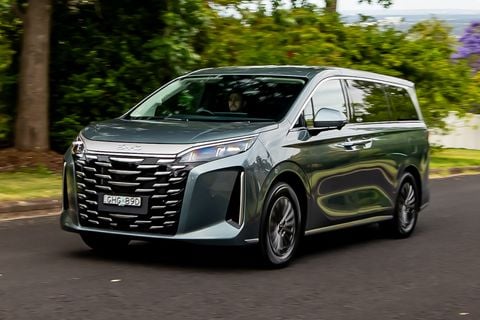
2027 BYD M9 review
This new people mover is a plug-in hybrid, and it offers better on-paper value than the Kia Carnival – but should you buy it?

- Model tested
- 2026 BYD M9
- Variant
- Premium
- Drive-away from
- $67,207†Better deals with CarExpert
CarExpert's verdict on the M9
Excellent
What we love
- Astounding space and practicality
- Terrific standard equipment in Premium grade
- Solid driving manners and comfort
Worth a thought
- Not quite as practical as a Kia Carnival
- Strange service requirements
- No spare wheel
Are there other rating labels?
- Excellent
- An outstanding car in almost every way. A joy to drive, packed with great features, and highly recommended.
- Very Good
- A well-rounded car that's enjoyable to drive, offers great value or features, and is easy to recommend.
- Good
- A solid choice that does most things well. Comfortable, capable, and worth considering in this segment.
- Average
- Meets the standard for this segment. May not stand out, but still a dependable and reasonable option.
- Below Average
- Falls a bit behind others in the segment, but still passes safety checks and may suit specific needs or budgets.
Introduction
The new BYD M9 is a people mover that could be about to spoil the party for the Kia Carnival.
This plug-in hybrid three-row family bus is offered in two trim levels, with both of them offering excellent value and astounding tech for the cash.
The top-spec variant tested here, the BYD M9 Premium, costs $11,000 more than the entry-level Dynamic, but adds a bigger battery, more EV driving range, faster DC fast-charging, and a massive stack of extra equipment.
And while this isn’t a comparison test per se, it’s hard not to put this into context alongside a high-spec version of the Kia Carnival, Australia’s top-selling people mover.
Frankly, the South Korean brand’s long-running lead in the segment could soon be under threat, and deservedly so. Read on to find out why.
How much does the BYD M9 cost?
There are two versions of the BYD M9 available, both with plug-in hybrid (PHEV) powertrain technology, but with some differences that separate them beyond just the standard equipment list – scroll down to learn more about the battery specs and charging rates, among other things.
| Model | Price before on-road costs |
|---|---|
| 2027 BYD M9 DM-i Dynamic 8-seater | $61,990 |
| 2027 BYD M9 DM-i Premium 7-seaterTested | $72,990 |
For a bit of context, this people mover allows you to drive with electric-only power when you choose, and you could significantly rework your reliance on returning to the servo because of that, which is something you can’t say about rivals that don’t offer PHEV tech yet.
Yes, the Kia Carnival is the obvious one, and the petrol-electric hybrid lineup for that Korean-made eight-seater begins from $56,310 plus on-road costs, which is for a fleet/rental-spec stripper grade with barely any of the stuff you might desire.
So it’s fair to consider the Premium version of the Chinese-made M9 as more akin to the GT-Line version of the Carnival HEV, which officially lists at $76,840 plus ORCs, but there are dealerships out there listing the in-demand flagship for more than $90k.
Its cousin is the Hyundai Staria Lounge HEV, which lists from $73,740 plus ORCs. Again, there’s no plug-in option here, but it’s a luxe-laden land-barge with loads of room.
Other options for PHEV people mover customers include the reworked Ford Tourneo PHEV made in Türkiye, which uses the same powertrain as the Transit Custom PHEV commercial van and is now a bit cheaper than its diesel predecessor, priced from $73,340 plus ORCs.
The bling-thing option is the Chinese-built GAC M8 PHEV, which starts from $76,590 plus ORCs and offers good EV range, some sumptuous cabin treatments, and plenty of family-friendly features.
If full electric is more your style, and you really like the style of this M9, then Denza can sell you a D9 people mover, which offers the choice of front- or all-wheel drive, and some pretty big EV driving range too. It kicks off from $85,990 plus ORCs.
To see how the BYD M9 stacks up against its rivals, use our comparison tool
What is the BYD M9 like on the inside?
The interior follows a pretty familiar formula for a modern Chinese car. There's a big infotainment touchscreen dominating the dashboard, plenty of technology throughout the cabin, and a fairly comprehensive list of comfort and convenience features as standard.
But there's more to it than just a big screen. The infotainment system is controlled via a 15.6-inch touchscreen with Apple CarPlay and Android Auto, and there’s built-in Google Maps so you can log into your Google account to access saved locations and preferences, or use it anonymously if you'd prefer.
There's also a huge range of vehicle functions accessible through the screen, including smart charging settings for the plug-in hybrid system, controls for the onboard refrigerator (or there’s a touch panel for that near the fridge, too), suspension adjustments, and a surround-view camera system.
The latter is particularly good, and something I think should be standard equipment in a vehicle of this size – cheaper versions of the Carnival still don’t come with a 360-camera.
You can adjust the suspension on-screen between Comfort and Sport modes, change steering and braking assistance settings, access vehicle data, and even use entertainment apps like YouTube.
Thankfully, not everything is buried in menus. There's a permanent climate control panel at the bottom of the display, shortcut functions for commonly used features, and another row of favourites at the top. You can also quickly access things like lane-keeping assistance and driver monitoring settings via a drop-down menu, too.
The steering wheel has a decent collection of physical buttons for cruise control, media and display functions, while the column-mounted gear selector frees up some space in the centre console.
One thing I'm not particularly fond of is the lack of conventional air vents with manual directional adjustment. Instead, you have to use the touchscreen to control where the air flows, in what is essentially a Tesla-style arrangement. You can direct the airflow or have it swing around the cabin, but I'd still much rather have a couple of physical vent controls.
There's a reasonable amount of storage, including large bottle holders in the doors, a storage pocket beneath the centre console, cupholders between the seats, and a centre console bin with a removable tray.
There is USB connectivity and a 12-volt outlet, and the aforementioned heating/cooling box (fridge-oven?) is awesome. It can cool or heat its contents, meaning you can put choccy treats in there if you don’t want them to melt, or even ice creams – or use it to keep pies or sandwiches warm.
The front seats are another highlight. In this higher-grade version, they're trimmed in leather and offer electric adjustment, plus heating and ventilation. They're genuinely comfortable, with a nice level of softness to the upholstery.
It’s great that the driver’s seat includes a massage function, but it’s weird that the front passenger misses out. My missus didn’t like that.
You also get configurable ambient lighting, illuminated vanity mirrors and a panoramic sunroof. There's a digital rear-view mirror too, which is great if the rear entertainment screen is deployed.
The second row is where things start to get particularly interesting, because the M9 is clearly designed to be a bit of a special place to spend time.
There are individual seats rather than a conventional bench arrangement in the Premium variant, and each one offers a substantial amount of adjustment. You've got electric seat controls, heating, ventilation and massage functionality for both middle-row passengers.
There's also a pair of sliding door-mounted climate control panels, allowing rear occupants to adjust the temperature, fan speed and airflow independently. You can even control the sunroof blind from back here.
Both passengers get fold-out tray tables, while overhead air vents, reading lights and grab handles round out the practical inclusions.
The seats have a control panel cleverly hidden within the armrest, allowing you to adjust the massage functions and activate a zero-gravity seating mode.
You can move the front passenger seat forward and recline the second-row seat to create a rather impressive lounge-style arrangement, with plenty of room to stretch out and put your feet up. Plush!
The downside is that the touch-sensitive, glossy control panel can get quite grubby, and fingerprints and glare make it a little less pleasant to use than it should be.
The rear entertainment system – comprising another 15.6-inch touchscreen – can be operated by touch or remote control. It allows access to apps like Amazon Music, Spotify and YouTube, as well as karaoke, if that's your sing.
There are no sunshades for the rear windows, but the tint is dark, and for child-seat accommodation you've got ISOFIX points and top-tether anchors for the second-row seats, which is obviously important in a vehicle that will likely appeal to family buyers.
Just be aware that you’ll need an extension strap to reach the top-tether points, as they’re positioned all the way down under the seat.
The third row is accessed through the gap between the second-row seats, and there's a fairly generous walkway through to the back – but no easy access by moving the captain’s chairs out of the way. There are three seats across the rear, and the amount of space available is impressive.
With the second-row seats positioned for comfort, I still had plenty of legroom, with around three fingers of clearance between my knees and the seat in front (I’m 182cm/6’0”).
There's also a generous amount of footroom, which is a plus for adults in the third row, and headroom is also good. You can adjust the backrest angle using electric controls, and each side can be adjusted independently.
There are some limitations when it comes to child-seat accommodation. You get a single ISOFIX point and top-tether anchor in the third row, rather than provisions across all three positions. The centre position also gets a ceiling-mounted seatbelt.
Otherwise, there's a decent level of equipment in the back row, including cupholders, a USB-A charging port, air vents, reading lights and grab handles. The side windows are a little on the small side, but there's enough visibility to avoid occupants feeling completely boxed in.
What about boot space? With all three rows of seats in use, the cargo area itself offers as much space as some mid-size SUVs, with a substantial storage well underneath the third-row seating area.
That gives you somewhere to put luggage or other items when the rear seats are in use, and when you don't need all the seats the rear row can stow away to create a large flat luggage area.
It's a clever arrangement, although I do wonder whether all of the electric seat functionality is really necessary. One thing worth pointing out, though, is that there's no spare wheel. A deal breaker? Perhaps for some customers, but there is a tyre repair kit.
| Dimensions | BYD M9 |
|---|---|
| Length | 5145mm |
| Width | 1970mm |
| Height | 1805mm |
| Wheelbase | 3045mm |
| Cargo capacity | 470 litres |
To see how the BYD M9 stacks up against its rivals, use our comparison tool
What's under the bonnet?
The BYD M9 comes with a plug-in hybrid powertrain, but there are some differences between the grades.
| Specifications | BYD M9 Dynamic | BYD M9 Premium |
|---|---|---|
| Engine | 1.5L 4cyl turbo-petrol | 1.5L 4cyl turbo-petrol |
| Transmission | e-CVT | e-CVT |
| Battery | 20.4kWh LFP | 36.6kWh LFP |
| EV driving range | 80km – WLTP | 145km – WLTP |
| Peak power | 191kW | 218kW |
| Peak torque | 315Nm | 315Nm |
| Drive type | FWD | FWD |
| Kerb mass | 2450kg | 2650kg |
| Towing capacity - unbraked & braked | 750kg – unbraked 1500kg – braked | 750kg – unbraked 1500kg – braked |
| 0-100km/h (claimed) | 8.1s | 8.5s |
| Fuel consumption (claimed) | 2.7L/100km | 0.4L/100km |
| Fuel consumption – depleted battery (as tested) | - | 7.2L/100km |
| Max AC charge rate | 7kW | 7kW |
| Max DC charge rate | 41kW | 73kW |
| Recharging time - DC max rate (30-80%) | Approx 20 mins | Approx 18 mins |
| Vehicle-to-load (V2L) | 6.0kW | 6.0kW |
The claimed electric driving range is 145km on the WLTP cycle, which is a pretty substantial figure for a vehicle of this type.
But what can you realistically expect? After a full charge, I managed just over 120km of electric driving before the petrol engine fired up and the vehicle transitioned into hybrid operation.
That's a pretty respectable real-world result, particularly considering the size and weight of this family-hauler, and considering I was driving mainly on the motorway for that stint. Of course, a plug-in hybrid vehicle also needs to demonstrate reasonable efficiency once its battery charge has been depleted.
To test that, I set the minimum battery state of charge to 20 per cent, allowing the petrol engine and hybrid system to manage proceedings with the remaining electrical energy. I also had five occupants on board – three people and two dogs – along with a boot full of luggage.
The resulting fuel consumption figure of 7.2L/100km is quite respectable. It's not extraordinary, but it's important to understand that a PHEV like this is designed to be recharged regularly, rather than driven indefinitely as a conventional petrol-electric hybrid.
You can adjust the battery reserve settings to determine how much charge the vehicle retains, and it'll continue dipping into EV operation as conditions allow.
The ability to DC fast-charge is another advantage, particularly on longer journeys. If you're prepared to stop and replenish the battery along the way, you can potentially add another 100km-plus of electric driving to reduce your reliance on petrol.
Of course, if you don't bother plugging it in, you might see similar or higher fuel use, but the idea is to regularly charge it and make the most of its electric range. The fuel tank is also relatively small, so that's something worth considering if you're planning extended highway journeys. On the plus side, it can run on regular 91-octane unleaded petrol, or even E10.
To see how the BYD M9 stacks up against its rivals, use our comparison tool
How does the BYD M9 drive?
After spending around 1000km behind the wheel across a mix of driving conditions, I've got a much better understanding of how this plug-in hybrid works and, more importantly, how it should be used.
I wanted to assess it in two different scenarios: as an electric vehicle for everyday driving, and as a hybrid for longer road trips. After all, the claimed electric driving range is one of its biggest selling points, but it's also important to understand what happens when the petrol engine takes over.
And I'm pleased to report that I've been pretty impressed with the overall driving experience, regardless of which power source is doing the work. It's not the most powerful people mover I've driven, and something like the fully electric Zeekr 009 is considerably quicker, but there's enough performance here for everyday driving.
The only time you might find yourself wanting a little more is when the vehicle is fully loaded and you're trying to overtake, at which point you'll need to give the accelerator a fairly substantial prod to get the most out of the powertrain.
Otherwise, it's a smooth and largely effortless experience. The transmission manages power delivery without the need for conventional gear changes, and it isn’t clumsy or clunky when changing between EV or hybrid modes.
When operating in EV mode it's predictably quiet, but even when the petrol engine fires into life it's rarely intrusive. You might hear it hum under hard acceleration or when climbing a hill, but at a steady 110km/h on the highway it's barely noticeable.
The suspension offers a couple of different settings, and after experimenting with them over the course of my road trip, I found myself favouring the marginally firmer and more grounded-feeling Sport mode.
With my partner, daughter and two dogs on board at various points during the test, passenger comfort was the priority. I found Comfort mode a little too floaty, whereas Sport provided a more settled, controlled feel without making the ride harsh or uncomfortable.
The steering also offers different settings, although I was generally happy with the lighter Comfort calibration.
Regenerative braking is relatively subtle, even in the most assertive setting. It doesn't deliver particularly aggressive deceleration like you get from some EVs, which could actually be a positive if you're concerned about making passengers carsick.
The conventional brake pedal also has a reasonably natural feel. Across urban traffic, highways and country roads, the overall driving experience was consistently impressive. The M9 is comfortable, quiet and easy to operate, which is exactly what you'd want from a family-focused people mover.
There are a couple of annoyances, though. The driver monitoring system can be a little too chirpy, while the lane-keeping assistance was occasionally quite intrusive. I ended up switching the latter off for some of the longer drives. Beyond that, there's not a great deal to complain about.
To see how the BYD M9 stacks up against its rivals, use our comparison tool
What do you get?
Here’s a rundown of the two M9 variants, and what you get in each of them.
2027 BYD M9 Dynamic equipment highlights:
- Eight-seat layout (2+3+3)
- Synthetic leather seat trim
- 8-way power driver's seat
- 4-way power front passenger seat
- 4-way manual second-row bench
- Manual 60/40-split/folding third-row seats
- Power sliding side doors
- Power tailgate (electric boot)
- Front sunroof
- LED headlights and tail-lights
- Heated auto-folding side mirrors
- Rain-sensing wipers
- Acoustic front glass
- Rear privacy glass
- 15.6-inch infotainment touchscreen
- Wireless Apple CarPlay and Android Auto
- Built-in satellite navigation
- DAB+ radio
- 4-zone voice control
- 12.3-inch digital instrument cluster
- 8-speaker audio system
- 3-zone climate control with rear vents
- 50W wireless phone charger
- Keyless entry and start
- NFC/Bluetooth digital key
- 2.4 kW Vehicle-to-Load (V2L) adapter
- USB ports in all three rows
BYD M9 Premium adds:
- Larger battery, longer EV driving range, faster recharging
- Seven-seat layout (2+2+3)
- DiSus-C adaptive suspension
- Michelin ePrimacy tyres
- Genuine leather seat trim
- Heated front seats
- Ventilated front seats
- Memory settings
- Lumbar support
- Driver's seat massage function
- Second-row Captain's Chairs with:
- With leg rests
- Heating
- Ventilation
- Massage
- Memory settings
- Folding tray tables
- 15.6-inch fold-down ceiling rear screen
- 12-speaker sound system
- In-car refrigerator (-6 to 6 deg) and warming box (40 to 50 deg)
- Multi-colour ambient lighting
- Digital rear-view mirror
- Rear panoramic sunroof with electric sunshade
- Hands-free AR projection sensors for the sliding doors and tailgate
- Adaptive front headlights
- Sequential rear indicators
- Memory/reverse-tilt side mirrors
- Power-folding third-row seats
So the choice is clear: choose the more practical option with more seat capacity but less flashy stuff, or the flashy one that really spoils the second-row riders and adds a lot more spec and EV range for about $9000 extra.
To see how the BYD M9 stacks up against its rivals, use our comparison tool
Is the BYD M9 safe?
The BYD M9 has achieved a maximum five-star ANCAP safety rating against the strictest criteria yet under the 2026 assessment formula – however, at this stage, it only applies to the higher-spec Premium seven-seater, not the base-grade Dynamic eight-seater.
| Category | BYD M9 Premium |
|---|---|
| Safe driving | 75 per cent |
| Crash avoidance | 78 per cent |
| Crash protection | 89 per cent |
| Post crash | 100 per cent |
Standard safety equipment includes:
- 360-degree camera
- Front and rear parking sensors
- Adaptive cruise control
- Autonomous emergency braking
- Pedestrian detection
- Cyclist detection
- Intersection assist
- Blind-spot monitoring
- Rear cross-traffic braking
- Lane-keeping assist
- Child presence detection
- Sentry Mode
The child seat situation is decent but not as good as in the Kia Carnival, with four top-tethers and three ISOFIX points (second-row window seats, third-row passenger-side window seat).
The airbag count differs between the two grades, with seven for the Dynamic eight-seater – dual front, front side, front centre, and curtain airbags for all three rows – while the Premium seven-seater adds second-row side airbag coverage.
To see how the BYD M9 stacks up against its rivals, use our comparison tool
How much does the BYD M9 cost to run?
This is a peculiar part of the consideration list, in my opinion. That’s because the M9 runs two different odometers – one for the petrol engine, and one for overall mileage. And if you use the petrol engine a lot, then it could get costly and needy in terms of servicing.
| Servicing and Warranty | BYD M9 |
|---|---|
| Standard warranty | 6 years or 150,000km |
| High-voltage battery warranty | 8 years or 160,000km |
| Drive unit (electric motor) warranty | 8 years or 150,000km |
| Roadside assistance | 12 months free – then service activated |
| Service intervals | First service – 3500km (free) Petrol engine – due every 10,000km Regular intervals – 12 months or 20,000km |
| Capped-price servicing | 5 years or 100,000km |
| Average service price | $576 per visit |
| Connected services | 2 years free data for in-car entertainment – 2GB/month OTA and app updates free for life |
The ownership promise is improving as time marches on, though, as BYD is fast expanding its presence in Australia, meaning service and sales locations are easier to come by now, and hopefully spare parts will be, too.
To see how the BYD M9 stacks up against its rivals, use our comparison tool
CarExpert's Take on the BYD M9
This is not only the Kia Carnival’s worst nightmare, it’s a dream come true for buyers who are after a plug-in hybrid people mover that doesn’t break the bank.
It feels expensive and luxurious, and it has practicality, space, comfort and features on its side. The only thing it’s missing is a spare wheel.
With efficiency as a priority and potentially very low running costs if you prioritise EV driving, the BYD M9 offers buyers the most convincing alternative yet to the best-seller in the people mover class.
CarExpert can save you thousands on a new BYD M9. Click here to get a great deal.
Click the images for the full gallery






 Automotive Vehicle Spec Data & 4K images Powered by JATO Dynamics Ltd